
Holstonia revisited and repurposed

The late chemistry professor turned historian Dr. Jim Glanville once spoke of writing what he called “the big picture of Holstonia.” By that term, he meant the region of Southwest Virginia and Northeast Tennessee drained by the upper forks of the Holston River. His vision was to integrate decades of specialized research into a single, coherent synthesis of the region’s deep past.
Glanville shared that ambition with Dan Kegley during a conversation on Kegley’s front porch in Chilhowie in 2016. At the time, Glanville had already published extensively on the archaeology and prehistory of the region, which he regarded as extending from roughly 20,000 years ago to the arrival of Europeans. Saltville, he often said, stood at Holstonia’s cultural center.
Glanville died in 2019 before beginning the project. Concerned that his research might be lost or dispersed, Kegley contacted Glanville’s widow, Deena Flinchum, who entrusted him with the historian’s archives.
“It took several trips to their home in Blacksburg to retrieve it all,” said Kegley, a former president of both the Archaeological Society of Virginia and its now-closed Wolf Hills Chapter in Abingdon. “There were file cabinets filled with meticulously organized papers, dozens of digital storage devices, older computers, and shelves of reference books Jim relied on. The physical materials are now housed at the Museum of the Middle Appalachians in Saltville. I maintain the digital archive.”
The collection included Glanville’s published papers and presentations, along with reference works and unpublished materials he had gathered over decades. What it did not include was an outline—or even notes—toward the “big picture” he had envisioned.
“It was his unstarted, unfinished symphony,” Kegley said. “I knew the key he wanted to write it in, and I had some sense of the movements he imagined.”
Glanville’s work drew from formal excavation reports, private artifact collections, museum holdings, archival scholarship, and his own extensive photographic documentation. Much of what he studied did not conform to modern archaeological excavation standards. Rather than dismiss such material, Glanville coined the term “improper archaeology” to describe artifacts recovered without professional methodology but still capable, in his view, of contributing meaningfully to regional understanding.
“Jim operated at the boundary of archaeology where academics seldom venture,” Kegley said.
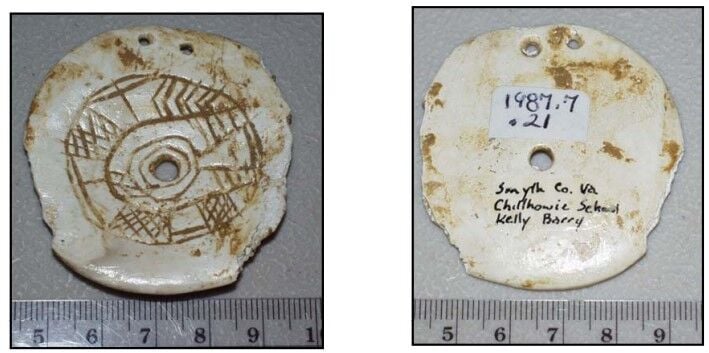
That boundary proved productive. Over decades, Glanville examined private collections across the Holston region and beyond. One recurring insight involved marine shell gorgets—engraved personal adornments often recovered from burial caves without precise stratigraphic context. Because of their uncertain provenance, professional archaeology has tended to treat such artifacts as isolated or anecdotal.
Glanville noticed something different. Across collections separated by geography, he observed recurring motifs—serpents, birds, and abstract forms—that appeared consistently within the Holstonia region. He concluded that the gorgets reflected a localized symbolic system. One recurring snake motif he dubbed the “Saltville Style.”
Working from the structure of Glanville’s files and guided by their 2016 conversation, Kegley assembled Glanville’s Holstonia: A Comprehensive Prehistory and Archaeological Synthesis, a 128-page monograph.
“Jim envisioned writing a book,” Kegley said. “But the project was daunting even without the added burden of pursuing academic publication. I think he would be satisfied with what I attempted.”
The monograph is being prepared for permanent residence at holstonia.co, an online archive of Glanville’s published work hosted through the Museum of the Middle Appalachians’ website.
“I have no illusion that the paper fully realizes Jim’s dream,” Kegley said. “But I believe it honors its intent.”
Another Chapter
The momentum generated by completing Glanville’s Holstonia led Kegley back into writing after more than a decade away from journalism. He left the Smyth County News & Messenger in 2012 and published little afterward. His new work again operates at the margins of established disciplines, though in a different direction.
Kegley has been interested in reports of Bigfoot since childhood. Several years ago, he became an investigator with the Bigfoot Field Researchers Organization. Even so, he grew dissatisfied with the state of Bigfoot research.
“Bigfooting runs from people who go camping and hope for an encounter to more methodical researchers,” Kegley said. “We have thousands of anecdotes, some footprints and trackways, and a range of circumstantial signals that something may be out there.”
What concerned him was not curiosity, but method. To move inquiry closer to biology rather than folklore, Kegley began writing papers proposing the adoption of practices drawn from ethology, the scientific study of animal behavior, emphasizing documentation standards, observer effort, and conservative inference.
“I earned a degree in psychology, but pursued animal behavior through independent study,” Kegley said. “It wasn’t easy persuading my advisor to approve work in an unrecognized minor. But both areas emphasized research design and methodological discipline.”
Under the banner Holstonia Bigfoot Investigations—a deliberate homage to Glanville—Kegley began publishing papers addressing weaknesses in Bigfoot research and proposing a citizen-science framework to give structure and credibility to field efforts.
As one paper’s preface states, “The goal of this work is not advocacy, debunking, or persuasion, but methodological clarification: to ask how such claims can be examined with rigor, restraint, and intellectual honesty.”
Initially shared through a Facebook group, the papers soon outgrew that format. Kegley launched holstonia-investigations.org, a website that now hosts 11 papers, with additional work forthcoming.
According to the site’s introduction, “The materials presented here constitute a working archive of methods, analyses, and reference materials developed to shift inquiry away from anecdote and assertion and toward constrained, testable inference.”
Kegley hopes the work builds on ideas advanced by his friend, neuropsychologist Dr. John Baranchok, author of Grasping Sasquatch.
“John argued for moving beyond being satisfied with experiences,” Kegley said. “He emphasized asking disciplined questions, collecting data systematically, applying statistical analysis, and refining those questions over time.”
Neither expects their efforts to transform the field overnight. Baranchok has expressed disappointment that his ideas have gained little public traction.
“John’s book provides a core text for citizen scientists in this area,” Kegley said. “If I can add practical context and methodological guidance, and if even 50 people across the country adopt these practices, that would advance the research significantly.”
For some enthusiasts, the ultimate goal is formal species classification. For many academics, only a body submitted for examination will suffice. Kegley’s aim is more modest.
“If enough valid, well-documented data can reduce the noise,” he said, “what remains may finally warrant serious scientific attention.”
Related

Jim Glanville was born in London, England, and came to the United States to pursue doctoral studies in physical and inorganic chemistry at the…