

News
Centerpiece Top Story
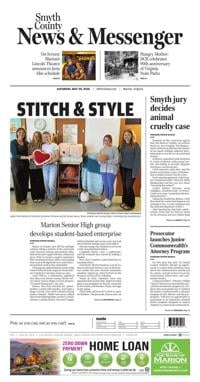
Stitch & Style: Marion Senior High group develops student-based enterprise
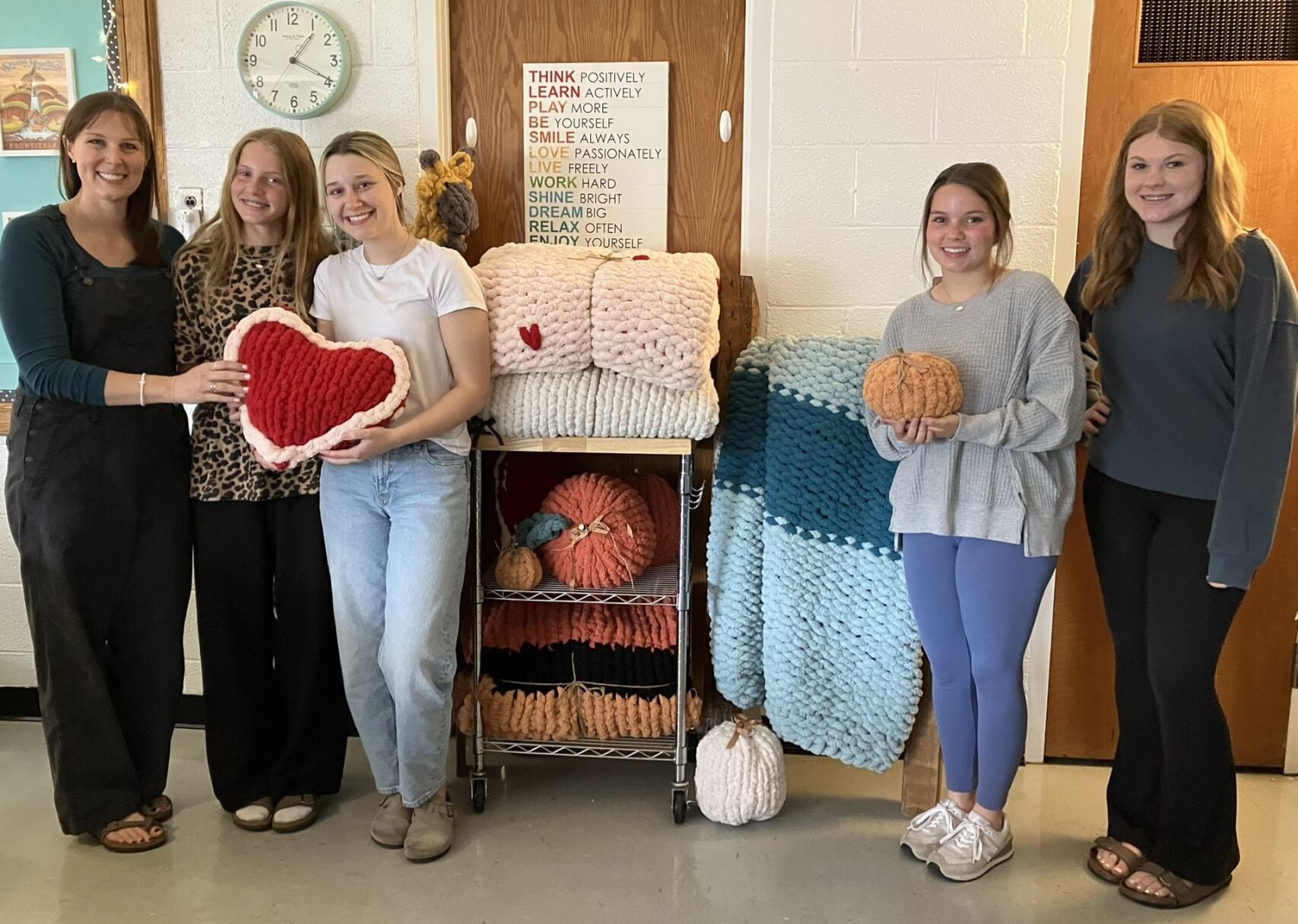
Under the direction of Family & Consumer Sciences teacher Susan Hanna, these students are turning finger crocheting into an enterprise.
Skeins of chunky yarn fill the multiple cubicles lining a portion of the classroom wall. Everyone, teacher and students alike, believe the yarn supply will only continue to grow. They’ve found a creative experience that’s teaching business skills, encouraging time away from digital devices, and is introducing their work to the community.
The program, dubbed Marion Senior High School Stitch & Style, began in Susan Hanna’s Family & Consumer Sciences class.
Carly Wilcox, a sophomore, explained that they were always seeing TikTok videos about various finger crochet projects. “It looked therapeutic,” she said.
Hanna, who had watched her grandmother crochet with needles, had taken a finger crochet class with a friend and had made a blanket. While instructors talked about how forgiving finger crochet is, Hanna said she’s a perfectionist. She wasn’t happy with her blanket and on one snow day took about half her blanket apart and redid it.
She encourages the students to strive for a well-done finished product.
Campbell Sheets, also a sophomore, said the students also started by making a blanket.
Now, they’ve gotten so good that they’re teaching others.
Downtown Marion business Lou & Co. hosted Stitch & Style for a class at the business earlier this year. Several community members signed up. They’ll return to the business on June 20 for a display.
Stitch & Style members have also expanded their product line, which included ghosts and pumpkins in the fall, snowmen in the winter, and bunnies, Peeps, and eggs in the spring.
Their items sell from $5 to $100 or more for blankets. The proceeds, Hanna said, are used to buy more yarn.
As Stitch & Style has developed, Hanna said it’s transformed into a student-based enterprise.
The students are involved in buying yarn, crocheting the products, marketing them on social media and selling them.
“They kind of run the show,” Hanna said.
The students unanimously agreed that they love to spend their free time crocheting whether it’s during holidays, after school, or class.
Sheets said it’s a great experience. She said she’s learned about the power of marketing, the cycle of money, and creating opportunities. This summer the cheerleader and tennis athlete will be working as a lifeguard. She plans to become a teacher and next year will take part in the Teachers for Tomorrow program.
Wilcox expects to stick with Stitch & Style throughout high school. She’s not sure about her career path, but she knows that spending time with family and friends is important and she enjoys working at Marion Family Pharmacy and sometimes with Josh Widener.
Suzanna Barker, another member of Stitch & Style and a MSHS junior, is enjoying the work while also taking part in softball and track. She hopes to study psychology.
Madalyn Mathena, a freshman, is one of Stitch & Style’s youngest members. She wants to become a travel nurse and enjoys spending time with her friends.
They all agreed that finger crocheting brings a diverse group of students together.
Hanna is optimistic about the students growing in their skills. “Who knows what else we’ll make,” she said.
Of the Lou & Co. opportunities and setting up at farmers’ markets and festivals, Hanna said it’s wonderful for the students and their work to be seen.
Hanna, a MSHS grad, began teaching full time at the school in 2019. Prior to that she’d substituted and realized that she wanted to teach. She considers herself fortunate to be teaching in the school that she grew up in.
Follow Stitch & Style on social media to learn more.
News
Top Story
Smyth jury decides animal cruelty case
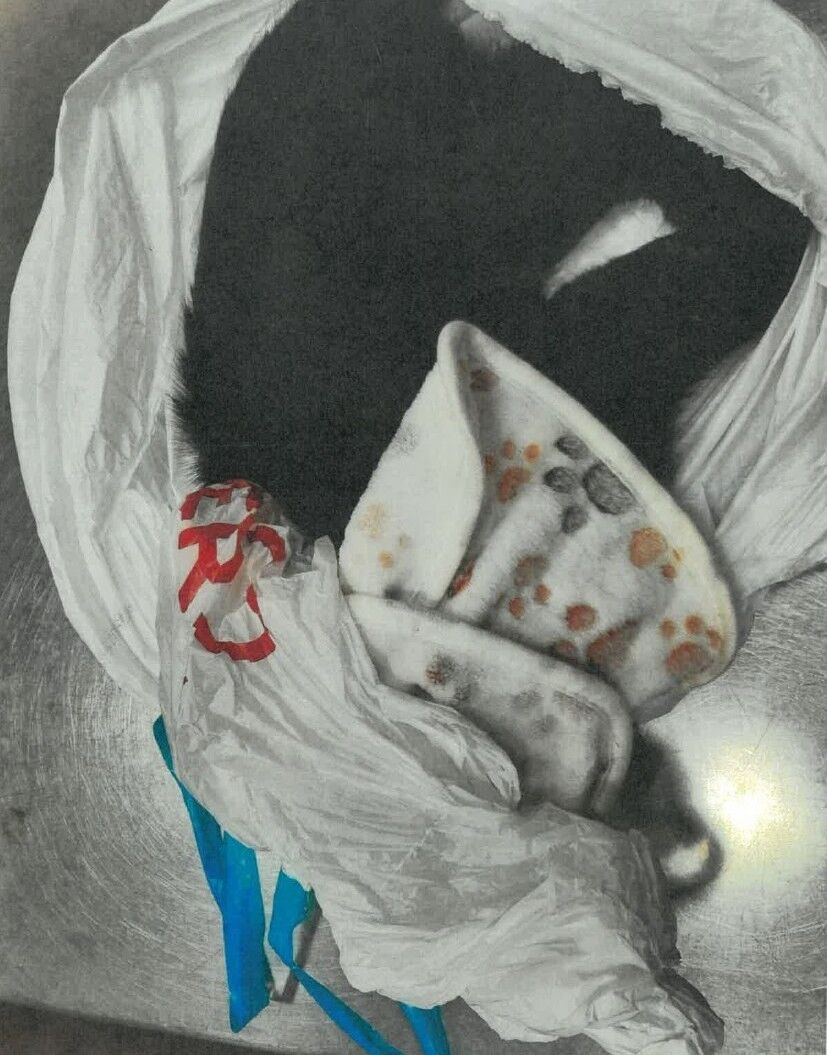
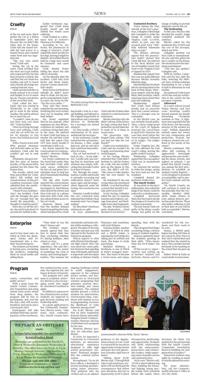
This photo among others was shown to the jury during Wednesday's trial.
Everyone in the courtroom agreed that the death of Delilah, an outdoor black cat, was a tragedy. The disagreement centered on whether the manner of her death willfully inflicted inhumane pain or was the act of a panicked woman.
In March, a grand jury indicted Karen D. Clark, of Marion, with animal cruelty and failing to provide adequate veterinary care for her pet.
Clark rejected a plea deal, and the matter went before a jury on Wednesday in Smyth County Circuit Court.
In his opening argument, Chief Deputy Commonwealth’s Attorney Keith Blankenship said the case was about “torturing this animal”.
Clark’s defense attorney, Jason Gallagher, countered that “at worst,” Clark’s acts were “a panicked and emotional decision.”
Taking the stand in her defense, Clark described the events that began on the evening of Jan. 31 and continued into the early morning hours of Feb. 1.
After hearing her dog bark continuously, Clark said she went to check on the situation and saw Delilah lying in the ice and snow. She’d gotten the cat as a kitten in September 2014, but because the cat didn’t like other pets in the home, Clark said she stayed outside but had access to a heated house and a heated water bowl and was regularly fed.
“She was very much loved,” Clark said.
Seeing the cat in the snow, Clark testified that she went out to get Delilah and suspected that she had been struck by a vehicle. She said that the cat’s head was swollen and soft to touch and a bloody discharge was coming from her nose.
Clark said she took the cat inside and put it on a towel and blanket to try to warm her up. The jury saw photos of the cat in that state.
Clark called her husband, who was staying in Wytheville so he could get to work in the winter weather. She said he advised her to shoot the cat.
“I couldn’t. How do you just blow your cat’s head off?” Clark testified.
Often testifying through tears and sobbing, Clark said she sat with the cat for 90 minutes to two hours, but Delilah just laid there.
With a Toyota Scion with little ground clearance and 400,000 miles on the odometer, Clark said she couldn’t get out to seek help.
Ultimately, she gave Delilah five pens of human insulin, as the prosecution pointed out five times the human dose.
The insulin, which had been prescribed for Clark, didn’t kill Delilah but caused seizures. As the cat’s condition worsened, Clark admitted that she smothered it with a blanket.
“I know it was a bad decision,” she testified. Clark said she thought she gave the cat “enough that she would die peacefully… I thought it would be quick.”
Once she cut off the cat’s air, she said it took about 30 seconds for Delilah to die.
Earlier testimony suggested that Clark knew insulin would not kill Delilah but would cause suffering.
Clark worked as a pharmacy tech at Greever’s Pharmacy in Chilhowie.
According to Dr. Zac Foster, the pharmacist in charge at Greever’s, Clark asked him about insulin for her dogs, fearing it might be diabetic. He testified that he told he a large dose would be traumatic and cause seizures.
Clark denied Foster telling her about the side effects of insulin.
On the Monday after the incident, Clark told Zach Foster and Brent Foster, Greever’s owner, about Delilah’s death.
Brent Foster testified that initially he didn’t know what to think, but the longer he contemplated Clark’s account, the worse he felt. “For the cat to suffer…”
They said they terminated her the next morning, testifying that such actions were not in keeping with their beliefs.
Zac Foster explained that he has animals, other employees do, they fill prescriptions for animals, and customers bring their pets in the store. He referred to what Clark had done as murder. He said that Clark told him she asked Chat GPT how much insulin it would take to kill a cat.
Zac Foster reported the conversations to Commonwealth’s Attorney Phillip “Bucky” Blevins.
Zac Foster confirmed on the stand that earlier they had provided Clark with some excess antibiotics for her cat and given her a nebulizer hose to help her give it homemade breathing treatments.
The day after Foster reported the conversations to Blevins, Animal Control investigator Lt. Kristi Moore interviewed the Fosters and then took part in a phone interview with Clark, who also allowed them access to the cat’s body.
However, Moore said that the weather delayed them from getting the body, which had placed in a trash bag inside a tote in a storage building, and taking it to the Virginia Department of Agriculture and Consumer Services in Wytheville for a necropsy (an animal autopsy).
Dr. Tom Lavalle, a VDACS veterinarian of 38 years, undertook the necropsy.
In his testimony, Lavalle noted that the cat had dental disease, a thin, rough haircoat, and an oral ulcer that could have been indicative of a mass.
The cat had received “a lack of care…, in my opinion,” Lavalle said, also noting that its intestines and stomach were empty, indicating that she hadn’t eaten in at least 24 hours.
Yet, through his examination, Lavalle said insulin is naturally occurring and suffocation doesn’t leave many signs and decomposition impacted some lab testing. His conclusion was open.
However, Lavalle testified the cat’s contorted body indicated that Delilah’s final moments were “not a happy ending.”
He described veterinary euthanasia as a gift.
In cross examination, Clark said she’d taken other animals to a veterinarian for euthanasia.
Blevins asked her why she didn’t call one of the Fosters for help, noting that they’d picked her up and taken her to work 10 to 15 times in recent years.
The prosecutor challenged Clark, asking, “Did you feel her take her last breath?”
Under cross examination, Clark said she wouldn’t do it again, now knowing what would happen.
In his closing, Blevins reiterated that Clark didn’t hesitate to call the Fosters for a ride, but she couldn’t pick up the phone in this case. She didn’t call 911. “She chose to take matters into her own hands,” he said.
He wondered if she was crying when she smothered Delilah, “a cat that loved her so much that she left it outside and it never left.”
In his closing, Gallagher asked the jury to separate emotion and evidence, outrage from proof, and hindsight from what happened.
He said, “Evidence shows panic, desperation…. A bad decision is not torture.”
Uncharted Territory
Twice during the trial, outside of the jury’s presence, Gallagher asked Judge Jeff Campbell to strike the charge of cruelty under Virginia Code 3.2-6570, which, in part, says the accused must have “willfully inflicted inhumane injury or pain.”
The defense attorney argued that the prosecution hadn’t proved that Clark did that. He referred to the Terry Michel case out of Franklin County that went to the Virginia Court of Appeals in 2025.
Blankenship argued that this case was quite different because Michel instantly killed his dogs.
Michel killed his two black labs by shooting them in the back of their heads. Veterinary experts said the dogs likely died instantly, which raised questions about their pain and suffering.
Blankenship argued that Clark used human insulin and an excessive dose that caused seizures. This is a stronger case, he contended.
In the Michel case, he was initially found guilty. Then, a three-judge panel of the Court of Appeals reversed the convictions in April 2025. However, the case then went before the Court of Appeals’ full panel of 16 judges. The judges split 8-8.
Under Virginia law, the tie vote affirmed the trial court’s ruling, leaving the guilty verdicts in place.
Wednesday, Gallagher argued that the case against Clark was in unchartered territory.
He renewed his motion to strike the charge, saying the facts had not met the standard.
Campbell denied his motion to strike twice.
The Smyth Verdict
At one point in the jury’s deliberation, they asked the judge if the felony could be reduced to a misdemeanor.
Campbell instructed them that they had to decide the charge as it stood on the evidence presented.
The jury found Clark not guilty of the felony cruelty charge, but guilty on the charge of failing to provide adequate care for the cat.
The Sentencing
In this case, the jury only decided the verdict, Judge Campbell rendered the sentence.
Blevins asked for the maximum fine of $250 and the cost of the necropsy, which was $556.
Gallagher pointed out that Clark is unemployed. He also said that given the jury’s verdict on the felony, she should receive the minimum punishment.
“The jury has spoken,” Gallagher said.
With its verdict, Campbell said the jury split the baby, referring the biblical story of King Solomon threatening to cut a baby in half to determine its real mother.
He sentenced Clark to pay a $150 fine and pay restitution to the county for the necropsy’s expense.
Afterward
In a news release issued Friday, Blevins said that cases involving cruelty toward animals are deeply disturbing "Scripture reminds us that, ‘A righteous man regardeth the life of his beast: but the tender mercies of the wicked are cruel.’ Delilah depended entirely upon her owner for care, compassion, and protection. Instead, the evidence showed she suffered at the hands of her owner."
Blevins continued, "My office will continue to aggressively investigate and prosecute cases involving the abuse, torture, and neglect of animals. I am proud that Smyth County was among the first jurisdictions to establish an Animal Cruelty Registry – a tool designed to promote accountability and to protect both animals and the public."
"In Smyth County, we will continue to stand for the principle that the vulnerable, whether child, adult, senior citizen, or even animal deserve protection under the law. Those who inflict suffering or fail in their duty of care will be held accountable,” Blevins concluded.
News
Top Story
Smyth's top prosecutor launches Junior Commonwealth's Attorney Program
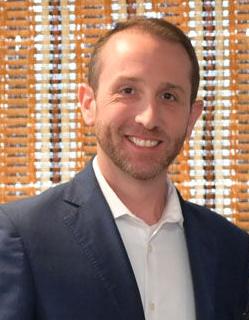
Commonwealth’s Attorney Phillip “Bucky” Blevins
For five days this July, 20 Smyth County students will get an opportunity to realize their potential, learn about the criminal justice system and its careers, and get to know local law enforcement, prosecutors, and community leaders.
Commonwealth’s Attorney Phillip “Bucky” Blevins has launched the educational enrichment program for students who are in grades 8 to 11. Dubbed the Junior Commonwealth’s Attorney Program (JCAP), Blevins said the participants “will have an opportunity to participate in an immersive criminal justice program designed to expose students to careers in law enforcement, courts, corrections, and public service.”
With a grant from the Smyth County Community Foundation and using money from assets seized from drug dealers, the program will be free to participants, and, over the five days, they will receive breakfast and lunch and a custom polo shirt.
Participants will take multiple field trips, including tours of the courthouse, the criminal justice academy, the regional jail, and Emory & Henry University.
The program isn’t only open to academic achievers; Blevins is also encouraging youth who might be considered troubled to apply.
In addition to exposure to the criminal justice system, students are expected to gain decision-making and leadership skills.
In a grant application to the Community Foundation, Blevins wrote, “Like many rural communities, Smyth County faces ongoing challenges related to youth engagement, exposure to the criminal justice system, and limited access to structured summer programing that promotes positive decision-making and career exploration. The summer months present a critical window for intervention. Unstructured time, combined with limited access to programming, increases the likelihood of risky behavior among youth.”
For JCAP, Blevins said that he drew inspiration from his friend, Anton Bell, Hampton Roads Commonwealth’s Attorney, who has established such a program for his area.
However, Blevins’ passion for education goes deeper.
In 2024, he launched a Courtroom-to-Classroom initiative, an innovative educational experience designed to offer high school government students’ firsthand insights into the criminal justice system.
He explained, “As an Air Force officer, I developed a love for teaching and mentoring junior attorneys. That parlayed into my civilian role as an adjunct professor at the Appalachian School of Law. JCAP is a natural fit for me and an opportunity to help mentor and grow the next generation of leaders right here at home.”
Talking about JCAP, Blevins said, “Through field trips to jail and prison, students will see firsthand the consequences that follow poor decisions. But just as importantly, JCAP is about introspection, mentorship, and opportunity. Students will build relationships with law enforcement, prosecutors, and community leaders, while exploring careers in public service and criminal justice.
“At its core,” Blevins said, “JCAP is about influencing lives, building the future, and helping young people realize their potential before life makes those decisions for them. I’m grateful for the partnership with the Smyth County Community Foundation Board in building our next generation of leaders!”
Interested students may apply by sending an email to smythca@smythcounty.org.
For more information, call the Commonwealth Attorney’s Office at 276-782-4042.