
June Dairy Month countdown (copy) (copy)
In less than 48 hours, June Dairy Month will officially be upon us. June Diary Month began in 1937 as National Milk Month. It was created by grocer organizations during a period of milk production surplus in the United States, when there was more milk being produced than consumers were buying. The goal was to distribute extra milk during the warm summer months and encourage more people to include milk in their diets.
The early 1930s were a challenging time for the U.S. dairy industry, marked by fluctuating milk prices and economic hardship during the Great Depression. Some farmers even organized milk strikes in 1933 to protest low prices, which sometimes turned violent en.edairynews.com. In response, the American Dairy Products Institute and other groups began promoting the nutritional benefits of dairy, linking milk to health and development.
By 1939, the name was changed to National Dairy Month after the National Dairy Council became involved in promoting the event. The month was chosen because it was the warmest time of year, making milk more appealing and easier to consume.
Over the decades, National Dairy Month has evolved into a nationwide celebration that:
• Highlights the hard work of dairy farmers and their families;
• Educates consumers on the nutritional benefits of dairy products such as milk, cheese, yogurt, and ice cream;
• Encourages participation through farm tours, recipes, and community events;
• Today, June Dairy Month is observed every year in the U.S. as a way to recognize the dairy industry’s contributions and promote the importance of dairy in a balanced diet.
In the coming weeks, we will be looking into some of the complexities of the dairy business. We may as well start with one of the toughest ones: Why were there 168 dairies in Smyth County in 1978 but only a handful today?
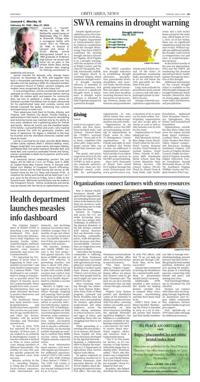
The answer is found in the historic way milk was marketed and some clues to that mystery are found above. It is harder to make milk the farther south the farm is.
In the 1970s, milk was priced using Federal Milk Orders and the farther that order was from Wisconsin, the more the farmer was paid for their milk. Our Appalachian Federal Order was run out of an office based in Louisville, Ky.
Adding stability to the federal system, Virginia and our local cooperative had base systems in place that regulated the supply of milk.
Our average daily production from Sept. 1 to Nov. 30 established the pounds of milk we could sell through Aug. 31 of the coming year, at a profitable price. If we produced more than that amount, it would likely be purchased but at a much lower price.
Other parts of the nation did not have these types of controls and by the mid-1980s, the abundance of milk resulted in the USDA initiating the Whole Herd Buyout program. Many news outlets reported falsely that this was a taxpayer bailout. The fact was the program was completely funded by a charge placed on every milk check received by those herds which remained in business.
Those market programs started to be challenged in court during the 1980s and by 1990, the dairy markets were pretty much wide open to supply and demand fluctuations. After years of predictable profitability, dairy producers (many of which were older) had no interest in riding a pricing rollercoaster.
As time went on, price swings saw higher highs and lower lows than anyone could have predicted. Herds expanded in attempts to out-produce their losses, only to find that the increased dependence on borrowed capital and hired labor only dug their financial holes deeper.
Some dairies converted to seasonal grazing operations; however, this wasn’t an option for anyone with a debt load. Others like my own home farm had invested so much in machinery and bringing feed to the silo on the edge of the farm that converting to grazing would require building a new dairy facility in the center of the farm. In our case, half of our farm was two miles out the road, so we’d have needed two separate dairy facilities.
Finally, each dairy is an individual story. In our case, June 1990 changed everything; it was the month our daughter was born. At that point, Hillary Overbay became our most important crop and everything else was just a means to help us raise her. When situations pointed us to exit the dairy industry, it wasn’t an easy decision, but it was clear that our decision helped our family.
Dr. Andy Overbay is the agriculture and natural resources extension agent for Smyth County.