This content is unavailable. Please contact customer service for more information.
Already a subscriber? Login or Activate your account.
You've reached the end of the standard E-Edition.
This content is unavailable. Please contact customer service for more information.
YMCA hosting Empty Bowls event
The YMCA at Virginia Tech invites community members to gather for the 4th Annual Y Empty Bowls Event on Tuesday, Oct. 13, from 5:30 to 8 p.m. at The Y Center, 1000 N. Main Street, Blacksburg.
This beloved community event benefits the YMCA at Virginia Tech's Meals On Main program, which helps provide nutritious meals to children throughout the New River Valley experiencing food insecurity.
Guests will enjoy a variety of handcrafted soups prepared by local restaurant partners, live music by Dean Trimble, handcrafted pottery, and an opportunity to connect with friends and neighbors while supporting a meaningful cause.
Participating restaurants and featured soups include:
Our Daily Bread – Creamy Beef Marsala with Wild Mushrooms
Blue Ridge Mountain Catering – Featured soup coming soon
Bull & Bones – Cam's Brunswick Stew, a sweet and hearty tomato-based stew with pork and chicken
Next Door Bake Shop – Thai Red Curry with Chicken
YMCA Food Truck – Albondigas Soup, a traditional vegetable soup with beef meatballs served on the side, with a vegetarian option available
As part of the Empty Bowls tradition, each guest will have the opportunity to select a handcrafted ceramic bowl to take home. The bowls serve as a reminder that while many tables are full, too many children and families in our community continue to struggle with hunger.
The bowls have been created and generously donated by members of the YMCA Pottery Studio, whose artistry and generosity help make this event possible.
“Empty Bowls is a powerful reminder that hunger exists in our own community, but it's also a celebration of what happens when neighbors come together to help,” said Laureen Blakemore, Director of Community Engagement at the YMCA at Virginia Tech. “Every ticket purchased, every bowl donated, and every bowl of soup shared helps us provide nutritious meals to children and families across the New River Valley. Together, we can turn an evening of community into lasting impact.”
The evening celebrates the power of neighbors coming together to support local children and families. Every bowl tells a story, and every ticket helps provide meals for children in need.
All proceeds benefit YMCA programs that provide food assistance to families facing food insecurity throughout the New River Valley.
Virginia farmland values continue to climb, reflecting national trend (copy) (copy) (copy)
Virginia farmland values continued their climb in 2026, mirroring a national trend that has pushed agricultural land prices to record highs even as the pace of growth has slowed.
According to the U.S. Department of Agriculture’s 2026 Land Values Summary, Virginia farm real estate averaged $6,300 per acre this year, up 3.3% from $6,100 in 2025. Cropland values rose 3.7% to $6,400 per acre, while pasture averaged $5,430 per acre, up 2.5%.
Those values place Virginia above national averages for all three categories. USDA reported U.S. farm real estate at $4,500 per acre, cropland at $6,020 and pasture at $2,000 in 2026.
Virginia also topped the Appalachian regional averages of $5,820 for farm real estate, $6,190 for cropland and $4,880 for pasture. The total value of Virginia’s farmland and buildings reached $43.92 billion in 2025, up 2.8%.
American Farm Bureau Federation economist Daniel Munch said the figures show farmland has remained a resilient asset despite tighter margins across portions of the farm economy.
“Higher values strengthen farm balance sheets and provide landowners with additional equity and collateral, but they also raise the cost of buying, renting and expanding an operation,” Munch said. “Farmland prices increasingly reflect more than agricultural earnings alone.”
Development, energy projects, outside investment and generational ownership changes can intensify competition for a limited land base, leaving land technically agricultural but less available or affordable for farmers who want to use it, said Tony Banks, senior assistant director of commodity/marketing for Virginia Farm Bureau Federation.
“Virginia farmers are competing for a limited land base, and agriculture isn’t always the only bidder,” he continued. “Rising land values can be good news for farmers who already own property, but they also raise the financial hurdle for the next farmer trying to rent or buy land or for an established operation that needs room to grow.”
Nationally, USDA reported average farm real estate values increased 3.4% to $4,500 per acre in 2026, marking the sixth straight annual increase. Cropland values rose 3.3% to $6,020 per acre, while pasture increased 4.2% to $2,000 per acre. Since 2020, average farm real estate values have climbed nearly 44%, cropland values have risen 48% and pasture values are up nearly 43%.
Cash rents have offered little relief for producers. Munch wrote that average U.S. cropland rent slipped by just $1 to $160 per acre in 2026 and remains 15% above its 2020 level. That creates added pressure for tenants and beginning farmers, who face elevated costs without benefiting from the equity gains landowners receive.
For Virginia farmers, Banks said, the latest report underscores the value of land as a farm asset while highlighting the increasing challenge of keeping working farmland accessible for future generations.
Farm Credit ed center launches ‘Invest with Confidence’ course to help producers make smarter technology decisions (copy) (copy) (copy)
The Farm Credit Knowledge Center, the educational arm of Farm Credit of the Virginias, is launching “Invest with Confidence: A Technology Decision-Making Course,” a new six-week educational program designed to help agricultural producers evaluate technology investments with greater confidence and clarity before committing valuable resources. The virtual course begins Thursday, Oct. 15, and is designed for producers considering precision agriculture tools, automation, software, sensors, equipment upgrades and other emerging technologies.
As technology continues to play an increasingly important role in agriculture, producers are faced with complex decisions that extend beyond the initial purchase price. The course provides participants with a structured framework for evaluating operational fit, scalability, data requirements, employee readiness, financial return and implementation planning.
"Technology investments can create tremendous opportunities for agricultural operations, but making the right decision requires careful evaluation," said Kyley Clevenger, director of industry relations and government affairs. "This course is designed to help producers look beyond the newest item to hit the marketplace and work through the practical considerations that determine whether a technology solution truly fits their operation."
Throughout the six-week program, participants will complete a comprehensive Technology Considerations Workbook while gaining access to return on investment (ROI) calculators, vendor evaluation resources, implementation planning guides and live webinars. By the conclusion of the course, participants will have developed a personalized technology implementation roadmap and a clear understanding of whether to move forward, test first or postpone an investment decision.
Designed for producers at every stage, the program is appropriate for both first-time technology adopters and established operations evaluating future upgrades and investments. Virtual sessions will be held weekly from 6 to 7 p.m. EST beginning Oct. 15. Recordings will be available to registered participants, allowing flexibility for those unable to attend every live session. Registration is now open.
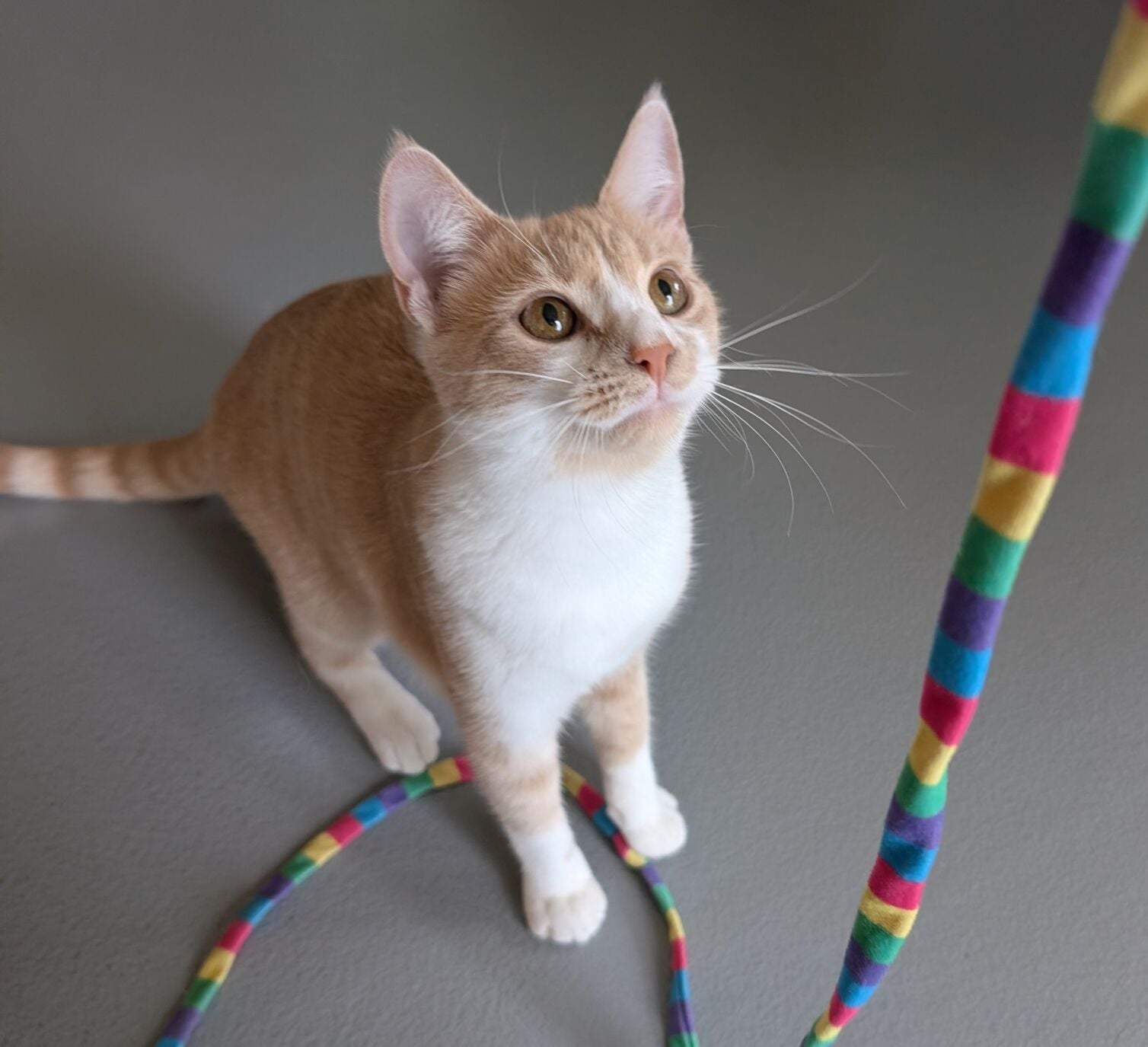
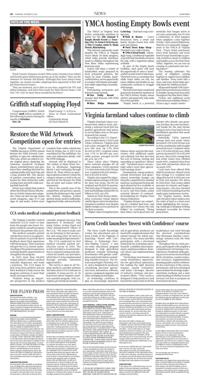
Floyd County Humane Society litter mates Domino (tan/white) and Dustin (grey/white) have grown up at the shelter. They are the sweetest 10-month-old kittens. Although they have always been together, we would consider adopting them separately if that will get them forever homes.
They are neutered, up to date on vaccines, negative for FIV and feline leukemia, and more than ready for their forever home. Call 540-745-7207 to meet these wonderful brothers!
Griffith staff stopping Floyd
Congressman Griffith’s Ninth District staff will be available at the following locations during the month of October.
Oct. 28
Floyd County: 3–4:30 p.m.
Town of Floyd Government Offices
Community Room
203 East Oxford St
2027 Restore the Wild Artwork Competition open for entries (copy) (copy) (copy)
The Virginia Department of Wildlife Resources (DWR) annual Restore the Wild Artwork Competition is open for submissions. This year, artists are asked to create original pieces depicting the American woodcock (Scolopax minor), a mottled brown-and-gray, forest floor-dwelling bird that has a plump profile with short legs and a long, pointed bill. This species of greatest conservation need is known for their distinctive walk, rocking back and forth while leaving their head still.
Artists may submit their work in either the Natural History Illustration or Artistic Expression categories. There are also two age-based youth categories, Ages 11-17 and Ages 10 and under. Artists must complete their online submission form by Friday, Jan. 8, 2027, to be considered for the exhibition. For rules and submission details, visit the DWR webpage.
Artwork will be displayed in The Gallery at Main Street Station in Richmond, beginning March 5 and continuing through March 28. There will be an opening reception on March 5 where the category winners as well as the art selected for the Restore the Wild fine art print and sticker will be announced.
This is the seventh year of the competition and previous species include the Rafinesque’s big-eared bat, Atlantic sturgeon, eastern spotted skunk, eastern hellbender, loggerhead shrike, and wood turtle.
CCA seeks medical cannabis patient feedback (copy) (copy) (copy)
The Virginia Cannabis Control Authority (CCA) wants to hear from the people who know Virginia’s medical cannabis program firsthand: the patients who use it.
The medical cannabis patient satisfaction survey is an opportunity for patients to provide direct feedback about their experience with the program. Their responses will give the CCA a better understanding of the patient experience and help identify opportunities to strengthen the program.
In 2025, more than 114,000 unique patients visited a medical cannabis dispensary and made a purchase. The CCA hopes to hear from those patients and use their feedback to help ensure the program continues to meet their needs and expectations.
“Patients bring an important perspective to the medical cannabis program because they experience it firsthand,” said Jamie Patten, Acting Head and Chief Administrative Officer of the CCA. “We want to make sure we are listening to that perspective and using what we learn to make meaningful improvements.”
The CCA conducted its first medical cannabis patient satisfaction survey in 2024. The results included a recommendation to expand training and education for health care providers, which the CCA has implemented through provider education opportunities.
The survey is open to all Virginia medical cannabis patients and takes about 10 to 15 minutes to complete. It closes on Oct. 16. To learn more about Virginia’s medical cannabis program, visit cca.virginia.gov/medicalcannabis.
Click and hold your mouse button on the page to select the area you wish to save or print.
You can click and drag the clipping box to move it or click and drag in the bottom right corner to resize it.
When you're happy with your selection, click the checkmark icon next to the clipping area to continue.