This content is unavailable. Please contact customer service for more information.
Already a subscriber? Login or Activate your account.
You've reached the end of the standard E-Edition.
This content is unavailable. Please contact customer service for more information.
DMV campaign encourages drivers to see the human under the helmet (copy) (copy) (copy)
The Virginia Department of Motor Vehicles (DMV), the Commonwealth’s Highway Safety Office, is launching a new highway safety campaign aimed at increasing motorists’ awareness of motorcycles and the people who ride them. Centered on the message that there’s a human under every helmet, the campaign urges drivers to keep their eyes out for motorcyclists, share the road, check their blind spots, and make safe choices to help everyone get home safely.
At the heart of the campaign is a video featuring a young girl playing “I Spy” from the backseat of a car with her mother. Viewing the world—and motorcyclists—through the eyes of a child offers a simple but powerful reminder: “When we stop judging the ride, we start seeing the rider.”
“Motorcyclists are our neighbors, friends, and family members, and as a rider myself, I know how important it is to be seen and respected on the road,” said DMV Commissioner Gerald F. Lackey, the Governor’s Highway Safety representative. “This campaign is about shifting perspective, reminding drivers how absolutely vital it is to keep their eyes out for motorcyclists and recognize that every rider has a story, a purpose, and someone waiting for them at home.”
Last year, preliminary data show, 2,006 crashes involving motorcycles resulted in 101 motorcyclists losing their lives on Virginia’s roadways, making awareness and shared responsibility critical to saving lives.
DMV is urging all drivers to take a few simple steps to improve safety for motorcyclists:
• Keep your eyes out for motorcyclists;
• Look twice and check blind spots before changing lanes or turning;
• Give motorcycles a full lane of space;
• Maintain a safe following distance;
• Stay alert and avoid distractions behind the wheel;
• Remember, there’s a person under every helmet.
Developed by Two Tango Collaborative and produced by Brian Camp Pictures, the campaign will run statewide across television, digital platforms, and social media, reaching Virginians with a message designed to build empathy and change behavior on the road.
For more information about motorcycle safety and DMV’s highway safety initiatives, visit DMV’s website.
Diary of a Word Nerd
Diary of a Word Nerd: Don’t forget to celebrate successes (copy) (copy) (copy)
Julia Tomiak
Correspondent
When was the last time you paused long enough to absorb a lesson life was trying to teach you? For me, it happened last Saturday. That weekend, I ran the Charlottesville Ten Miler. I keep going back to this spring race because it keeps me honest in the cold months of January and February. On a gray Saturday morning when the wind howls at 50 mph, I can’t skip training even though I really want to. Knowing I’ll have to race ten miles at the end of March forces me to complete the workout, even if it’s on the dreadmill. The importance of consistency is a great life lesson. But that wasn’t what I needed to figure out last Saturday. Consistency I’m good at. I have other weaknesses to confront.
For over an hour and a half, I ran through my beloved alma matter and Charlottesville neighborhoods dotted with pink and white spring blossoms. Cheering fans lined the streets with waving posters, noise makers, and tiny cups full of candy. They really helped motivate me when I was tackling a tough hill. But learning run up hills wasn’t my lesson that day either. I live in Wythe County. As I used to say to my high school runners, “we eat hills for breakfast.”
The message came with the end of the race. When I heard the music blaring and saw the finish, I raced to the line on strong legs. Hubby, who finished well before me, caught the moment on his phone. He showed me the pics later, as we each enjoyed a Bodo’s Bagel, and that’s when life, or God, poked me on the shoulder and said, “look at that.”
In the series of photos documenting my finish, I have a determined face and a strong stride as I approach the line. The pics show me at the moment of crossing, with my right hand at my left wrist, stopping my watch. Any runner will recognize this classic motion. But in a different picture, the one leading up to my finish, I noticed the woman in front of me finishing with her arms raised in victory. Her mouth open with a cheer.
She celebrated her finish.
I clocked mine.
Runners are notorious for their attention to detail and desire to collect data. I am a typical runner. However, sometimes my focus on structure leads me away from more important things. And not just with running. Too often, I get so caught up in the details and the evaluation that I forget to celebrate the achievements along the way. For five decades, I have struggled with this tendency, and apparently, I still have work to do. I want to be more like the woman with uplifted arms who finished in front of me. I want to remember to have fun.
In a world that daily bombards us with challenges and frustrations, we would all be better off to celebrate small achievements and the moments that bring us joy. That can be as big as finishing a marathon or as small as remembering someone’s name in the grocery store. The leadership guru Michael Hyatt once said in a podcast, “You get more of what you notice.” I want to get better at noticing the joy, the reasons to celebrate. I hope you will too.
Julia Tomiak lives in Wythe County and posts regularly to her site, Diary of a Word Nerd. Find her at www.juliatomiak.com.
Seasons at Demeter
An Old Guy Fall? (copy) (copy) (copy)
Dale Sargent
Correspondent
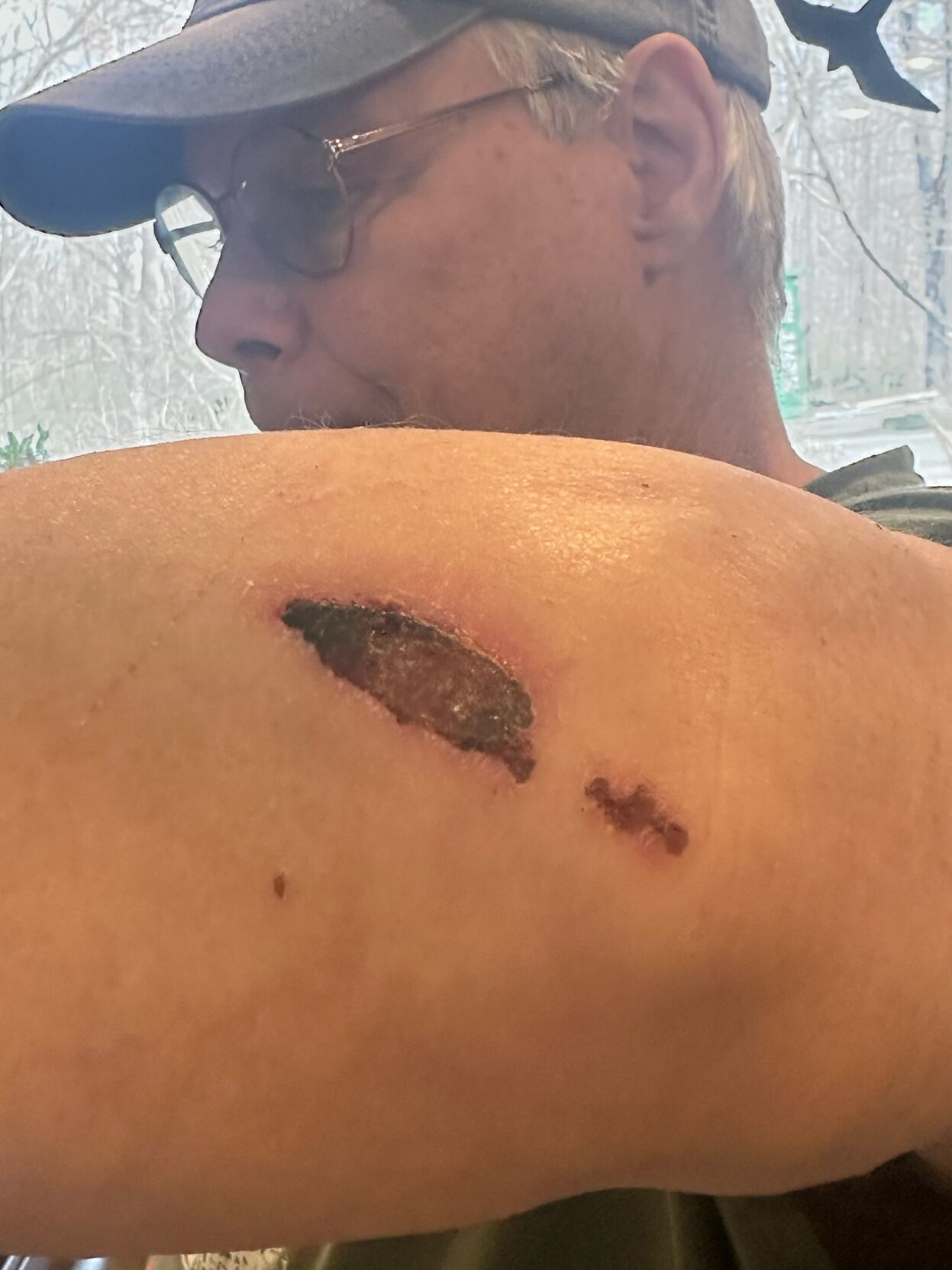
My friend, Brad, drops by the office near the end of my shift. We chat about the workload, interesting patients and plans for the weekend. He notices the scrape on my elbow. “How did you get that?”
“I fell on the new deck. Tripped over some string the workers left. You should see the bruise on my thigh.”
“Looks like it hurt.” Brad leaves it at that and goes back to work. Later one of my partners pops in. He overheard the conversation.
“So, you took a fall, huh?” He surveys the elbow. “Was it an old guy fall or a young guy fall?”
I’m not sure how to respond. Dr. B. is a great doc and I love working with him, but he can be a touch passive-aggressive at times. I suspect he’s throwing shade at my age. I shrug but don’t answer. “And how about those scratches on your arms? Same fall?”
“Got into some briers while using the chainsaw.”
“Definitely young guy stuff.”
It’s a short conversation but it got me thinking. For those of us who’ve passed into Medicare land, we know that our annual physical includes a host of required questions. One of those is “have you fallen recently?” It makes perfect sense for your doctor to ask about falls. As we age, we lose muscle strength, our balance and vision isn’t as good and our bones are more fragile. Not only are we more prone to fall but more at risk for injury. There are also simple things we can do to decrease the risk of fall and injury. An on-line search will give you lots of ideas.
This isn’t a trivial issue. On any given shift, I’ll have two or three patients who’ve suffered a fall and broken a hip, shoulder or ankle or (worse) suffered a brain bleed. Although fractures are rarely fatal, they can lead to significant debility and rehab time. In many cases they’re the event that heralds the start of a rapid decline in function and independence and often lands a person in a long-term care facility – something we all dread. Anyone who practices hospital medicine is reminded of this on a daily basis. Falls are bad, aren’t they, or did my partner’s comment suggest some nuance or even paradox?
One of the best ways to prevent falls is to stay physically active and yet I’m unaware of any physical activity that doesn’t involve at least some risk of a fall. During my annual physicals the fall question often elicits a laugh. I point out that I trout fish, hunt, trap, forage mushrooms and manage forest land in the Appalachian Mountains. I don’t consider myself clumsy or reckless but there’s never been a year in my life that I haven’t fallen multiple times. This year I’ve had three falls – fishing, trapping (mud over ice) and the deck fall - and its only April. My physician is also a fisherman, so I get an eye roll instead of a lecture.
There are plenty of risky lifestyles but one of the riskiest is being sedentary. One of my pet peeves is a patient’s family member (usually an out-of-town daughter) wanting me to tell daddy to stop - take your pick- gardening, fishing, mowing the grass, cutting wood or any other active endeavor. Daughter wants daddy to get in the recliner and never get out. She is sure he’ll be safer and live longer if the doesn’t “take risks”. I can usually maintain my tact while imparting that the worst thing we can do for daddy is take away the activities he loves and make him inactive. I temper that with comments about not taking foolish risks, etc. It works about 80% of the time.
I can’t say that I chose my version of an active lifestyle for health reasons (well… maybe mental health). Being outdoors and active is who I am. It enriches my life and makes me happy. Tripping over a root or slipping on wet shale on occasion goes with the turf. I accept that.
So, Dr B, if I was a little quicker with my retort I would have responded that, yes, its true I’m starting my eighth decade but my falls are still young guys falls…and I’ve got the brier marks to prove it.
And I might also admit that I know the debt is going to come due someday – something will eventually break. It happens to everyone. But my plan for now is to keep falling for as long as I’m able.
Extension Answers
Bull buying season 2026 (copy) (copy) (copy)
Dr. Andy Overbay
Columnist
Genetics is a powerful but oftentimes underutilized tool in our livestock operations. While it is true that good parents don’t always have good offspring, it is also true that bad parents rarely produce a good one! Selecting sires and dams of the next generation are more and more critical as profit margins tighten. High performing livestock offer increased chances for success, so it behooves us to pay attention to the lineage of our animals.
According to Dr. Scott Greiner, Expected Progeny Differences (EPDs) have proven to be the most effective tool for genetic improvement of beef cattle. The majority of the genetic progress within a beef herd is accomplished through sire selection, and therefore EPDs play a primary role in identifying and purchasing bulls.
Advancements in science and technology have resulted in a large number of EPDs being developed for multiple traits. Producers are faced with two particular challenges as a result: 1) Which EPDs should I focus my selection on? and 2) What should be the target value of the EPDs of importance?
Once selection criteria have been established (i.e. What traits do we need to improve?), benchmarks or an acceptable range of EPDs should be established for application to bull-buying. For example, if the goal is to increase weaning weight of the calf crop, WW EPD would be defined as a primary EPD selection criteria for a new bull. The questions become: What WW EPD does the bull ideally need to have? Is there a minimum? Or maximum?
In most situations, there is likely a range in EPD values that would be considered optimum. The adage that “more is better” is often not applicable in most selection scenarios when it comes to EPDs. Higher WW EPDs would certainly achieve the goal of enhancing weaning weights; however, there may also be correlated reductions in calving ease due to higher birth weights or potential increases in mature cow size for heifers retained as replacements. Balanced trait selection is always important and defining an optimum EPD range as a benchmark is compatible with this strategy.
Defining the optimum EPD range or benchmark, however, can be challenging. Knowledge of the EPD value of former and current sires in the herd can provide valuable insight and assistance in this matter. Associating EPD values on current/former sires with the performance of their progeny can be useful to establish a benchmark from which to select future sires. In the previous example, where enhanced weaning weights were a goal, it would be advantageous to know the WW EPD values of current sires. We could then set our WW EPD goal accordingly higher. Similar examples can be applied to milk, calving ease, and carcass traits. The basic premise is that defining where we are headed genetically is much easier if we can characterize where we have been.
Breed percentile rankings are additional tools that can assist with EPD selection. It is useful to understand where a particular bull ranks within a breed for traits of interest. This ranking will give a general idea as to the genetic merit of the bull compared to others within the breed. Percentile rankings are readily available in sire summaries published by breed associations. With this information, bulls can be specifically evaluated as to where their EPDs rank relative to all animals in the breed for specific traits. The following table provides a brief summary of percentile rankings in Angus and Purebred Simmental bulls for calving ease, yearling weight, milk, and marbling EPDs. It is important to note that percentile rankings do not reflect genetic differences for traits between breeds and can only be utilized on a within-breed basis. Utilizing the percentile table, it can be determined that an Angus bull with a Calving Ease EPD of +8 or higher ranks in the upper 25% of the breed for calving ease and would be a strong candidate for use on heifers. Similarly, a Simmental bull with a milk EPD of +5 is slightly higher than the Simmental breed average for milk. These percentile rankings also illustrate practical differences between EPDs. In other words, differences of a couple of pounds of WW or YW EPD between bulls are rather insignificant in the grand scheme of selection, as examination of the percentile rankings for these differences reveal that these bulls would essentially rank identically within the breed. A two-pound difference in birth weight, however, is a substantial difference.
In summary, EPDs are a powerful selection tool and establishment of herd goals and benchmarks are important for optimal utilization. Tracking performance of progeny and percentile ranks are two mechanisms that assist in the establishment of benchmarks to be applied to bull-buying decisions.
Advancements in genetics include genomics, a powerful tool for evaluating potential seedstock and seedstock needs on your operation. Like most testing programs for soil, forages, etc. on the farm, the number to look at when evaluating your use of genomic testing isn’t the cost of the test but the value of the information gained.
Dr. Andy Overbay is the agriculture and natural resources extension agent for Smyth County.
Click and hold your mouse button on the page to select the area you wish to save or print.
You can click and drag the clipping box to move it or click and drag in the bottom right corner to resize it.
When you're happy with your selection, click the checkmark icon next to the clipping area to continue.