This content is unavailable. Please contact customer service for more information.
Already a subscriber? Login or Activate your account.
You've reached the end of the standard E-Edition.
This content is unavailable. Please contact customer service for more information.
News
Washington County judge halts enforcement of Virginia’s assault weapons ban (copy) (copy) (copy)
Nori Leybengrub
The Virginian-Pilot
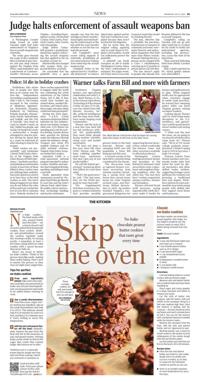
A Washington County judge issued an order Tuesday night that halts enforcement of Virginia’s ban on assault weapons ban statewide.
The order goes beyond the scope of the complaint filed on behalf of gun owners and gun shop owners against the Virginia State Police superintendent and a patchwork of Commonwealth’s Attorneys across Virginia — including Washington County, Chesterfield County, York County, Frederick County, Giles County and Chesapeake.
Judge Jeffrey Campbell granted a preliminary injunction against enforcing the assault weapons ban that applied to the six localities on June 29.
He concluded that the plaintiffs have a good enough case that the ban infringes on their Constitutional rights and ruled halting the enforcement of the ban until the court decides whether or not the ban can lawfully proceed.
But Campbell’s most recent ruling expands it statewide, prohibiting all law enforcement in Virginia from enforcing the assault weapons ban.
Campbell writes in his opinion that it is “traditionally disfavored” to enforce injunctions against parties that aren’t named in a complaint because they aren’t involved in the litigation.
But he wrote that the original ruling, applying only to a half dozen of Virginia’s 120 localities, would not sufficiently protect the plaintiffs.
A plaintiff can freely transport an AR-15 inside Washington County, where the ban’s enforcement is enjoined, the judge wrote, but if they were to cross into Grayson County they would be violating the law.
The ban, effective July 1, prohibits the purchase, manufacture or transport of commonly used semi-automatic firearms and ammunition magazines that hold more than fifteen rounds. If found violating the law, a person can be charged with a Class I misdemeanor, carrying up to 12 months in prison and/or a $2,500 fine.
The ban doesn’t apply to people who already own firearms defined in the ban as assault weapons.
Campbell’s ruling on Tuesday will not go into effect until July 21, to allow for his clerks to notify law enforcement agencies, including top prosecutors, across the state of the injunction.
Warner talks Farm Bill and more with farmers (copy) (copy)
Sen. Mark Warner told farmers that he hopes he's wrong about
the impact AI will have on the labor force.
Submitted photo
Southwest Virginia farmers and agricultural stakeholders met with U.S. Sen. Mark Warner, D-Va., at the Grayson Agriculture, Technology & Educational Center on June 30 to discuss the stalled Farm Bill, disaster recovery, tariffs, artificial intelligence and the long-term workforce needs shaping rural communities.
Warner said the lack of a new five-year farm bill has left producers without the predictability they need while already facing weather volatility, rising costs and market uncertainty.
“We have not done a five-year farm bill since 2018,” Warner said. “We keep cobbling together short-term extensions that don’t give any of you predictability.”
He said the federal government “ponied up about $66 billion for rural farm relief.
“That’s the good news,” he said. “The bad news, they cut the SNAP program by more than half.”
The Supplemental Nutrition Assistance Program is a federal initiative that provides monthly grocery funds to the food insecure. Warner said sweeping SNAP cuts will jeopardize a Farm Bill being passed this year.
A revised version of the farm bill is currently being considered by the Senate.
The discussion came as regional farmers continue recovering from extreme weather, including a spring frost and freeze that caused severe losses for some Virginia orchard crops, and Hurricane Helene devastation in 2024. Ag leaders thanked Virginia’s congressional delegation for supporting disaster declarations, which could make low-interest loans and other assistance available to affected producers.
Washington County multigenerational farmer and president of the National Cattlemen’s Beef Association Gene Copenhaver said neighbors helping neighbors after the storm was “the real story here,” noting cooperation among counties, farmers and lawmakers.
Warner criticized broad tariff increases, saying unpredictable tariff decisions make it harder for farmers and agribusinesses to plan. While targeted tariffs may be appropriate when countries engage in unfair trade practices, he warned that sweeping policy shifts can harm Virginia growers relying on export markets.
Looking ahead, Warner said AI could bring major disruption to the U.S. workforce, and agriculture could be positioned to attract workers into lasting careers.
“I think over the next five years, we are going to see massive job dislocation come from AI,” Warner said. “We’re at 9% recent college graduate unemployment. I think it’s going to go to 30% in two years. I hope I’m wrong.”
Grayson County Farm Bureau member and community leader John Fant noted the need for diesel mechanics and other skilled trades workers, suggesting stronger career pathways for students not pursuing a traditional four-year degree. Workforce options in rural communities may retain young people with skilled jobs that support local farms and businesses.
Police: 14 die in holiday crashes (copy)
Preliminary data shows that 15 people lost their lives in 14 crashes over the four-day Independence Day holiday counting period (July 2-July 5). The crashes occurred in the counties of Alleghany, Appomattox, Brunswick, Fauquier, Frederick (2), Nottaway, Pulaski, Roanoke, Shenandoah, Smyth, Spotsylvania, and Suffolk, and the City of Danville. One head-on crash in Smyth County on July 3 killed two people, and on July 5 in Frederick County a motorcyclist a trooper attempted to stop for reckless driving by speed died in a crash on Interstate 81 after refusing to stop for the trooper.
“Fatal crashes are preventable” said Lieutenant Colonel Todd Taylor, Director of the Virginia State Police Bureau of Field Operations. “Seatbelts save lives, and preliminary information reveals at least four of those killed in these crashes were not utilizing their seatbelts. Excessive speed was a factor in at least four of the fatal crashes as well. The worst thing to happen to you when you do not follow the rules of the road is not a ticket but loss of your life or someone else’s. Nobody involved in these crashes expected that to happen while the world was celebrating the 250th anniversary of the United States, but it did. If they would have buckled up, slowed down, avoided distractions, and stayed sober, these tragic outcomes likely could have been prevented.”
During the 2026 Operation C.A.R.E. (Crash Awareness Reduction Effort) initiative for the Independence Day holiday, troopers cited over 3,153 drivers for speeding and 1,540 for reckless driving. Seventy drivers were arrested for driving under the influence/driving under the influence-drugs. Troopers also wrote 474 seatbelt citations and 133 child restraint citations. Virginia State Police troopers worked 892 crashes.
Operation CARE is a state-sponsored, national program intended to reduce crashes, fatalities and injuries due to impaired driving, speeding, and failing to wear a seat belt.
Funds generated from summonses issued by Virginia State Police go directly to court fees and the state’s Literary Fund, which benefits public school construction, technology funding, and teacher retirement.
Click and hold your mouse button on the page to select the area you wish to save or print.
You can click and drag the clipping box to move it or click and drag in the bottom right corner to resize it.
When you're happy with your selection, click the checkmark icon next to the clipping area to continue.