

On the Appalachian Trail, a strike team wages war on invasive species (copy) (copy) (copy)
ATKINS — With their helmets pulled low and chemical canisters strapped to their backs, four members of a designated strike force methodically work their way through the oppressive heat of a small clearing near Mount Rogers.
Their target: invasive species.
Claire Jarvis, Justin Tapia, Evie Davis and Alex Dullea, all in their 20s or early 30s, are employees of the Appalachian Trail Conservancy and members of the Non-native Invasive Species Strike Team. Since March, they have worked to remove invasive species in the lower third of the Appalachian Trail region, from the trail's southern terminus in Georgia to Rockfish Gap near Charlottesville.
On Wednesday, they were joined by Claire Krotoski and Virginia Mooney, also Appalachian Trail Conservancy employees, on a roughly 4-acre parcel in Smyth County known as Kegley Tract. A large swath of the parcel is unwooded, which is significant because open land is often where non-native species take root first.
The grant that funds the strike team came as a result of Hurricane Helene, which in 2024 leveled trees and opened new land for invasive plants to take hold.
"When something like Helene comes through and blows all the forest down, the invasive species love to run in where the new sunshine is," Mooney said.
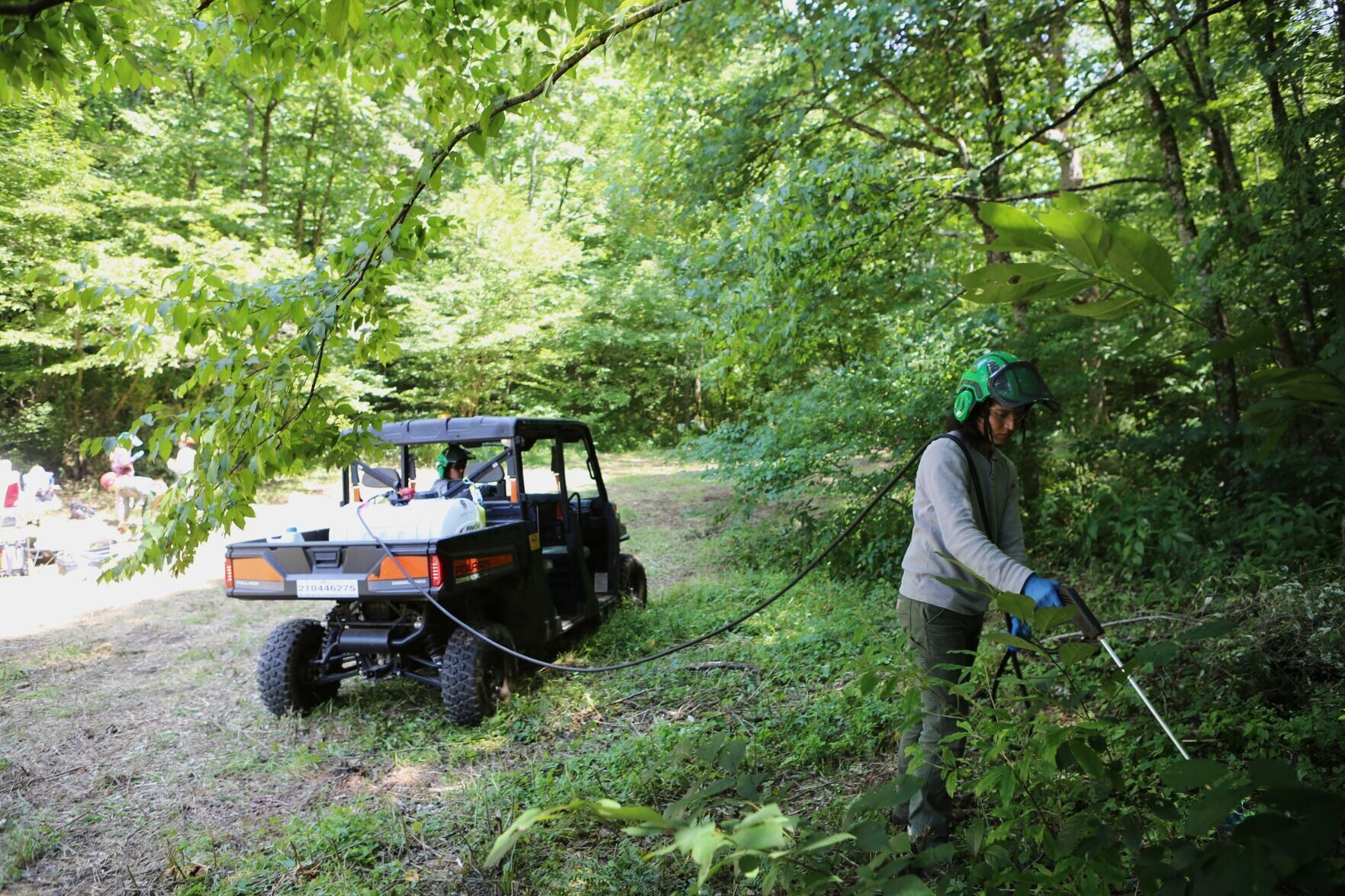
Using an herbicide tank carried by a UTV, Justin Tapia sprays at the edge of the Kegley Tract clearing.
While the floodwaters have receded, funding remains for conservationists to prevent the spread of invasive species, and areas like Kegley Tract are a prime focus.
The strike team's primary targets Wednesday were autumn olive, multiflora rose and tree-of-heaven, all native to eastern Asia.
Their presence disrupts the existing ecosystem and crowds out many native species essential to the health of local plant and animal life. Tree-of-heaven is also the preferred host of the spotted lanternfly.
The insects first invaded Pennsylvania in 2014 and have since spread along the East Coast. Also native to eastern Asia, they found a ready host in the already established tree-of-heaven.
Spotted lanternflies threaten agriculture, forests and quality of life by feeding on more than 70 plant species, including grapevines, fruit trees and hardwoods. They weaken trees, stunt growth and produce sticky honeydew that attracts insects and promotes the growth of black sooty mold.
They have already spread through much of Virginia, including Roanoke County and the New River Valley, though large portions of Southwest Virginia remain free of the pest, according to the Virginia Tech Department of Entomology.
Although strike team members said it's only a matter of time before spotted lanternflies fill in the gaps on the map, removing tree-of-heaven may slow their spread.
On Wednesday, the team worked with clippers, chainsaws and an herbicide called triclopyr. Though the work is slow — they average about a quarter-acre per person each day — all of the members agreed it is satisfying.
"It's kind of like doing the dishes in a way," Dullea said. "It felt like doing a good thing to join the strike team and make a difference."
For Jarvis, focusing on the Appalachian Trail is especially meaningful. Describing the trail as a "reprieve from society," they said it should be as close to a healthy habitat as possible.
"I think that mile for mile, you impact more lives by removing invasive species on a trail like this than you would by just bushwhacking into some random lot because it's a place that's super visible, it's well known, it gets millions and millions of visitors a year," Jarvis said.
When asked why residents farther from the strike team's work should care about the impact of invasive species, Krotoski said, "we see ripple effects in ecology all the time, one place is always going to affect the other."
"Species like this don't respect political boundaries," she said.
Ethan Hunt (540) 381-1678