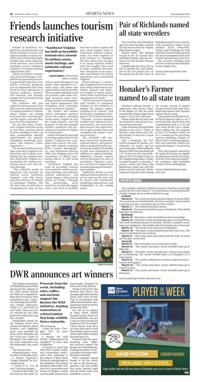


Gage Hylton led Richlands against Patrick Henry.
Gage Hylton led Richlands against Patrick Henry.
Gage Hylton led Richlands against Patrick Henry.
Gage Hylton led Richlands against Patrick Henry.

Raised bed gardens make planting, weeding and harvesting easier.
Raised bed gardens make planting, weeding and harvesting easier.
While they got few answers, a large crowd showed up at Richlands Town Hall on March 10 with questions about their electric bills.
Multiple speakers not only asked why the bills were so high but questioned other items associated with the bills and offered suggestions to help people struggling to pay their bills.
Hope Hale said the utility bills were higher than normal causing serious serious financial burden for low-income families. She said they are already dealing with rising costs of food, housing, gas and other items.
“People do not think they are being heard," she said. "Why should we have to make up the money wasted? We need solutions that do not place the entire burden on the shoulders of working people."
She asked for payment plans rather than cutting off the electricity for those who cannot pay.
Bobie Ray said council created a problem and put a hardship on the people. She asked if there were any plans in place to help people? She asked if there was an $800,000 positive Power Cost Adjustment, (PCA), and whether it could be credited back to the customers.
Henrietta Johnson asked why the PCA is still being charged if there is a surplus. After Council member Seth White’s motion to suspend Robert’s Rules of Order and allow the town manager to address the issues.
Interim Town Manager Don Marr said he had talked to many, many citizens since the bills were mailed.
“People said they kept the thermostat on 68 and bills still doubled or tripled," he said.
Marr said the record cold spell was a big part of the problem.
“We had several days when it was below zero. If you go from 35 to 68 it moves the temperature to 33 degrees. Going from five below zero moves it 73 degrees."
Marr said the rate should cover the cost of operating the system and produce capital to buy poles, trucks and other equipment. He said towns should do a five-year study to determine what the rate should be.
He said the electric company operates totally on its own and is not over-budget. He said the PCA is under-funded and wages are low for the four people who maintain the grid.
Marr said the town’s general fund, as well as its water and sewer funds, need to be self-sufficient just like the electric fund. Some speakers asked about payment plans and Marr said cash flow was the biggest obstacle to that.
Tim Lester said diagnosis was not cure, and he asked about the timeframe for the gas generator project the town is working on and if money was being put into the generator, which is supposed to allow the town to produce electricity rather than buy it.
“If so, which would be easier to get out of? We cannot sustain both," he said.
Penny Shelton said the town needs to attack the problem on lots of levels.
“We have statistics over five months showing bills went from $450 to $700. That is unaffordable for Richlands. The poverty rate of 30.2 percent is more than triple the state rate. Some residents are already homeless and some on the verge and we have no homeless shelter," Shelton said.
Other speakers asked if the town would work with individuals on solar panels and other options.
Several speakers questioned the accuracy of their bills, prompting Council member Rick Wood to ask the town manager if the town needs to pull meters and calibrate them.
Morgan Earp suggested looking into the Percentage of Income Payment Plan. Earp said Buchanan County offered a program which allows those who qualify to pay a percentage of their monthly gross income, either 5 or 10 percent depending on whether they have electricity or electricity and gas.
Council Member Laura Mollo said that program is not available to municipal systems.
A member of the Richlands Town Council accused fellow council members of violating the law governing closed sessions.
During the March 10 council meeting, council went into closed session for consultation with legal counsel.
Council member Laura Mollo disputed the reason, saying she suspected they were going behind closed doors to discuss how to stop her from revealing information about an investigation of another matter on the agenda.
Mollo left the closed session early and told the people waiting that council was not getting legal advice and alleged they were arguing about how to stop her from talking about the investigation.
The rest of council, Mayor Rod Cury, Interim Town Manager Don Marr and Town Attorney Michael Thomas returned to open session and read the disclosure that only matters for which the council entered closed session were discussed and voted 5-1, with Mollo voting no, to affirm that was the case.
Mollo said she voted no because several legal opinions she read showed there had to be a specific reason stated for a closed session involving legal consultation.
Thomas asked that her statement be included in the minutes.
Seth White moved and Rick Wood seconded the motion to affirm 2.2-37.11 A8 was the only matter for which they went into closed session. All members except Mollo voted to affirm the motion.
After the motion, Thomas asked that Mollo’s statement be included in the minutes. White asked Thomas for a legal opinion on what they discussed to which he replied that the council’s vote was what went into the record.