
Virginia's House and Senate pass budget versions, reconciling them now starts (copy) (copy)
Virginia’s annual budget theater entered its second act Thursday, as the House of Delegates and state Senate each passed their separate rewrites of former Gov. Glenn Youngkin’s final budget proposal.
The House passed its budget by a vote of 83-14.
“We have put together a budget where there are no new taxes in this budget, and we have met the requirements of a balanced budget,” said House Appropriations Committee chair Luke Torian, D-Prince William.
The Senate passed its version by a 24-16 vote.
"This is a very responsive budget; it is responsive to the needs of the commonwealth," said Senate Finance Committee chair Louise Lucas, D-Portsmouth.
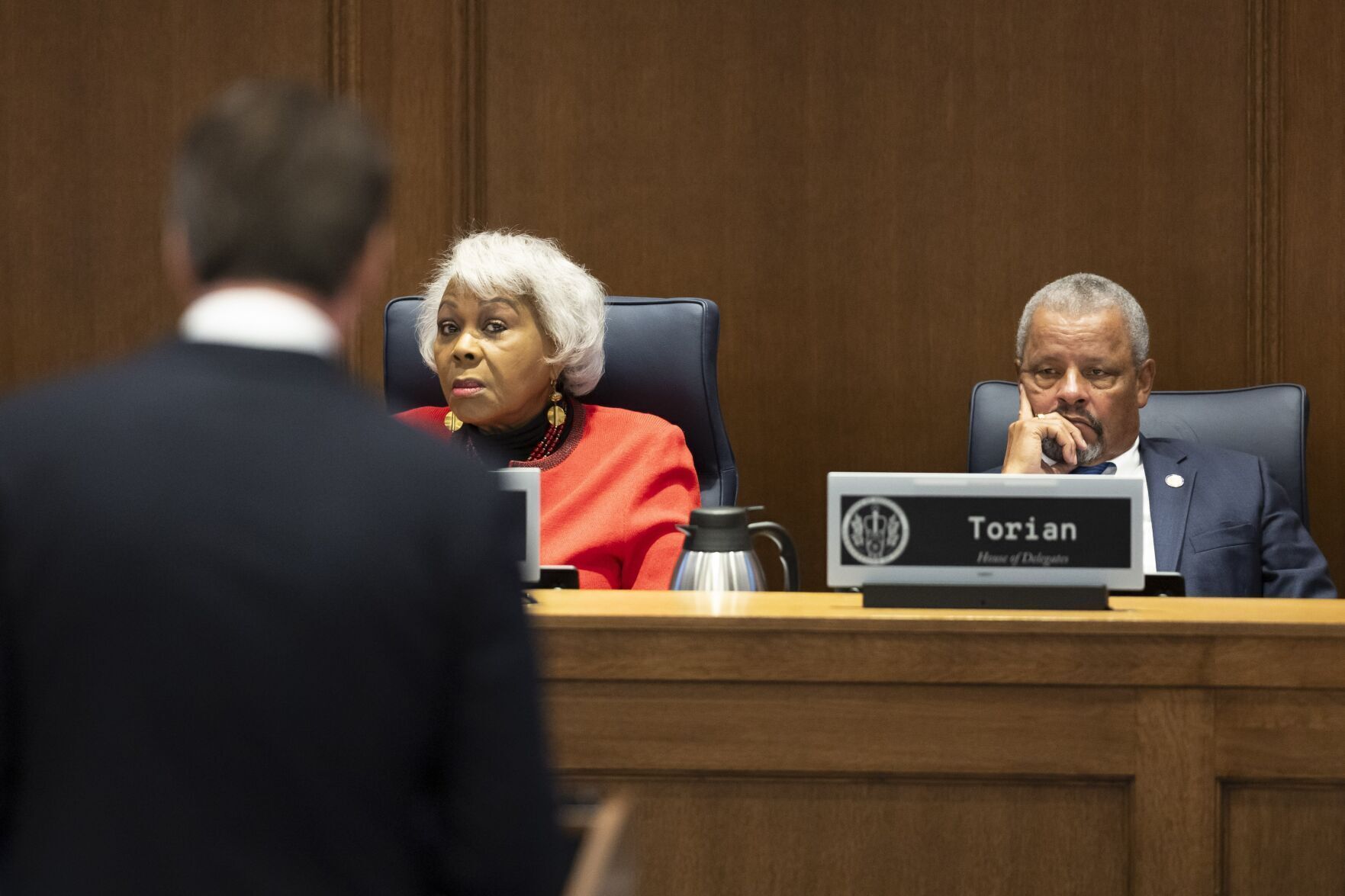
Senate Finance Committee chair Louise Lucas, D-Portsmouth, and Del. Luke Torian, D-Prince William, chair of the House Appropriations Committee, listen as Gov. Glenn Youngkin outlines his budget proposals at a joint meeting of the legislature’s money committees, Wednesday, Dec. 18, 2024.
General Assembly budget writers call for legislative pay raises
Each chamber says the state will have more money to spend than Youngkin forecast, though they differ about how much, in large part because the Senate wants to do away with the $1.9 billion sales tax break data centers get.
Because the House and Senate budgets don’t agree, and almost certainly won’t after a bit more Act 2 back and forth in the next few days, Act 3 will bring a small group of senior legislators together to either hammer out a deal or throw up their hands and try again later in a special session.
In the House, Republicans failed to knock out 30 specific changes to Youngkin’s budget proposal and to win support for four of their own initiatives.
“Where did we go? From this bill, from Gov. Youngkin to these amendments, I'll tell you where we went. We went an additional $1.2 billion in expenditures — $1.2 billion, that's a lot of money," said Del. Joe McNamara, R-Roanoke County, waving the 685-page budget proposal from Youngkin and then the 283-page book detailing House Appropriations Committee changes.
“I'm very proud there are no taxes, but I'd be even prouder if there was a tax relief, because we're continuing to grow our government faster than our paychecks at home are growing,” he said.
McNamara had argued, unsuccessfully, against funding the launch of a paid family medical leave program, calling it a tax on every paycheck that Virginians never voted on, and failed to carry the day for adopting federal tax breaks on tips and overtime pay.
“That’s what makes life more affordable for our people,” he said.
Torian fired back, saying the budget reflected what Virginians want.
“Back in November, citizens of the commonwealth spoke. ... They trusted us then, and they trust us now. They trusted us back then to increase our numbers from 51 to 64, believing that we would listen to them, and we have listened," Torian said.
“We are caring for the citizens of this commonwealth. This budget provides affordable living here in the commonwealth,” he said.
The House approved its budget after rejecting Republican objections to a pay increase for legislators.
Senators also rejected Republican objections to a legislative pay increase, to $50,000 a year as opposed to the House budget’s $45,000.
“To increase legislators’ pay by 300% when we’re offering teachers 2% is, in my view, indefensible,” said state Sen. Mark Obenshain, R-Rockingham.
“This keeps us up with inflation,” said Senate Majority Leader Scott Surovell, D-Fairfax, after noting that members of Congress make 10 times state senators’ current $18,000 salary, “and we get a lot more work done."
Senators, meanwhile, backed the biggest single difference between the Senate Finance Committee’s proposal and the House budget: eliminating the sales tax exemption for data centers.
“If you or I go to the store and buy something, we pay sales tax, but data centers are exempt,” said state Sen. Creigh Deeds, D-Charlottesville, adding that the cost to the state had risen from the $1.6 million a year projected when the General Assembly enacted it in 2008 to $1.9 billion now.
Obenshain argued that ending the exemption would lead data centers to look elsewhere and deprive Virginia of the billions in salaries, investment and local property taxes data centers pay.
“These are companies that make $100 billion a year, and we’re giving them a tax break … bricks and mortar businesses where I live don’t get that,” said state Sen. Richard Stuart, R-King George.
Ending the exemption “is the fair thing for Virginians,” he said.
Republicans in the House and Senate objected to provisions to fund collective bargaining for government employees.
“It has a distinct possibility to bankrupt our school systems and some of our local governments. Local taxes will skyrocket to pay for this,” said Del. Eric Phillips, R-Henry.
House Minority Leader Terry Kilgore, R-Scott, objected to language requiring Virginia to rejoin the Regional Greenhouse Gas Initiative, while McNamara argued it would add $500 million a year to Virginians’ power bills.
Senate Minority Leader Ryan McDougle, R-Hanover, said that while he liked much of what is in the Senate budget, both the launch of paid family leave and collective bargaining for government employees would saddle Virginians with big bills in the years to come.
Bills seek to ease the burden for missing a court date in Virginia
Tenants rights bills cross key General Assembly hurdle

Read the stories from the Richmond Times-Dispatch's three-day series on data centers and the key issues they pose.
Dave Ress (804) 649-6948