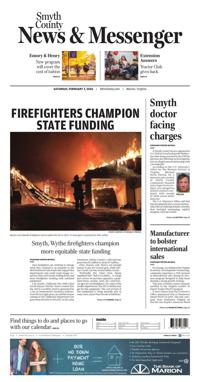

Smyth, Wythe firefighters champion more equitable state funding
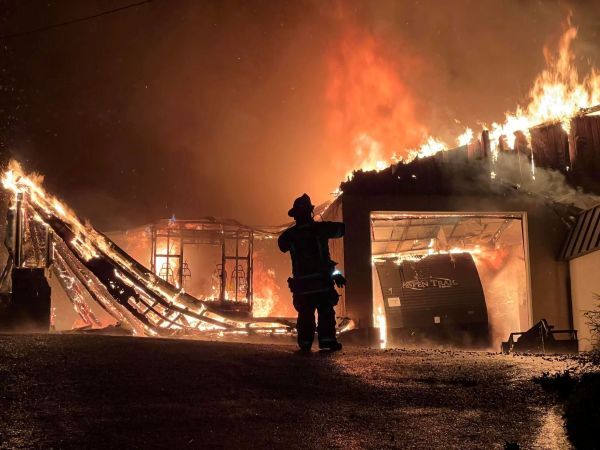
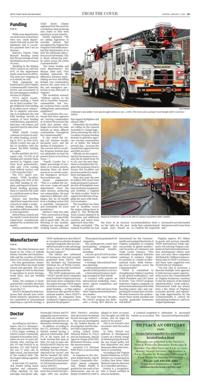
Marion and Adwolfe firefighters had to battle this fire in 2023. Turnout gear is essential for their safety.
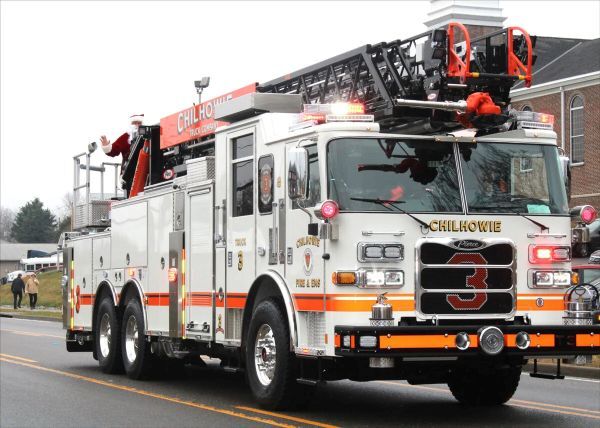
Chilhowie's new ladder truck was brought online on Jan. 1, 2024. This truck and a pumper truck bought with it cost $2.2 million.
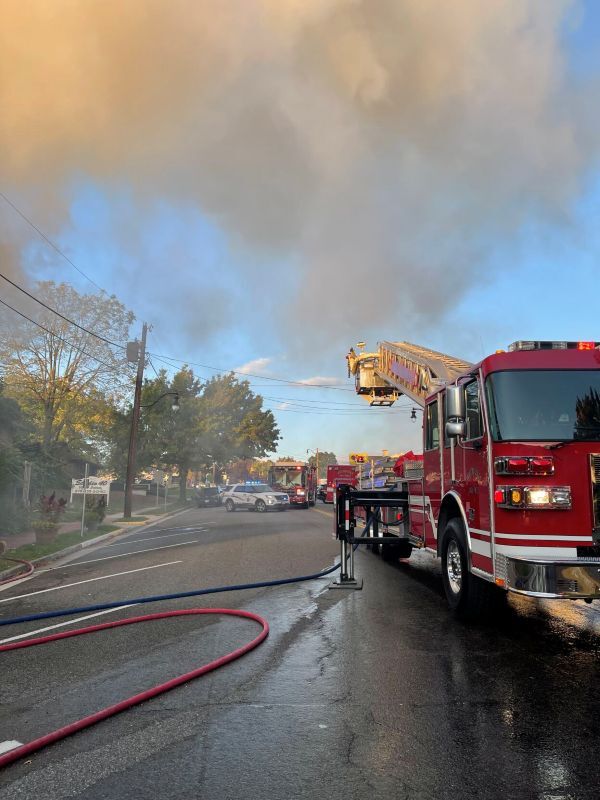
Regional firefighters want to be able to replace equipment when needed.
Area firefighters are working to change what they contend is an inequity in the distribution of state funds that support fire departments and could create longer-response times and unsafe staffing levels and leave firefighters working with outdated equipment.
Last month, Chilhowie Fire-EMS Chief David Haynes told his Town Council that the Aid to Localities fund is generated by a tax on homeowners insurance policies. Over the last eight years, he said the money coming to the Chilhowie Department has gone from $10,000 to $15,000. In the same timeframe, Fairfax County’s collection has gone from $3 million to about $7 million.
Here, Haynes said, there’s not enough money to pay for turnout gear, while Fairfax County can buy several ladder trucks.
Wytheville Fire Chief Chris Slemp explained that “Aid to Localities… is a large part of how we purchase apparatus, equipment (hose, nozzles, tools, etc.) and turnout gear for our firefighters. For some of the smaller departments, the ATL is all they may get for this equipment. The cost of most of this equipment is rising annually and, in some cases, faster than the rate of inflation.”
While some departments see an increase as insurance rates rise, small departments that only receive the minimum Aid to Localities payment don’t see an increase.
Marion’s Deputy Chief Richard Keesling noted that the percentage of fund distributions hasn’t risen in 30 years.
Speaking to the Marion Town Council, he said that 87% of fire department funds come from localities. The state isn’t stepping up as it should, he said.
Their arguments are backed up by a 2024 Virginia Commonwealth University review and assessment of fire and emergency medical services in Virginia.
VCU’s report recommended creating a “Fund for At-Risk Localities: Target additional state funding to localities most vulnerable to negative outcomes due to insufficient fire and EMS funding. Include an analysis of local funding contributions, population, land area, call volume, and reported need in allocation decisions.”
While Smyth County continues to bolster its public safety funding, according to VCU, in 2021-2023, Smyth County was one of the 10 localities with the lowest fire/EMS funding per capita.
For fire and EMS, the VCU report said, “97.15% of all funding put towards these services in Virginia came from local governments, with only 1.13% coming from Federal sources and 1.72% from the State.”
The VCU report concluded, “With localities providing over 97% of fire and EMS funding in Virginia, and impacts of insufficient funding growing, there is a need for the State to contribute more to these crucial services.”
Haynes and Keesling asked their respective town councils to adopt a resolution seeking change. The resolution will be forwarded to state legislators.
Both of those councils and the Smyth County Board of Supervisors unanimously adopted the resolution last month.
Haynes and Marion-EMS Chief Rusty Hamm explained that the need for a resolution came up among area chiefs as they were meeting in recent months.
Hamm explained, “We are asking legislators to consider options that strengthen the Virginia Fire Programs Fund while ensuring that departments at or near the minimum allocation are not left behind. This is about enhancing public safety across the entire Commonwealth.”
“For many smaller and rural departments,” the Marion chief said, “this funding represents the difference between maintaining services and falling behind. Our communities deserve the same level of fire and emergency protection as any other part of Virginia.”
The resolution warned, “without reform to the Aid to Localities Program, communities risk longer-response times, unsafe staffing levels, and outdated equipment.”
The resolution also cautioned that these agencies are “serving communities at or below the poverty line [and] face greater challenges but receive the same formula as more affluent communities throughout the Commonwealth.”
It also noted the rising call volumes locally, increased costs, and the decline of volunteers. “…The current Aid to Localities Program formula does not adequately account for poverty levels or local fiscal stress….”
“Smyth County has a higher percentage of residents at or below poverty, meaning there are fewer resources to sustain essential emergency services,” the resolution said.
Hamm emphasized, “This is a unified fire service issue. Large and small departments share the same mission, protecting our communities. We may experience different challenges, but we all benefit from a funding system that is equitable, transparent, and sustainable for every jurisdiction.”
Marion’s chief also said, “This conversation is being approached respectfully and in good faith. We are listening to one another, refining our message, and working toward solutions that support firefighters and citizens alike.”
Ultimately, the localities are calling on the General Assembly to “Adopt legislation reforming the Aid to Localities Program funding formula to prioritize agencies serving communities at, or below, the federal poverty line… increase the overall State support for Fire and EMS services.”
Officials are also requesting that the property insurance fee be raised from 1% to 2% over the next biennium to strengthen the Virginia Fire programs Fund to ensure that localities can purchase protective equipment and apparatus.
They also want the new $5 million PPE Grant Fund made permanent to guarantee that all firefighters have basic protective equipment; and establish a targeted “At-Risk Locality” Fund to support jurisdictions struggling the most with financial constraints.
The resolution has been sent to localities across the region asking them to adopt it. The Wytheville Town Council adopted it in December, and additional counties and towns have approved it since then.
Slemp concluded, “The General Assembly has had the issue of an increase on the table for the past couple years (based on recommendations from a study they commissioned) so I believe the requested increased is not only needed but proven and is more than fair.”