

Chilhowie's Gunnar Milhorne carries the ball around the Northwood defense.
Chilhowie's Gunnar Milhorne carries the ball around the Northwood defense.
Chilhowie's Gunnar Milhorne carries the ball around the Northwood defense.
Chilhowie's Gunnar Milhorne carries the ball around the Northwood defense.
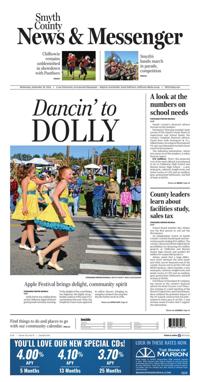
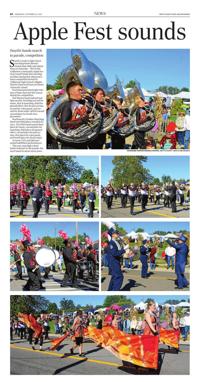
Dolly Parton was smiling down on the Chilhowie Apple Festival’s grand parade Saturday morning. To the delight of the crowd lining Lee Highway, the highly recognizable cadence of the song 9 to 5 carried down the road. Then, the Simplicity Dance team appeared in yellow dresses, bringing an energetic routine to the song that the late Parton wrote in 1980.
That was just one entry in the parade that was longer than any in recent years. It also featured nine of the marching bands that would go on to perform in the afternoon’s band competition.
There’s a line in 9 to 5 that says, “…It’s all takin’ and no givin’”, but there was lots of giving in Chilhowie as the multi-day festival entertained with games and train rides, festival foods, vendors, live music, and much more – all put on by community-minded volunteers, town staffers, and others.
On Monday, Town Manager Brian Martin said, “I was extremely happy to see such a great turnout for this year’s festival and I want to thank the hardworking volunteers who pull it off so successfully!”
Also on Monday, Chilhowie Police Chief Andrew Moss said no major problems – only hiccups – occurred throughout the weekend.
The sunny weather was a delight to organizers whose memories can easily go back to two years ago when Hurricane Helene put a serious damper on the festival.

Smyth County’s financial advisor focused on the numbers.
During last Thursday evening’s joint session of the Smyth County Board of Supervisors and School Board, the county’s longtime financial advisor, David Rose with Davenport & Co., talked money, focusing on the proposed 1% sales tax referendum to fund school construction projects.
The following information, which also zeroes in on the numbers, is taken from his report.
$31 million: That’s the projected cost of the work officials have planned to do at Chilhowie High School and Marion Senior High School – a new main gym, cafeteria, weight room, and locker rooms at CHS and an auxiliary gym, gymnasium bathrooms, and hall of fame at MSHS.
$221+ million. The cost in 2026 dollars that ZMM Architects and Engineers put on the needs of all Smyth County Schools.
$2.6 million: The revenue that could come to the county for school construction and renovation if voters approve the 1% sales tax referendum on this November’s ballot. The amount is projected to grow 1% a year. It is estimated that one-third of the sales tax is paid by people who don’t live in the county.
This amount is less than 1% of the total sales tax because the tax on food and hygiene products are not be included in this measure.
20 years: The length for the 1% sales tax for school construction, also known as the New School Sales Tax, currently allowed by legislation.
$37 million: The amount the 1% sales tax for school construction would enable the county to borrow for needed school construction or renovation projects.
That’s $21.6 million for the proposed CHS and MSHS projects and another $15.4 million for for future additional school projects.
15 cents: If the New School Sales Tax shouldn’t pass, the county would need revenue equilvalent to a 15-cent real estate tax increase to accomplish the projects – 9 cents for the CHS and MSHS projects and 6 cents for other school projects.
$195,000: The county’s Real Estate tax rate has decreased in the past three years; and one penny results in approximately $195,000 of tax revenue. The rate was 74 cents per $100 in 2024. Following a reassessment that significantly raised property values, the supervisors reduced it to 59 cents per $100. Effective July 1, the rate was raised to 69 cents per $100.
54 cents: Davenport compared Smyth’s real estate tax to 15 of their Virginia peers. The peer group median rate was 54 cents per $100. Montgomery County’s real estate tax rate was 81 cents per $100, while Scott County’s was 75 cents per $100 and Pulaski County's was 74 cents per $100. Of neighboring counties, Wythe’s rate is 51 cents per $100, Grayson’s and Tazewell’s is 58 cents, Washington’s is 43 cents, and Bland’s is 42 cents.
$5,366,722: The county’s debt service for past projects for 2027 is about $5.4 million. That amount will grow until 2031 when it reaches $5.7 million. Then, in 2033, the debt service will drop to $2,856,124.
From left, Supervisor Mike Sturgill, school board members Ben Adams and Paul Grinstead, Supervisor Courtney Widener, and school board member Sue Tilson listened to presentations on the facility study of the county schools and revenue options for renovation and construction projects during a joint meeting of the Board of Supervisors and School Board.
School Board member Ben Adams was the first person to call out the discrepancy.
An independent review of Smyth County’s schools found repair and renovation needs totaling $221 million. The county’s financial advisor talked about possibilities for financing $31 million projects at Chilhowie and Marion Senior high schools and another $15 million for unspecified projects.
Adams noted that a huge difference exists between the total needs and what can be financed even if the county chooses not to do the CHS and MSHS projects, which includes a new main gym, cafeteria, weight room, and locker rooms at CHS and an auxiliary gym, gymnasium, bathrooms, and hall of fame at MSHS.
David Rose of Davenport & Company has served as the county’s financial advisor for about 30 years. Last Thursday evening at a joint meeting of the Board of Supervisors and School Board, Rose outlined the potential impact of the 1% schools construction tax referendum if voters pass it on Nov. 3 and revenue needs if voters don’t support the referendum.
In response to Adams’ observation, Rose said it’s quite common for a locality’s needs to exceed its financial capacity.
Rose did conclude that 1% sales tax referendum will put “less burden on citizens.”
If the referendum fails, Rose said that revenue equaling a 15-cent real estate tax increase will be needed to accomplish the same projects.
Adams agreed, noting Rose’s earlier observation that about 30% of the sales tax revenue is paid for by people who don’t live in the county but are visiting or passing through.
Still, Adams said the county’s schools aren’t getting younger, and officials can’t stick their heads in the sand for the community’s children.
Based on the dates provided by ZMM Architects and Engineers, the firm that conducted the school facilities study, Adams is right about the schools. The newest school, Oak Point Elementary, is 24 years old. Next up is Chilhowie Middle School, which is 36 years old.
Though some have had renovations, the other schools were all built before 1970. Atkins and Sugar Grove elementary schools and Marion Middle were built in 1938, making them 88 years old.
Hunter Wilson, a ZMM project manager, described the study as a “fairly thorough anaylsis of the schools.”
In Southwest Virginia, he said that school leaders have considerable practice in getting extra life out of buildings. The study includes some recommendations to do just that, he said.
Adams pointed to a portion of the study that examined each school’s population capacity. He questioned the higher capacity noted for Chilhowie High School, saying that the cafeteria would have to start feeding students lunch as soon as they come in.
Wilson responded that the enrollment capacity was based on teaching stations. In some cases, if those numbers should be realized, he said that dining rooms and other facilities might need to be upgraded.
Some citizens, Adams said, might point to those capacities and say that students should be combined there without realizing that additional work would be needed.
Supervisor Roscoe Call said the community needs to get together on the issues. Some people may need to remove the chips from their shoulders, he said. “We’re hurting,” he said.
Wilson noted that the study made no recommendations about consolidation or how the county should move forward.
No further suggestion of the possibility was made.
For those who would like to review ZMM’s study in detail, it is available on the School Board’s website -- www.scsb.org/ -- at the top under the District heading. It is a large file and can take some time to load.
Supervisor Jason Parris noted that growth may also occur in the county. He noted the proposed truck stop at Exit 39, which could generate additional sales tax and other revenue.
Rose noted that the interest earned on the sales tax revenue as it’s banked would be significant. “It’s a powerful growth tool,” he said. “This 1% takes you a long way down the road.”
Call noted that the situation involved everyone in the county and that Northwood High School should be mentioned.
ZMM’s study identified a need for crack monitors at NHS. Some cracks at the school have been filled, Wilson said, but widening suggests continued movement.
Wilson recommended that monitors to track movement, expansion, or closing of cracks in concrete, brick, masonry, and other structures be installed and track the situation for a year. Given Saltville’s geography, which includes underground caverns and openings, Wilson said the situation is not surprising.
Thursday evening was the first time the supervisors had heard a presentation on the study and the second time for the school board. It was the first time for both bodies to hear Rose’s presentation.
County Administrator Shawn Utt noted that it was a great deal of information to absorb. That meeting, Utt said, was the first of what he expects to many conservations over the coming months on the subjects. He noted that opportunities will come for citizens to share their input.
While the 1% sales tax referendum is a possibility created by the Virginia legislature, some work is occurring on the federal level.
Tim Kaine, one of Virginia’s U.S. senators, sent out an email on the topic last week.
“All students deserve a safe, healthy learning environment where they can succeed. Yet many schools in Virginia and across the country need urgent, and often costly, repairs. Forty percent of public school buildings nationwide were built before 1980, and many facilities still contain harmful materials such as asbestos and lead-based paint,” he wrote.
Kaine also noted the financial crunch, saying that “school districts are facing an estimated $85 billion funding gap for public school facilities, with state and local governments shouldering nearly all the cost.”
Last week, Kaine said, he reintroduced the School Infrastructure Modernization Act of 2026, which “would help communities renovate aging school buildings by expanding access to the federal historic rehabilitation tax credit.”
The future of any federal legislation is uncertain at best.