Local governments from Petersburg south to the North Carolina line are quietly wondering whether Virginia is about to shut the door on data center development just as they reached the front of the line for economic benefits they sorely need.
Localities in the so-called "Gateway Region" are actively courting data center projects that they fear could slip away if the General Assembly agrees to a Senate proposal to repeal a 16-year sales and use tax exemption on computer equipment that has made Virginia the center of the global industry, primarily in affluent Northern Virginia.
"It has hit a nerve," said Keith Boswell, president and CEO of Virginia's Gateway Region, a nonprofit organization that promotes economic development in nine localities in the Tri-Cities area and Southside Virginia.
Potential data center projects are pending throughout the region in various stages of development prior to public announcement, but Boswell said some developers are saying, "'We're going to hold off until the General Assembly figures out what it's going to do. It's too much uncertainty for us.'"
General Assembly adjourns without budget, will return April 23
The assembly adjourned March 14 without a new, two-year state budget because of the Senate proposal to end the tax exemption, which cost the state $1.9 billion in revenue last year. The House of Delegates opposes repeal of the tax break, as does Gov. Abigail Spanberger, primarily out of concern for Virginia's business reputation if the state were to suddenly end an exemption that is not scheduled to expire until 2035.
The disagreement leaves a $1 billion gap in revenue between the two budgets that the legislature will have to bridge when it returns to Richmond on April 23 for a special session that Spanberger has called at its request.
House Appropriations Chairman Luke Torian, D-Prince William, whose committee produced a balanced budget without touching the exemption, said Senate budget negotiators are waiting for a report from the data center industry "on what they are capable of doing and what they can't do" to generate more revenue for the state.
Torian said he doesn't want the state to undermine economic development efforts to attract data center projects to Southside Virginia and other rural parts of the state that say they want and need the business investment, jobs and local government tax revenue.
"From my perspective, I'd like to see those come to fruition because it's good for the Commonwealth," he said.
Sen. Creigh Deeds, D-Charlottesville, said the Senate is looking for ways to meet long-term revenue needs.
"We're looking at data centers because, frankly, that's the easiest place to look," he said.
Curry Roberts, president of the Fredericksburg Regional Alliance and former commerce secretary under then-Gov. Gerald Baliles, thinks the Senate proposal would hurt the state more than it would help.
"It's really bad optics for the state, across the board, to go back on a deal," Roberts said. "It just creates a stigma. It ain't going to help with the CNBC rating (for best state to do business) any."
Deeds, who is an attorney, contends that repealing the tax exemption wouldn't be the same as breaking a contract because he said most contracts contain a provision that allows for action by the General Assembly that could change the terms of a deal.
"People want to say, 'You can't go back on a contract.' It's in the contract," he said.
Deeds said budget negotiators "had a conversation" with industry officials last week and expects conversations to continue this week.
"I'm confident we'll get there, but we haven't gotten there yet," he said.
But the uncertainty has had a chilling effect on potential data center projects that could make a big difference to localities in Southside and other rural areas of the state, Boswell said at Virginia's Gateway Region, based in Colonial Heights.
"If we're going to do away with it now, all the 'have' communities get what they want and all the 'have-not' communities are on the cusp of getting data centers that could transform their communities and budgets," he said. "That's just not right."
Localities in Southside see the economic benefits that Mecklenburg has received from almost a dozen data centers, either operating or under construction, since Microsoft Corp. made its first investment there in 2010.
"We've made a concerted effort to attract data centers to Brunswick County and been somewhat successful," said Alfreda Jarrett Reynolds, economic development director of the Southside county next to the North Carolina state line.
Brunswick has assembled about 2,000 acres for a technology park that would take advantage of gas-fired power plants that Dominion Energy operates in Brunswick and neighboring Greensville County. Reynolds said that data center projects are in "various stages of due diligence" before making any public announcement, but she acknowledged the budget debate in Richmond over the tax exemption has caused some uncertainty.
"I think everybody is quietly in a wait-and-see standpoint," she said.
![]()
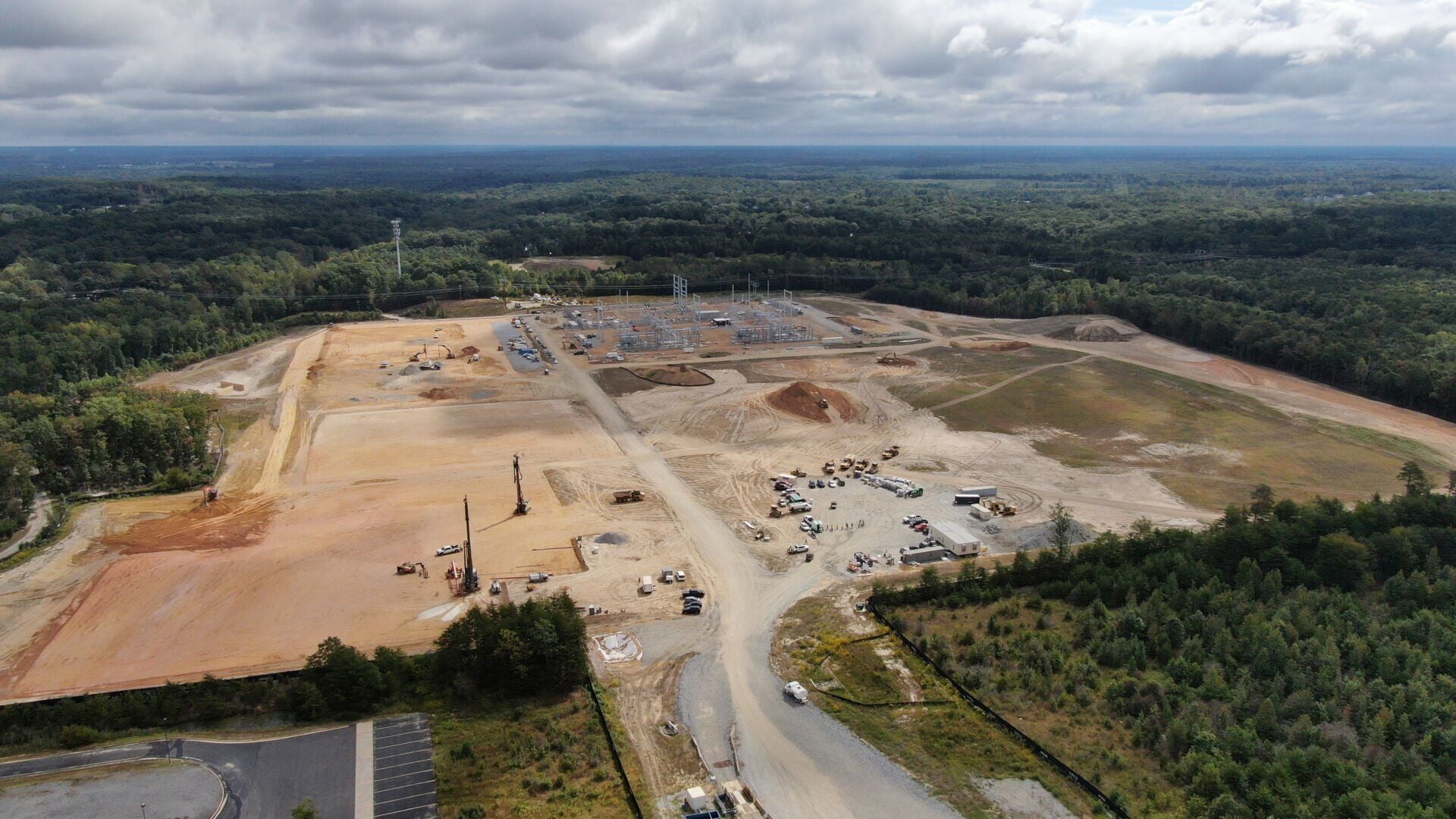
A data center campus is under construction near Fredericksburg
in this September 2025 photo.
MARGO WAGNER, TIMES-DISPATCH
Northern Virginia, particularly eastern Loudoun and western Prince William counties, has "reaped the benefits" of the data center exemption for years, Reynolds said. "It is our time."
"We are an economically distressed community," she said. "This is a way up."
Emporia has also been trying to land data center projects to boost the economy in the small Southside city and surrounding Greensville County.
"We're open for business," Emporia City Manager William Johnson said Monday. "We're recruiting data centers as well as manufacturing companies."
Johnson declined to discuss the political debate over the tax exemption, but Boswell, at Virginia's Gateway Region, said Emporia is still recovering from the closure of the Georgia-Pacific plywood factory there last year and a fire that destroyed the vacant facility in January.
"We're talking about a distressed community," Boswell said. "They would love to have a data center."
Sen. Emily Jordan, R-Isle of Wight, whose district includes Emporia, Greensville and Brunswick, said a data center "could be a game changer for that community."
"It would be real easy for Northern Virginia to close the door on everybody else," said Jordan, who voted against the Senate budget.
Petersburg City Council voted unanimously last month to sell 176 acres of city-owned land next to a railroad switching station in the southern part of the city to The Warrenton Group, a Washington-based company looking to develop a data center on the property, which the council rezoned for light industrial uses. Former Gov. Glenn Youngkin, in his last "Partnership for Petersburg" appearance before leaving office, said in early January that a data center project could be coming to the city.
So far, the Senate proposal hasn't dimmed those prospects, the city said.
"No developer has brought up the state tax issue on possible data centers in Petersburg," spokesperson Joanne Williams said Monday.
Spanberger meets with Virginia budget negotiators to jumpstart talks
Virginia Senate budget ditches data center tax break to create more than $1 billion in revenue
Read the stories from the Richmond Times-Dispatch's three-day series on data centers and the key issues they pose.