

Va. loses almost 48,000 jobs in year; unemployment at 3.7% (copy)
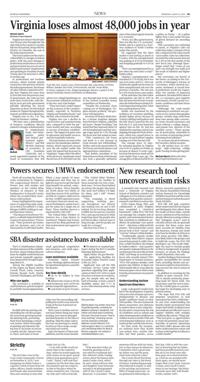
Virginia lost almost 48,000 jobs over the past year through July, the only state in the country to see jobs fall over that period, along with the District of Columbia, the seat of the federal government.
The losses underscore the state's vulnerability to changes in federal policy, with the most damage in professional and business services and government because of cuts to federal government employment and spending by President Donald Trump since he returned to office 19 months ago.
In professional and business services, which include private contractors who perform work for the federal government, the Bureau of Labor Statistics reported on Friday that Virginia lost more than 22,000 jobs over the previous year. In government, the state has lost more than 10,000 jobs, with hiring by local and state government partially offsetting the forced departure of about 24,000 federal workers in Virginia through layoffs, buyouts and deferred resignations.
Virginia rises to No. 3 in 'Top States for Business' ranking
"We have seen a deterioration of business conditions directly related to changes in federal policy in employment, trade, and immigration policy and federal government expenditures," said Bob McNab, chairman of economics at Old Dominion University and a newly appointed member of the board of economists that will advise Gov. Abigail Spanberger on the economic outlook for revisions to the two-year state budget.
"They have had a major impact on the economy of the commonwealth, especially in Northern Virginia and Hampton Roads," said McNab, who is based in Norfolk.
Virginia also saw a decline in construction and manufacturing jobs, compared to both the previous month and year, according to surveys of business establishments. The biggest job gains were in education and health services, and the hospitality industry.
The bad numbers are more of the same for the Spanberger administration, which expressed concern over the job market earlier this week, but argued that increases in Virginians' wages offset the effect of the job losses. Spanberger noted the net loss of 43,600 jobs over the year through June in her remarks to the General Assembly money committees on Wednesday.
"Despite the economic chaos coming out of Washington, Virginia remains resilient," the governor told legislators.
Secretary of Finance Mark Sickles, a former longtime delegate from Northern Virginia, called the job losses "deeply troubling," but noted that they represent about 1% of total employment and that average wages grew by 3.3% through the fiscal year that ended on June.
"This counteracts job losses and leads to a net increase in (state income tax) withholding," Sickles said in his presentation to the House and Senate finance and appropriations committees.
Tom Barkin, president of the Federal Reserve Bank of Richmond, also took a generally optimistic view of the mixed signals from the U.S. economy.
"If you, too, like a good mystery, then you like the U.S. economy," Barkin said in a speech to a business audience in South Carolina earlier this month.
He suggested that the labor market is not hurting as much as it seems, with the unemployment rate peaking at 4.5% in November and dropping gradually to 4.1% in July.
"How can unemployment be so low when the news feels so bad?" Barkin asked.
Virginia's unemployment rate remained at 3.7% in July, but it was one of 22 states and D.C. that saw statistically significant increases in their unemployment rate over the previous 12 months. The rate rose by 0.4% in July from a year earlier.
At the same time, the state's labor participation rate fell to 63% in July, the lowest level in the 50 years since the Federal Reserve Bank of St. Louis began measuring states' labor force participation in 1976.
Barkin was heartened by the resilience of consumer spending, despite higher prices because of Trump's shifting tariff policies and the fuel shock caused by the war that the U.S. and Israel launched against Iran on Feb. 28. Iran has retaliated by exerting control over shipping through the Strait of Hormuz, which has caused prices to go up for oil and fertilizer supplies coming out of the Persian Gulf.
The average price of regular unleaded gasoline in Virginia rose to $3.91 a gallon on Friday, an increase of almost 13 cents a gallon from the previous week and 90 cents higher than a year ago. The average price of diesel fuel hit $5.64 a gallon on Friday — $2 a gallon higher than a year earlier because of global demand far exceeding supply.
Still, consumers are continuing to spend, as Virginia's sales tax collections reflect, rising by 14% in July, compared to the same month a year earlier. Sales tax collections exceeded the state revenue forecast by 6.4% in the first month of the new fiscal year, although Spanberger noted that "some of our sales-tax strength was really just the result of inflation and higher prices."
But consumers are fearful of the future, according to the University of Michigan's Surveys of Consumers, which showed consumer sentiment at record lows in preliminary results for August. After two months of improved sentiment, the index fell by almost 8%, as consumers gave negative assessments of both current economic conditions and their future expectations.
"Although the early-month weakening in sentiment was pervasive across various demographic groups, notably large reductions were seen among older consumers, lower-income consumers, and those without a college degree," said Joanne Hsu, director of the monthly survey. "These groups are all particularly vulnerable to any erosion of purchasing power stemming from inflation."
Va. revenues ahead of estimates, but tax policy debate resumes
Va. job market faces AI challenge: high-achieving college grads 'having trouble getting jobs'
Michael Martz (804) 649-6964