

Mountain Valley Pipeline does not threaten endangered species, federal agency finds
Five federally protected species of bats, fish and a plant are not likely to be jeopardized by running a large natural gas pipeline through their habitats, the U.S. Fish and Wildlife Service has determined.
A 297-page biological opinion of the Mountain Valley Pipeline’s impact on threatened and endangered species, released Wednesday, marked the third time the Fish and Wildlife Service has studied the issue.
Two earlier opinions reached the same conclusion in 2017 and 2020, but were invalidated by a federal appeals court.
The latest document provides additional data and analysis to support the federal government’s finding of no significant harm to five species: the endangered Indiana bat, the threatened northern long-eared bat, the endangered Roanoke logperch, the endangered candy darter and the threatened Virginia spiraea, a flowering shrub native to southern Appalachia.
For Mountain Valley, the finding was an important step in its efforts to regain a series of approvals that have been struck down by the 4th U.S. Circuit Court of Appeals.
“The MVP project team appreciates the USFWS's significant work to develop a thorough report that exceeds all regulatory requirements, protects natural resources and habitats, and provides a path forward for completion of this important infrastructure project,” company spokeswoman Natalie Cox said in a written statement.
“We look forward to resolving the few remaining permitting issues, resuming forward construction, and completing the MVP project later this year,” Cox said.
The finding was derided by opponents, who say building a 303-mile pipeline through pristine woodlands and across clear-running streams has already had dire environmental consequences.
“Here on the ground, our critters — particularly the endangered and threatened ones — are invaluable to our entire ecosystem,” said Russell Chisholm of the Protect Our Water, Heritage, Rights Coalition.
“We are in the midst of an escalating climate crisis where it’ll get harder for human and non-human species to stay alive. Yet our regulatory agencies are allowing an unnecessary fracked gas pipeline to destroy our home for no reason other than satisfying corporate greed.”
Construction of the buried pipeline, which began in early 2018, has been delayed repeatedly by legal challenges from POWHR and other groups.
Equitrans Midstream Corp., the lead partner in the $6.6 billion project, says it hopes to have the remaining work done in time for the pipeline to begin transporting natural gas by the end of this year.
“However, we must acknowledge that the ultimate hurdle remains legal challenges of the permits,” Thomas Karam, chairman and CEO of Equitrans, said during a conference call last week to discuss annual financial results.
Erosion and sedimentation caused by clearing land and digging trenches for the 42-inch diameter pipe have been a recurring problem along a route that takes it from northern West Virginia, through Southwest Virginia, to connect with an existing pipeline near the North Carolina line.
A ruling from the Fourth Circuit is expected soon in a lawsuit in which environmental groups are contesting a stream-crossing approval by the West Virginia Department of Environmental Protection. The three-judge panel, which has ruled against Mountain Valley repeatedly, is also considering a similar approval by the Virginia Department of Environmental Quality, with a ruling expected by early summer.
In striking down the Fish and Wildlife Service’s second biological opinion last year, the Fourth Circuit found what it called “serious errors” with the conclusion that endangered species would not be jeopardized.
“If a species is already speeding toward the extinction cliff, an agency may not press on the gas,” Judge James Wynn wrote in a unanimous opinion from the panel.
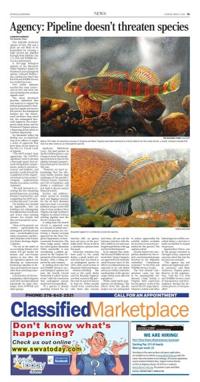
Particular attention has been paid to the candy darter, a small, multi-colored fish that was listed as an endangered species in 2018, after construction of Mountain Valley had begun.
Bottom-dwelling fish such as the candy darter and the Roanoke logperch use their snouts to flip pebbles over in search of insects to feed on. When muddy runoff from construction sites flows into streams and rivers, silt can coat the bottoms, interfere with the fish’s ability to see and cause longterm problems with egg and larval development.
In its opinion this week, the Fish and Wildlife Service wrote that “project impacts are expected to be relatively small because most of the effects of sedimentation are expected to be sub-lethal and occur within a relatively small portion of the species range within each affected population.”
While candy darter populations are declining, “the effects from this specific project are not anticipated to reduce appreciably the suitable habitat available for recovery or recovery potential for the species,” the opinion stated.
Shortly before the completion deadline for the report, environmental groups involved in the litigation submitted “voluminous materials” to the Fish and Wildlife Service, it said.
The “last-minute” submissions came too late to be meaningfully addressed, Cindy Schulz, a Virginia field supervisor for the agency, wrote at the end of the 297-page report. However, Schulz said other federal agencies will be consulted before a decision is made on whether to reopen the process.
Appalachian Voices, one of the groups involved in the legal action, expressed concerns about the way the decision was reached.
“The agency has not addressed legitimate public concerns,” said Peter Anderson, Virginia policy director of the organization, “and the U.S. Fish and Wildlife Service’s lack of transparency and thoroughness during this decision process is irresponsible.”