
Va. study: Serious issues at many assisted living facilities and 90% of home care services haven't been inspected in years (copy)
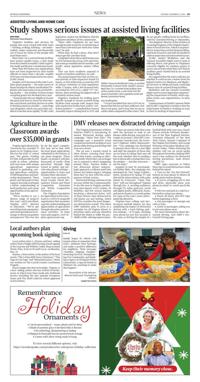
Virginia’s facilities and services for people who need a hand with daily tasks — bathing, cooking, toileting — are understaffed, under-inspected and financially out of reach for many of the people who need them most.
More than 1 in 5 assisted living facilities have serious quality issues, a new study from the General Assembly’s Joint Legislative Audit and Review Commission found.
More than 450 home care organizations have not been inspected by state health officials in more than a decade; roughly 90% have not been inspected in two years, JLARC found.
Despite a 29% increase in the state’s auxiliary grant program — the main source of financial help for elderly and disabled Virginians who need a place in an assisted living facility — the number of these homes accepting grants has declined every year.
“Some people who are eligible to receive the grant may have to move far from families and friends and their doctors in order to find placement in a facility … some forgo care altogether, which can cause their condition to decline more rapidly,” JLARC chief legislative analyst Joe McMahon told the legislative members of the commission.
“Most older Virginians do not have enough income to pay for assisted living or more than a few hours per week of in-home care,” he said.
When they do find a place, they don’t always get the care they need.
Complaints about these adult homes rose by 21% between fiscal year 2025 and 2026, and some go unaddressed for months, said JLARC senior legislative analyst Dillon Wild.
That can leave residents exposed to unsafe or harmful conditions, he said.
The annual inspections that are the current priority of state inspectors found 122 homes, or 21% of the total, account for 65% of serious violations of state regulation, while 17 homes, with 1,450 licensed beds, accounted for 36% of so-called “C3” violations, those involving the highest risk of extremely serious harm.
Virginia’s standards for staffing aren’t specific enough to ensure assisted living facilities have enough staff, beause they only require that homes have staff in “sufficient numbers” — a standard that General Assembly reports dating back to 1979 said was inadequate.
“I’m just horrified that since 1979 we’ve known that this has not been sufficient, that this is not good, and to hear that we are an outlier when compared to other states” that do set specific staffing levels for facilities, said Del. Charniele Herring, D-Alexandria.
Tara Ragland, director of the Division of Licensing Programs at the Virginia Department of Social Services, which is responsible for inspecting assisted living facilities, said more resources and staff are needed to address inspection and enforcement issues.
JLARC analyst McMahon said the General Assembly might want to look at offering direct cash grants to Virginians currently eligible for auxiliary grants to access care at home when they can’t find an auxiliary grant-funded bed in an assisted living facility.
He suggested that the state could also see whether it could secure a waiver from the federal Centers for Medicare and Medicaid Services so Medicaid funds could help finance stays in assisted living facilities.
McMahon said the General Assembly might want to enact legislation empowering the Department of Health, which regulates home care organizations, to deny licenses.
Commissioner of Health Cameron Webb told JLARC's legislative members that the Department of Health is working on ways to clear its backlog of inspections.
Dave Ress (804) 649-6948