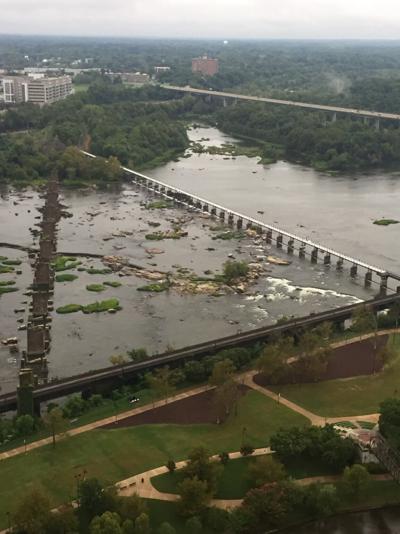


The T. Tyler Potterfield Bridge is seen from one of the upper floors at the Richmond Fed.
RVA 100: 100 people, places, things that you should know about Richmond
RVA 100: The Markel Building

No, that’s not a flying saucer that landed just west of Willow Lawn shopping center. It’s the Markel Building, commissioned in 1962 by the specialty insurer Markel and designed by Richmond architect Haigh Jamgochian.
That crinkly looking metal wrapping each floor is a 500-plus foot long chunk of aluminum and Jamgochian, reportedly inspired by a foil-wrapped baked potato, wielded the sledgehammer that created that distinctive texture.
It’s been deemed one of the 10 ugliest buildings in the world, but rather like Jamgochian (who only managed to get one other design built) and Markel — which got its start insuring jitneys and is now a $55 billion insurance and investment powerhouse that long ago moved its headquarters to suburban Glen Allen — it’s uniquely Richmond.
--Dave Ress
RVA 100: Murals

Richmond’s more than 100 murals range from thought-provoking to statement-making to just plain odd.
One of the first, a beauty queen on the wall of Sidewalk Cafe on West Main Street, was painted by Ed Trask in the 1990s. Then in 2012, mural painting exploded here after the first RVA Street Art Festival and the Richmond Mural Project, which led to the design of 100 murals in five years.
They have also drawn pushback as the city became “muralized.”
Richmond’s murals rose hand in hand with the city’s breweries, restaurants and social media. They appear in tourism videos, help define neighborhoods and drive economic development. Most are on private buildings, paid for by the owner. Near VCU, a mural of a woman crouched in a glass jar is among the most famous.
This spring, Richmond was ranked the second best city in the U.S. for public art by the USAToday Best List.
--Eric Kolenich
RVA 100: Richmond Kickers

Established in 1993, the Richmond Kickers are the longest continuously run professional soccer club in the country and a cornerstone of RVA’s sports scene.
The Kickers compete at historic City Stadium and annually place among the highest attendance numbers in USL League One, with an average of roughly 4,000 fans in a stadium situated to hold 6,000 for home games.
The club has two primary groups of supporters — the River City Red Army and Scuffletown Social Club — traditionally filling Section O in the southwest corner of the stadium, from whence red smoke drifts and drums emanate.
The Kickers in 2018 were purchased by majority owners 22 Holdings, LLC, led by CEO and former player Rob Ukrop, from Richmond Kickers Youth Soccer Club, which maintains a minority stake in the club.
— Zach Joachim
RVA 100: The Flying Squirrels

Professional baseball was played for generations in Richmond before the Flying Squirrels soared into town for the 2010 season. Nothing before was comparable in name, entertainment presentation, or impact.
With a heavy accent on the fans’ game experience, the Double-A franchise affiliated with the San Francisco Giants became a highly popular attraction for those who are serious fans of the sport, and those who enjoy a lively atmosphere with baseball as background.
The Flying Squirrels instantly became one of the leading draws in the minor leagues, regularly averaging more than 6,000 fans and uplifting the community 12 months a year with coat drives, reading programs, youth-league field renovations, and other contributions.
RVA 100: Richmond Coliseum

For nearly 50 years, the Richmond Coliseum at 601 E. Leigh St. stood as the city’s premier venue for sports, concerts and political rallies.
After opening its doors in 1971, the Coliseum served as the home of the VCU men’s basketball team for nearly 30 years and a part-time home for the ABA’s Virginia Squires until the league folded.
Perhaps the most dramatic Coliseum moment occurred during the 1994 Women’s NCAA Division I Basketball Championship, when North Carolina’s Charlotte Smith hit a buzzer-beating 3-pointer to defeat Louisiana Tech by a point.
Concerts at the Coliseum featured such legends as Aretha Franklin, Elvis, Prince, The Jackson 5, Van Halen, B.B. King, Bruce Springsteen and Cher.
The Coliseum’s final event was a Harlem Globetrotters show on Dec. 29, 2018, with the arena officially closing a couple of months later.
Demolition of the Richmond Coliseum is currently on pause, but could start in 2025.
— Thad Green
RVA 100: Agecroft Hall

Richmonders can get a taste of Renaissance-era England at Agecroft Hall.
The Tudor-style manor, with exposed timber and a stone-style roof, was built in the late 1400s or early 1500s in Lancashire, England.
By the 20th century, it had fallen into disrepair. So Richmonder Thomas C. Williams Jr. bought it, had it disassembled and shipped to Richmond, where it was remodeled and rebuilt at 4305 Sulgrave Road in the Windsor Farms neighborhood, overlooking the James River.
Work finished in 1928, but Williams died a year later. The house opened to the public in 1969.
Visit the sunken garden, the trails and museum at 4305 Sulgrave Road. Adult tickets are $12. Or bring a tailgate chair, a picnic basket full of food and catch a Shakespearean play on the lawn during the Richmond Shakespeare Festival.
RVA 100: Bill's Barbecue

For more than 80 years, Bill’s Barbecue was an independent, Virginia barbecue chain that served vinegar-based pork barbecue sandwiches, homemade chocolate pies and freshly squeezed limeade.
The first Bill’s opened in Norfolk in 1930. The first Richmond location opened the following year at 3216 N. Boulevard. At its peak, there were 13 Richmond-area locations and nearly 125 employees.
In 2005, Rhoda Elliott, the company’s president and daughter of Bill’s longtime owner and operator, the late W.S. Richardson Sr., said “small independents are a dying breed.”
“We ought to be put on the endangered-species list. It is hard to fight the big corporations. They have so many resources that the small independents don’t have.”
She was right. In December 2012, the last three Richmond locations closed. Lines were 30 to 50 people deep as longtime customers waited for just one more limeade.
RVA 100: Byrd Theatre

The historic Byrd Theatre has been a film spot in Carytown for nearly a century.
The venue, known as “Richmond’s Movie Palace,” opened in 1928 when silent films were the popular entertainment. It was named after William Byrd II, the founder of Richmond.
The theater has 1,392 seats — 916 on the main level and 476 in the balconies. Hanging from the ceiling is a giant chandelier that features 500 colored lights that illuminate 5,000 crystals. It also has an organ, the Mighty Wurlitzer, which is still played ahead of shows on Saturdays.
In 1977, it was added to the Virginia Landmarks Register. The Byrd Theatre Foundation, a nonprofit, purchased the Byrd in 2007 and has since put the building under many renovations.
The Byrd’s programming has changed over the years from offering second-run films to offering a mix of classic movies and film festivals.
—Jackson Didlake
RVA 100: The Carillon

“What is that?”
For those new to Richmond, the Virginia War Memorial Carillon rises like a distant beacon above its leafy Byrd Park neighborhood.
At home, the Carillon is a beloved landmark that stands in homage to 3,700 Virginians who died in World War I as part of the Allied Expeditionary Forces. Their names are not yet listed in stone but will be next year with the completion of a three-stage restoration of the state-owned historic landmark.
The 240-foot tower rose from a civic initiative that began a week after the Armistice ended the war on Nov. 11, 1918, and culminated in the memorial’s dedication in a public celebration attended by 15,000 people on Oct. 15, 1932. Now, the Carillon is poised for rededication with the same lofty goal of remembering the war dead.
—Michael Martz
RVA 100: Jackson Ward

For those who want to understand the complex history of Richmond, Jackson Ward is ground zero.
In the 1920s, Jackson Ward — bounded by north Belvidere and Third and East Broad streets and Interstate 95 — made a name for itself as a Black Wall Street. Since then, it has suffered from years of segregationist policy decisions, chief among them the 1954 decision to route a section of I-95 through the heart of the neighborhood.
Some 1,000 homes were removed to fit the highway, which now cuts the neighborhood in half, according to historian Benjamin Campbell.
The historically Black neighborhood sits on the northwest corner of Richmond’s bustling downtown. Its key landmarks include a colorful section of Broad Street, the Maggie L. Walker Memorial Plaza, a small business triangle dedicated to the civil rights leader; the historic Ebenezer Baptist Church; and the distinct Leigh Street Armory, which is now the Black History Museum & Cultural Center of Virginia.
— Luca Powell
RVA 100: The James River

At Richmond, Virginia’s backbone waterway passes its final falls and rapids to begin its more stately path to the Chesapeake Bay. You can spot bald eagles and ospreys circling overhead; herons stalk the shore.
Dropping 105 feet in elevation as it flows through Richmond, the river’s passage over rocks and dams creates class I, II, III and IV rapids — the last rated difficult because of their power, with standing waves; souse holes; and boiling eddies.
The James River Park System, whose 600 acres stretch along both shores from Huguenot Flatwater past Pony Pasture, Texas Beach, Reedy Creek, Belle Isle and Great Shiplock to Ancarrow’s Landing, is a Richmond favorite.
— Dave Ress