
Appalachian Music Collective launches across region (copy) (copy) (copy)
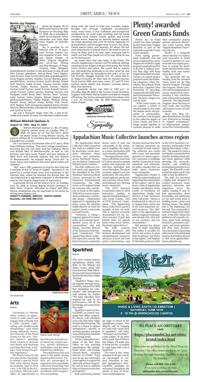
The Appalachian Music Collective (AMC) launched last week as a unified voice for musicians, venue operators, educators, music services, and presenters across Northeast Tennessee, Southwest Virginia and Western North Carolina.
The AMC addresses critical needs and opportunities identified in the 2024 Northeast Tennessee Music Census sponsored by the Tennessee Entertainment Commission. The AMC serves as the regional home for everyone who contributes to music in the region. With 59% of census respondents preferring a community-based, collaborative approach to organizing the music scene, the initiative builds directly on what the region's music community has said it needs.
"Tennessee is taking a regional approach to music policy and economic development across all of our communities," said Bob Raines, executive director of the Tennessee Entertainment Commission. "The Appalachian Music Collective represents exactly this kind of focused, community driven work. It puts the community at the center, and it amplifies the region as a music destination with real economic potential."
The regional music workforce contributes more than $75.9M in annual economic output and represents 503 full-time equivalent jobs across the region. The music economy supports not just performers, but educators, sound engineers, producers, and everyone whose livelihood depends on a thriving music community
"The ETSU Research Corporation exists to drive innovation leading to regional and global impact," said David Golden, CEO of ETSU Research Corporation. "The Appalachian Music Collective is a perfect example of how we work. This is regional economic development for the creative economy. It puts data behind what we already know: when music thrives, the whole region thrives."
The AMC connects working musicians with business development and entrepreneurial resources, advocacy in local and state policy conversations, and the peer network that 86% of regional musicians say is essential to their careers. The collective also works with venue and presenter operators to reduce regulatory confusion (a challenge cited by 42 percent of venue operators) and advocates for policy changes that can make music businesses more sustainable.
"Appalachian Studies is rooted in understanding and supporting the communities of this region," said Dr. Ron Roach, chair of Appalachian Studies and director of the Center of Excellence for Appalachian Studies and Services at East Tennessee State University. "Music is fundamental to who we are as Appalachians and is one of our most important cultural resources. The AMC gives us the opportunity to address regional challenges and develop this vital part of our economy and our communities.”
"My passion has always been to build something that makes it possible for artists and venues to grow their businesses and thrive in this region," said Stephen W. Marshall, professor, CMO of the ETSU Research Corporation, and founder of the Appalachian Music Collective. "We wanted to create a sustainable community that benefits working musicians and venue operators while elevating the economic, tourism, and workforce development potential of our region. The data tells us this is what the region needs. The AMC is how we deliver it."
The AMC has launched a digital hub designed to connect musicians, venue operators, educators, and supporters across the region, making it easy to find opportunities, share knowledge, and collaborate on the real-world work of building music careers and thriving venues. The digital hub is the beginning, not the end. The community is invited to shape what comes next. As the AMC refines the platform and expands services, input from working musicians, presenters, educators, and venue operators will drive every decision. The community is launching with several virtual listening sessions that kicked off June 8. Visit www.appalachianmusiccollective.org