

Chilhowie's Garrett Dickison (7) and Luke Mullinax (12) celebrate after a touchdown against Rural Retreat on Oct. 16, 2025.
Chilhowie's Garrett Dickison (7) and Luke Mullinax (12) celebrate after a touchdown against Rural Retreat on Oct. 16, 2025.
Chilhowie's Garrett Dickison (7) and Luke Mullinax (12) celebrate after a touchdown against Rural Retreat on Oct. 16, 2025.
Chilhowie's Garrett Dickison (7) and Luke Mullinax (12) celebrate after a touchdown against Rural Retreat on Oct. 16, 2025.
Joshua Widener sits with attorneys Barry Proctor and Herbert Clay at the defense table during his 1998 trial.
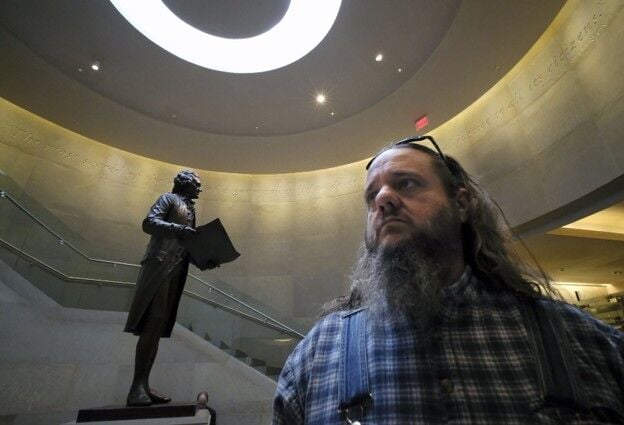
Scott Campbell, of Bristol, has been a regular visitor to the Virginia State Capitol in Richmond, addressing legislators and advocating for the rights of crime victims and their families. This photo was taken in 2020.
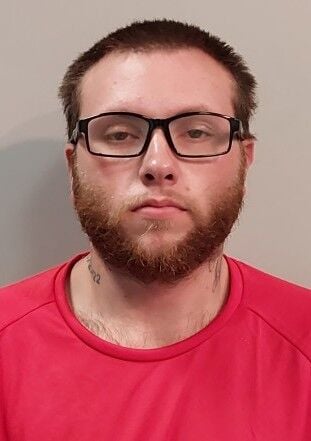
Joshua David Widener in 2020.
Scott Campbell inside the Virginia State Capitol in Richmond on Feb. 27, 2020.
Widener's co-defendant, Harold Davis, testifies against him at Widener's 1998 trial.
Editor's note: Please be advised that this article contains sensitive material regarding a rape and murder.
In just over a week, the anniversary of a horrific loss of a life in this community will come. The day is one many would prefer to forget, but for some that is impossible as ramifications of the crimes -- the rape and murder of a beloved fifth-grade teacher, volunteer, church member, and golfer in her Marion home -- continue to unfold and spread these 30 years later.
“On September 4, 1996, 68-year-old retired schoolteacher Anna Jean Smith Anderson was robbed, raped, and strangled to death in her Marion home.”
So begins a June letter from Smyth County Commonwealth’s Attorney Phillip “Bucky” Blevins to the Virginia Parole Board’s chairman. Blevins goes on “to voice my strongest objection” to the possible parole of one of Jean Anderson’s murderers.
Joshua David Widener, then 17 years old and one of Anderson’s former fifth graders, was arrested within days of the murder.
On Sept. 3, 1998, Circuit Court Judge Charles Smith sentenced him to three life sentences for the crimes.
Later this week, Anderson’s nephew, Scott Campbell, and Blevins will oppose Widener’s release from prison before the state’s Parole Board.
Under a law that went into effect July 1, should Widener be denied parole this year, they may have to fight his release every year.
The law approved by this year’s General Assembly and signed by Gov. Abigail Spanberger also requires the Parole Board to evaluate juvenile offenders sentenced to life and who were younger than 18 at the time of their crimes “using criteria that reflect their demonstrated maturity, rehabilitation, and reduced culpability due to youth.”
Parole Board material says it has “developed tailored interview questions highlighting factors that will be given substantial weight in parole decisions, such as maturity, insight, conduct, and rehabilitative work, as well as factors that will be given substantial mitigating weight in parole decisions.”
The law also requires the board, if it denies parole, to give the offender recommended actions “to demonstrate commitment to rehabilitation and at the next hearing, the Board is required to consider whether the prisoner has followed such recommendations.”
To Blevins the harshest aspect of the law is the requirement to annually review the cases of juvenile offenders who are eligible for parole. “That means Ms. Anderson's family will be forced to relive her horrific murder while Joshua Widener seeks an opportunity for release every year,” he said.
This law built upon one that took effect on July 1, 2020, which granted parole eligibility to offenders convicted of crimes that were committed while they were minors after they have served at least 20 years of their sentence.
In his letter, Blevins confronted the Parole Board chair with blunt words that conveyed the nature of Widener’s action
He wrote, “The horrifying photographs of the crime scene cannot fully capture the terror, pain, and suffering Ms. Anderson undoubtedly endured in her final moments…. Most disturbingly, Widener is reported to have later bragged that he achieved the “best [climax] of his life” at the same moment Ms. Anderson drew her last breath.”
Blevins did note that 23-year-old Harold Davis also took part in the murder.
Davis pleaded guilty to capital murder, robbery and burglary in 1997 to avoid the death penalty. He also received three life sentences in prison. Because Davis was an adult when the crime was committed, he is not eligible for parole. Virginia abolished parole in 1995.
After these three decades, Blevins said, “…The facts of this case continue to haunt our community. This was not an impulsive act of youthful misjudgment. It was violent, calculated, and brutal. For 30 years, these heinous crimes continue to pain Ms. Anderson’s loved ones. The passage of time has not diminished the severity of Wideners’ conduct, nor has it lessened the Commonwealth’s obligation to speak for the victim, her family, and the safety of our community.”
Blevins continued, “Releasing Widener would substantially undermine public confidence in the criminal justice system. It would send a message that even the most violent and calculated crimes can be excused in just 30 short years.”
“The sentence imposed in this case should be untouched. It reflected the gravity of Widener’s crimes. Granting parole to Joshua Widener would be offensive to the life of Ms. Anderson, to her family, and to this entire community.”
Blevins concluded, “Widener showed no mercy to Ms. Anderson when her life was in his hands. I am asking that you, likewise, show him no mercy.”
Separately, Blevins told the News & Messenger, “I believe Josh Widener remains a real threat to all Virginians, especially elderly women, if he is ever released. His own words reveal his depravity…. That is sadistic, predatory violence he will undoubtedly seek to satisfy again if ever given the chance.”
In 2020, when Widener was also seeking parole, then-Smyth County Commonwealth’s Attorney Roy Evans, who prosecuted Widener and his co-defendant Harold Davis, said a release for Widener would mean that the justice system has completely failed both victims and their communities.
“The facts of this case were horrific,” Evans said. “An innocent elderly woman, a retired teacher living alone, feeling safe in her home in our small town was raped and killed by these monsters. No amount of time in prison is enough to ever make it right for either of them to walk free in our community or anyone else’s.”
Scott Campbell, who has long served as the family’s spokesman before the state legislature and the Parole Board, couldn’t agree more with Blevins and Evans.
“It was my understanding that it was the judge’s intention that he’d leave jail in a pine box,” Campbell said of Widener in a 2020 interview with the Richmond Times-Dispatch.
For decades, the Bristol man has lobbied legislators to not implement laws such as the one that may now take him to Richmond more often. He has frequently testified to General Assembly committee members about the impact of the laws they’re proposing.
Still, Campbell believes that his voice is limited against the budgets of big law firms and paid lobbyists, who contribute to legislators’ campaigns.
Noting all the material he provides the legislators, he doesn’t understand why they don’t oppose the legislation in its early stages. “It would be an easy argument to make,” he said Monday.
Campbell’s also testified to the Parole Board numerous times and vows to continue as long as he can.
Campbell speaks of his files upon files about the case – about the political process, the criminal justice system, and so much more. He shares documents that detail multiple aspects of the case, including one that projects the monetary cost of implementing this law.
Yet, the true cost of the fight to keep Widener behind bars can’t just be measured in the time and money that’s been required.
“I’ve lost everything,” Campbell said in one recent conversation, reflecting on his health and acknowledging that he and his wife divorced several years ago.
For years, he took on the fight to protect his mother, who has since died, but at the time of Jean Anderson’s death was one of her surviving siblings.
It was Jean’s family that first knew something was wrong and alerted her neighbors on that tragic day.
The day before police found her body, Anderson had lunch at the country club with friends because rain stopped their golf round. Her lunch partners remembered that she planned to bake a cobbler to deliver to a sick friend. The friend called her about 8 p.m. to say thanks.
Campbell recounted that Jean was to meet a relative in Russell County the next day but never arrived.
Two neighbors found the kitchen door of her Culbert Drive home unlocked at about 10:30 p.m., her telephone was dead, and items in her home were out of place. They called police, who found her body in the home.
Jean Anderson was just days from her 69th birthday. She was born on Sept. 10, 1927.
While considerable attention is focused on keeping one of her murderers in prison, Blevins believes “Ms. Anderson's memory should remain bright.”
With a degree from then-Radford College, Anderson taught fifth grade in Smyth County for 32 years. She retired in 1990.
By all accounts, retirement didn’t slow her down. She continued to volunteer in schools and served as an auxiliary volunteer at Smyth County Community Hospital.
She loved golf and regularly played the Holston Hills course.
Anderson was also a woman of faith, a member and Sunday school teacher at First United Methodist Church.
Campbell remembers going to church with her and reflected that she may have spent more time volunteering at SCCH than at home many days.
In her 68 years, Anna Jean Anderson served students, neighbors, her community, and her God. Though more quietly, the ramifications of her service continue to spread.

The officials tasked with developing and now updating proposed zoning regulations for data centers are sending a revised ordinance to the county’s Planning Commission Thursday night. All the revisions would more tightly regulate any data center that might want to locate in Smyth County.
The Joint Ordinance Committee is made up of three members each of the Planning Commission and the Board of Supervisors. Over the last several weeks, they’ve met with county staff to review the proposed regulations, using information gathered from a public hearing in June and trips to Mecklenburg County and Loudoun County to see data centers in those locations and their impacts.
During last Thursday’s committee meeting, Supervisor Mike Sturgill reminded those gathered that when the ordinance is put in place it will be “a living document” that can be updated as issues come up.
Sturgill noted that the world of AI and data centers use ever-changing technology.
Of his goals for this endeavor, Sturgill said, “I want to protect the citizens of Smyth County,” while also protecting the community’s beauty and addressing the need for additional revenue.
County Administrator Shawn Utt said the work needs to protect the county’s citizens of today and those of the future.
Digging into the specifics of the ordinance, Commissioner Tony Dean suggested the group might want to recommend that the regulations require a closed-loop water system to ensure local water systems are protected.
However, Sturgill said they shouldn’t exclude better technology advances by requiring a specific system. He noted that data centers of today don’t look like those built 20 years ago.
Assistant County Administrator Clegg Williams said that better technology is already available and agreed that it shouldn’t be excluded.
For data centers with closed loop water systems, officials talked about possible spills of the contaminated wastewater.
Williams noted that closed loop systems do save water but also use contaminants. If such wastewater exists, he said it needs to be handled by a treatment plant.
To protect farms and natural resources, the group agreed to recommend a requirement that if a data center wants to locate in an agricultural district or an agricultural/residential district, it must be located within one mile of a high-voltage transmission line or electrical substation.
The group also agreed to recommend increasing the required setback from 60’ to 200’ for a data center building’s up to 65’ in height. For those that exceed 65’, the setback will increase by one foot for every foot in additional height.
They also agreed to recommend that accessory rooftop equipment be excluded from the height as long as they’re not taller than 30’ and are set back from the roof’s edge by 50’.
In another point, the group agreed to recommend that the actual data center building not cover more than 25% of its lot.
While the regulations did require a total decommissioning of any data center that reached the end of its life, Williams noted that the building could be of use. With that in mind, the committee recommended changing that regulation to allow the Zoning Administrator to determine what assets may remain after decommissioning.
Work continues on a more complete definition of “data center”. Williams said he plans to ask the county attorney to review it, but he expected it to be available for this week’s commission meeting.
The motion to forward these updates to the Planning Commission for review was seconded by Lea Meadows and passed by a 3-2-1 vote. Supervisors’ Chair Charlie Atkins and Commissioner Graham Davidson Jr. opposed the action.
The Planning Commission will meet at 6 p.m. in the county office building.
Matthew Allen Shupe
A string of metal theft cases has struck Smyth County.
According to the Sheriff’s Office, at least three churches, two governmental agencies, and a restaurant in Smyth County were the victims of a thief taking parts from outdoor air conditioning units. Their losses are expected to exceed $55,000.
Sunday evening, the SCSO said the reports of these crimes have come in over the past couple weeks and ranged from Atkins to Chilhowie.
So far, the SCSO said the following victims have been identified: Atkins First Church of God, Mount Rogers IDC, Freedom Tabernacle, Evergreen Soil and Water, Chilhowie Pentecostal Church, and Casey’s Diner.
On Saturday, the SCSO said that after conducting investigation into one of the incidents, deputies identified a suspect, Matthew Allen Shupe, 21, of Glade Spring.
Upon further investigation, deputies found several stolen items in the car Shupe was driving and he confessed to the thefts.
Shupe is now facing six counts of felony grand larceny and was being held without bond at the Southwest Virginia Regional Jail in Abingdon, pending an arraignment in the Smyth County General District Court. His arraignment was set for Tuesday afternoon.
The Sheriff’s Office is urging “everyone to please report criminal activity to us as soon as possible to potentially prevent further incidents.”
On Saturday, following the theft at Casey’s Diner, the owner shared their frustration on Facebook, saying, in part, “I’m tired of working my tail off to build something for my family, only for someone else to think they have the right to come onto our property and take or destroy what we have worked for. This is now the second time one of our properties has been vandalized. We’ve already dealt with windows being busted out of a rental property, and now this.”
The post continued, “The part that hurts the most is that I was finally getting excited about putting work into this place again and seeing what the future might hold for it. Now we’re facing another expense and another setback because someone decided to take something that did not belong to them.”
This incident comes right after a theft of wiring and tools valued at $41,000 from an Abingdon industry. The suspect took wiring to Berry’s in Chilhowie, where staff recognized that it might be stolen and let law enforcement know. An arrest was made last week in that case.
Berry’s urged people to visit StopMetalTheft.org to learn more about preventing and reporting metal theft. The website is a resource provided by the Recycled Materials Association, the trade association for the recycled materials industry.