
Smyth County residents must be stewards of community in data center debate
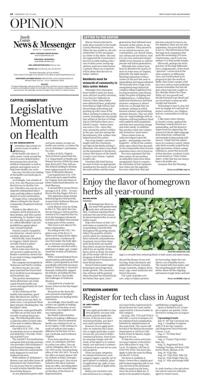
Sherree Tannen planned to make these remarks to the Smyth County Planning Commission. When she was unable to, she submitted them to this newspaper as a letter to the editor. She said she supported the Commission’s decision to table making a decision on data center zoning regulations until more information is gained. Please see a separate article about that decision in today’s edition.
Although I have been gone from Smyth County for many years and just recently returned, I was born in Chilhowie in Greever Clinic when babies were delivered there, graduated from Marion High School, had the privilege of knowing and growing up with some of the oldest and finest residents of the county, including my own family that settled at the foot of White Top in 1748 before there was a Smyth County--before there was even a USA—since they were among the earliest settlers in the area, and also among the Revolutionary War soldiers who helped found this nation.
One of my family’s ancestors fought with the Overmountain Men in the Battle of King’s Mountain. His name is inscribed on the monument to the Revolutionary War heroes at the Smyth County Court House: Captain Joseph Cole.
I mention this brief history because it forms an appropriate backdrop for the matter at hand: the early settlers and the many generations that followed were stewards of this nation, in one way or another. They passed to us our natural resources, our communities, our shared values, our culture and our history. And it is our civic and moral responsibility to be stewards as well for present and future generations.
Although data centers have been in operation for nearly 20 years in some areas of Virginia, primarily, the rapid and proliferating expansion of these centers in the past few years is unparalleled and unprecedented. We basically have a large scale, unregulated mega industrial complex riding roughshod over local governments and citizens under the guise of helping and enlightening us. Calling these industrial warehouses and their environs campuses is almost ludicrous, as though they are academic settings in which learned scholars and promising students flourish. They are what they are: large buildings with no windows and long hallways lined with sophisticated equipment; and they have enormous energy and water needs. In addition, they produce what one community termed an “eerie noise”.
These centers have an unknown impact upon the quality—and perhaps even the longevity—of life in the communities upon which they descend. So the communities that do have experience have a lot to teach us.
For every argument that the data centers do not produce an unhealthy noise even when unregulated, there is a reputable refutation of that argument that states just the opposite; for every claim that vital and precious natural resources are not depleted, there are not only arguments, but proof that this is not so. The bottom line is that the large tech companies that push this technology DO have a bottom line, and it is not our welfare: it is their profit margin.
Microsoft, perhaps the most gracious of the large billionaire class conglomerates, if the word “gracious” can be used in the same sentence as billionaire class, just backtracked on its proposal to give the world an idyllic data center campus with nice trees and no water pollution (anyone remember the bad old days when Lake Erie caught on fire, literally, before the Clean Water Act was passed) and decided instead to go ahead and use fossil fuels to keep up with Google and Amazon.
Technology is here to stay, but how we engage in it and how we protect ourselves, our children, and our communities is still up to us.
I, like many other citizens in Smyth County, applaud the Planning Commission for recommending, and the Board of Supervisors for approving, the removal of the by right language from industrial, commercial, and manufacturing zoning ordinances. I think that the experiences in Loudoun County, which only fairly recently ended the by right provisions of their zoning ordinances, prove the necessity of that decision. Loudoun Couty is now known as “Data Center Alley”, a title that has not always been a desirable one.
I propose that the Planning Commission table the proposed text amendment from the June 25th public hearing until more information can be gathered and deliberations take place concerning, among other issues, setback requirements of only 60 feet, the lack of mention of closed loop water cooling systems, and the inclusion of agricultural and ag/rural districts for consideration of special permit use for data centers.
I’ll close with some comments by the administrator of Mecklenburg County as reported by the local news in that county in December 2024.
Mr. [Alex] Gottchalk, reflecting upon Mecklenburg County’s experience with data centers as he advised officials in Pittsylvania County, said the following, and I quote, “It is better to locate them in a pre-identified industrial area, rather than building them in the middle of rural farmland, where you would need to invest in a tremendous amount of utilities to support that site”. He then goes on to say that secondary roads would not support the truck traffic that goes into the site.
That is advice from someone who is a seasoned veteran concerning the ins and outs, and pros and cons of introducing data centers into a community, and we would do well to heed it. It is our responsibility to heed it. Forewarned is forearmed. Big Tech does not own Smyth County. We, the people, do!
Sherree Tannen
Marion, Va,