
Working from home certainly has its perks, but it can also lead to unhealthy habits like excessive snacking. Here are ten simple and healthy snacks to enjoy throughout your work day.
People are also reading…

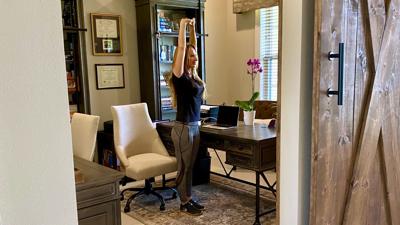
Create a habit of getting out of your chair every hour for a few minutes of movement. Stretches relieve stiffness and mitigate the negative health impacts caused by sitting all day long.
For some, work from home is not going away. Here's how to make the most of your space.
Common pains

Neck ache, back pain, sore shoulders _ it's not just you. University of Chicago physical therapist Zachary Stapleton said these are the most common complaints he receives from people who work desk jobs.
Think for the long haul

"Desk jobs" these days may be more aptly called "couch jobs" or "kitchen table jobs" for some, but as more companies move to make work-from-home a more permanent measure, it might be time to reevaluate your workspace for the long term.
A good workspace

"I encourage people to establish environments that lead them to be as efficient as possible," said Stapleton, who is also board-certified in orthopedics. Whatever your setup, he said it's important that you have your feet on the floor and elbows at a 90-degree angle. The top of your computer monitor should be even with your brow and angled upward to take some tension off of your neck, he said.
Make the most of your space.

"If you're able to do these main things, the rest will fall into place," Stapleton said.
'Neutral posture'

Occupational therapist Nikki Weiner calls this "neutral posture," where your ears should be in line with your shoulders, which should be over your hips, which should be slightly higher than your knees. Your neck should also be neutral - not looking up, down or to the side.
Make the most of your space

In her evaluations, Weiner said she looks at how a person interacts with their work environment. Her approach is personal and focused on an individual's neutral posture. She doesn't recommend specific types of "ergonomic" tools for this reason. She said tools or furniture labeled "ergonomic" are misleading because a "one size fits all relationship" doesn't exist.
Good furniture

But good furniture can be beneficial: "Having the right setup allows you to work in a neutral posture," she said.
A crucial upgrade

A quick and crucial upgrade Weiner recommends for people who work from laptops is a laptop stand paired with an external keyboard and mouse. "If you don't use an external mouse and keyboard and then raise up your screen to an appropriate eye level, you won't be able to work in neutral posture," she said.
Make the most of your space

It's also easy to overlook aspects of ergonomic workspaces because they don't necessarily involve a piece of furniture, Weiner said.
Good lighting

Lighting is particularly important. "Good lighting doesn't necessarily mean strong lighting," she said. A balance of natural, overhead and task lighting should minimize eye strain _ which can also be caused by staring at screens all day, Weiner said. She said if seeing in perfect color isn't important for your work, you can turn on your monitor's blue light filter, which warms the display to be kinder on your eyes.
20/20/20

The 20/20/20 rule can also help. Every 20 minutes, look at something 20 feet away for twenty seconds. This alleviates strain from continuously staring at a screen.
Noise

Random sounds and distractions can affect your productivity, Weiner said, so working in a space where there is less likely to be unpredictable noise may help. She said continuous sound, like a fan or white noise, can improve your attention. Temperature can also impact your work. "If you're working within a thermal zone that's uncomfortable, you have less productivity and make more errors," she said.
Good distractions

While distractions may take your mind off work, they can also be positive. Putting an object on or around your workspace that brings you joy or reminds you of a pleasant memory can help you refocus, Weiner said.
Get moving

You workspace setup and neutral posture will only do so much for you, Stapleton said, because you can't be in any one position for too long: "When I work with people who have a desk job and I feel as though their environment is contributing to the persistence of pain, one of the first things I'll do is look at their routine outside of the office."
Stretch

Stapleton said we need "positional variation," which can be achieved by getting up and walking around throughout the day. He said stretching and strengthening routines, as well as cardio, will give your body the movement and variation it needs. (Dreamstime/TNS)
Move around

He said his recommendation of positional variation means you should feel free to move to other workspaces throughout the day. "By all means, work from the couch," he said. "As long as it feels good, then it's totally fine.
Make the most of your space

Weiner said she used to recommend having a single workspace, but that's not feasible for a lot of people who are sharing desk space with children doing remote schoolwork or other adults working in the home. She said that by keeping neutral postures and ergonomics in mind, you can make almost any space more comfortable to work in.
Be realistic

"We need to kind of be easy on ourselves during this pandemic and be flexible in our workspaces," she said. "I think that's the most realistic way to do this in this new age of working from home."