
Va. budget leaders look for $1.6 billion from data centers (copy) (copy)
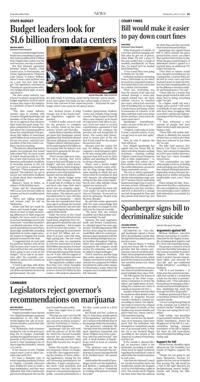
General Assembly budget leaders finally have something to agree on: they want an additional $1.6 billion from Virginia data centers over the next two years, one way or another.
But that informal agreement between Senate Finance Chair Louise Lucas, D-Portsmouth, and House Appropriations Chairman Luke Torian, D-Prince William, doesn't mean a deal anytime soon on a new two-year state budget. The legislature convened on Thursday in a special session without a budget deal in sight, or much said about it.
The data center industry says it hasn't received a proposal from budget negotiators on how much revenue they expect the industry to contribute or how it would be raised.
“The data center industry remains open to working with Governor (Abigail) Spanberger and members of the House and Senate on an approach that advances their respective goals, keeps Virginia competitive for investment, and allows the Commonwealth to honor the commitments that produced $80 billion of investment and $5 billion in tax revenue in just the last two years," said Josh Levi, president of the Data Center Coalition, based in Leesburg.
"The industry offered legislative leaders two proposals that would help achieve this, the most recent of which would provide $1.1 billion of new state revenue over the biennium and hundreds of millions in recurring revenue in the out year," Levi said in a statement on Thursday. "These proposals were rejected. The industry has yet to receive any substantive feedback or details about what a resolution might include.”
Monroe's home in limbo, as nation's 250th birthday nears
Torian said his conversations with Lucas have focused solely on revenue, not how it would be raised or spent.
"We're just talking revenue and revenue only," he said on Wednesday.
Torian said that he's ready for House and Senate budget negotiators to meet to begin reconciling differences in their proposed budgets, but Lucas wants to wait to see how Spanberger reacts to the Democratic-controlled assembly's coordinated rejection of her proposed amendments to more than a dozen high-profile bills, including legislation to create a legal cannabis market in Virginia that would generate revenue for the state.
"I suggested that we wait until the governor finishes with all the bills because I don't want to come back and have her veto something that's going to put a hole in the budget," Lucas said in an interview after the assembly completed its annual veto session on Wednesday.
"I want to get done with all her stuff, and then we'll start working out all the mechanisms for how we get that money," she said.
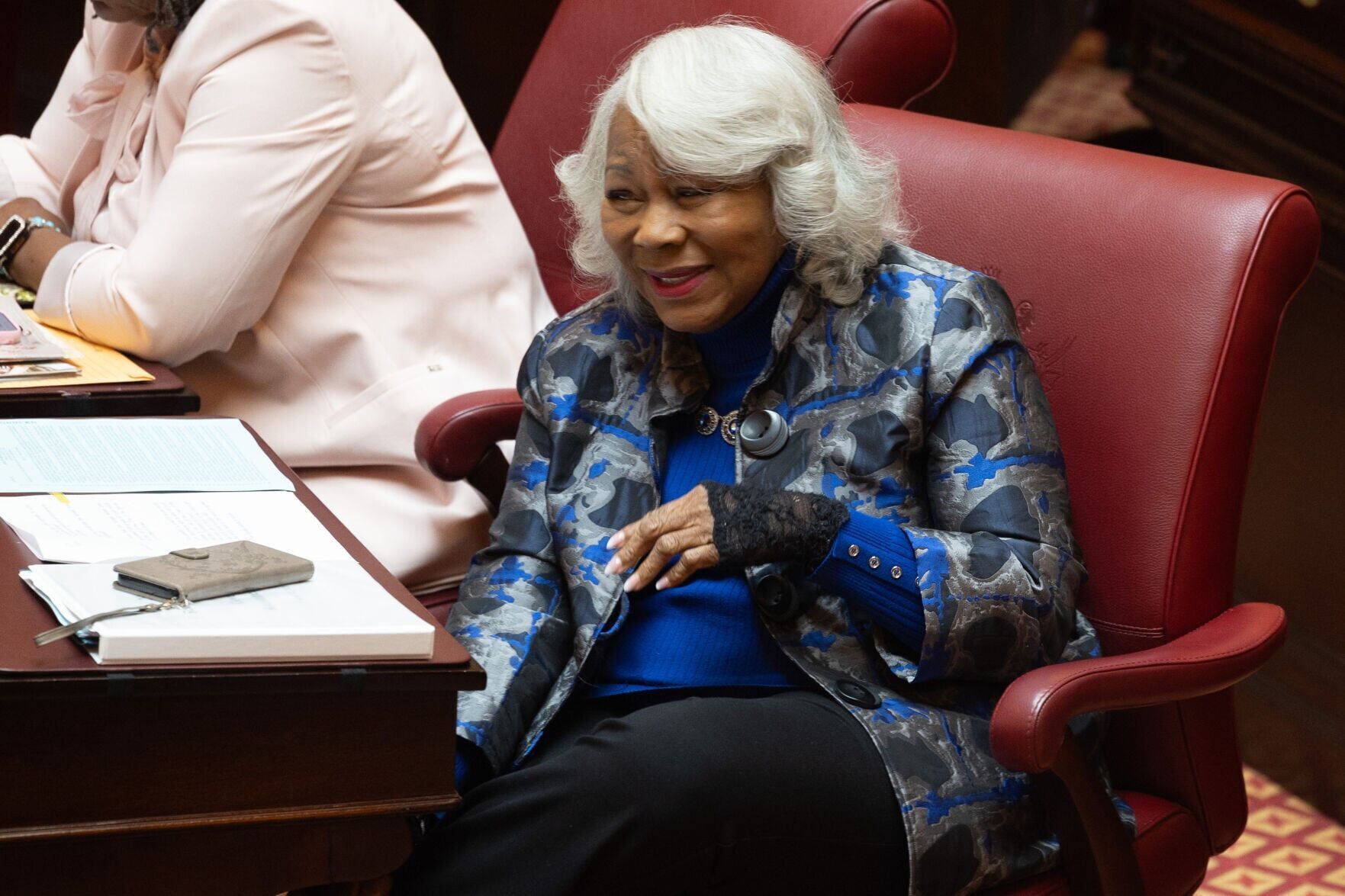
Senate Finance Chair Louise Lucas, D-Portsmouth, champions doing away with a longstanding, $1.9 billion a year tax exemption for data centers in the next two-year state budget.
Sen. Richard Stuart, R-King George, one of the Senate budget negotiators, supports her position.
"I think it makes sense to wait for the governor to complete her actions, based on her prior actions," Stuart said Thursday.
Senate Finance members already are upset that Spanberger vetoed legislation that would have allowed electronic skill games to operate in Virginia without offering proposals for replacing the $256 million in tax revenue that the industry was expected to generate for the proposed House budget.
"That's money right now, taxes, that we're missing, that we're trying to find and fill gaps in our budget," said Sen. Aaron Rouse, D-Virginia Beach, before forgoing a vote on Wednesday to override the governor's veto of his legislation to regulate and tax skill games.
But the Senate budget never relied on that revenue. Instead, it would take $1.9 billion in state and local sales taxes that aren't levied now on computer equipment and software purchased for data centers. The industry says it has relied on the 16-year-old sales and use tax exemption — which the state last expanded just three years ago in exchange for massive capital investments and new jobs — to make Virginia the data center capital of the world.
Under the terms of the Cloud Computing Cluster Infrastructure Grant Fund, adopted in 2023, Virginia agreed to extend the sales and use tax exemption — due to expire in 2035 for most data centers — to 2040 in exchange for investments of at least $35 billion and creation of at least 1,000 full-time, high-paying jobs. The law would extend the sales tax exemption to 2050 for investment of at least $100 billion and creation of at least 2,500 new jobs. The final version of the legislation passed the Senate on a 36-4 vote, with the support of Lucas and other senators who now want to repeal the exemption.
The legislation codified a deal that then-Gov. Glenn Youngkin made with Amazon Web Services to invest at least $35 billion in data centers, with projects planned in Caroline, Spotsylvania, Stafford, Louisa and, initially, King George counties. King George backed off after a new majority on its Board of Supervisors took office in January 2024 and voted to rescind a performance agreement it had reached with the company the previous fall and renegotiate its terms. The county later threatened to rezone part of the site that it had zoned for the project the previous year.
Amazon sued the county last year for failing to validate the company's vested property rights in the new zoning after purchasing more than 800 acres for $169 million and spending $6 million to advance the project.
Stuart, now a Senate budget negotiator, became county attorney for King George during the same meeting in which the new board voted to reconsider its deal with Amazon. He acknowledged voting for the data center legislation in 2023, after initially voting against one version of it.
"It was probably the worst vote I ever made," he said in an interview on Thursday. "It was just too much of a giveaway. We gave away the farm, literally."
He said data center agreements with the state acknowledge that they are subject to changes in state policy by the General Assembly.
"We know that one General Assembly can't bind another General Assembly," he said.
However, the Joint Legislative Audit and Review Commission, in a detailed report two years ago, warned, "Disallowing Amazon Web Services from using the extension would likely affect its custom performance grant agreement with the state to develop multiple data center facilities throughout Virginia, which was negotiated under the assumption the company would receive the extension, and could be subject to legal challenges."
STACK Americas, another large data center operator in Northern Virginia, now wants to use the same state law for a proposed $73 billion investment in a data center campus in Pittsylvania County, where the company says it would create 2,050 full-time jobs.
Without the tax exemption, the company says the project won't happen at the sprawling Berry Hill megasite near Danville.
"The tax exemption has been critical to the creation of the Virginia market and essential to the viability of STACK's proposed data center campus at Berry Hill," Kevin Hughes, chief external affairs officer at STACK, said recently. "If it were eliminated, we would expect the market to see a significant loss of proposed and active projects across the Commonwealth and eventually rising vacancies in operating facilities."
Local leaders in Southside and other rural areas have expressed alarm at the Senate proposal to repeal the tax exemption, which they are counting on to attract data center projects that have become unpopular in Northern Virginia and other heavily populated areas.
"Southside Virginia has waited a long time for an opportunity like this," Danville Mayor Alonzo Jones said in a letter to General Assembly budget negotiators last month. "We have done the work. We have built the site. We have cultivated the partnerships."
"All we ask is that the Commonwealth stand with us when it matters most," Jones said.
House budget leaders and Spanberger oppose the proposed repeal of the tax exemption because of its potential harm to the state's economy and business reputation. Sen. David Marsden, D-Fairfax, a former member of the finance committee, voted for the Senate budget but shares that concern.
"What I worry about the most is what message we're sending," Marsden said in an interview on Wednesday. "Are we sending a message that will undercut other economic development opportunities, like our business-ready sites?"
The Senate had little to say about the budget or data centers during a two-hour debate that opened the special session on Thursday, focusing instead on the redistricting referendum that Virginia voters approved on Tuesday.
Only Sen. Mark Peake, R-Lynchburg, and Sen. Lamont Bagby, D-Henrico — both former state chairmen of their respective parties — mentioned the budget, which is the reason for the special session.
Peake chided Democrats, who control both chambers and the governor's office, for failing to adopt a budget on time.
"We still don't have a budget," he said. "We don't know when we're coming back to talk about a budget, and that's the Democrats' responsibility."
Peake also warned, "You're trying to kill the goose that laid the golden egg, data centers, which have kept the tax rates low in many of your localities."
"We would like to have them down in my localities," he said. "We will take them."
Bagby responded, "I'll agree we need a budget, but we need a budget that's going to work for the people of Virginia."
"When we started this thing, no one ever thought that data centers would have to be forced to pay their fair share," he said.
"I want data centers here," he added. "I want more businesses in the commonwealth, but I want them to pay their fair share."
No budget deal this week, but negotiators report progress
Virginia Democrats spar with governor over money to pay looming bills
Michael Martz (804) 649-6964
Related

Virginia lawmakers debate redistricting during the budget special session