
Tagged and Sent Out: Citizen scientists at Hungry Mother release monarchs

This youngster shows delight as her monarch flies off.

Ellen Reynolds smiles and watches as a monarch lands on this little girl's head.
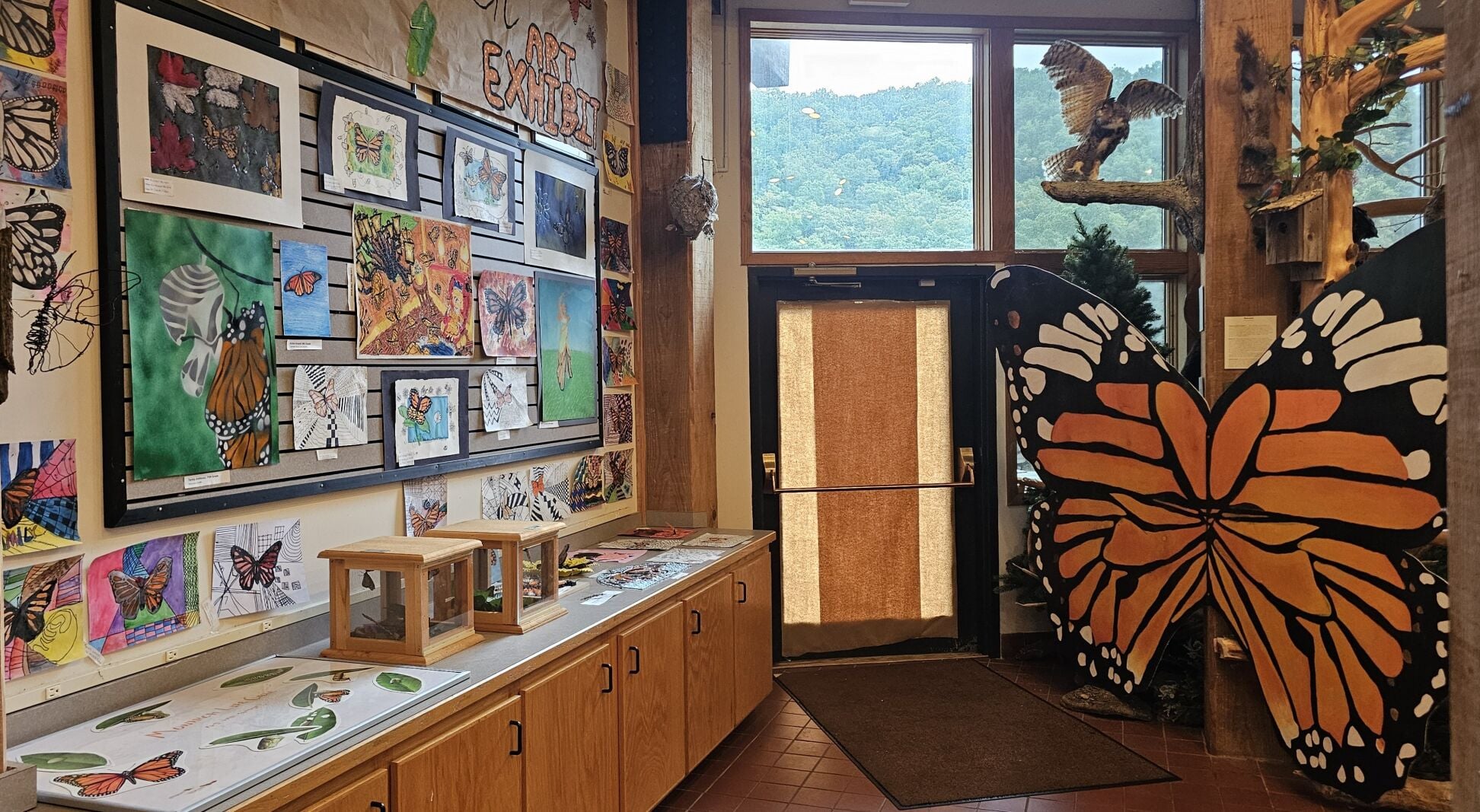
This exhibit in Hungry Mother State Park's Discovery Center features monarch artwork created by students at Marion Elementary School.
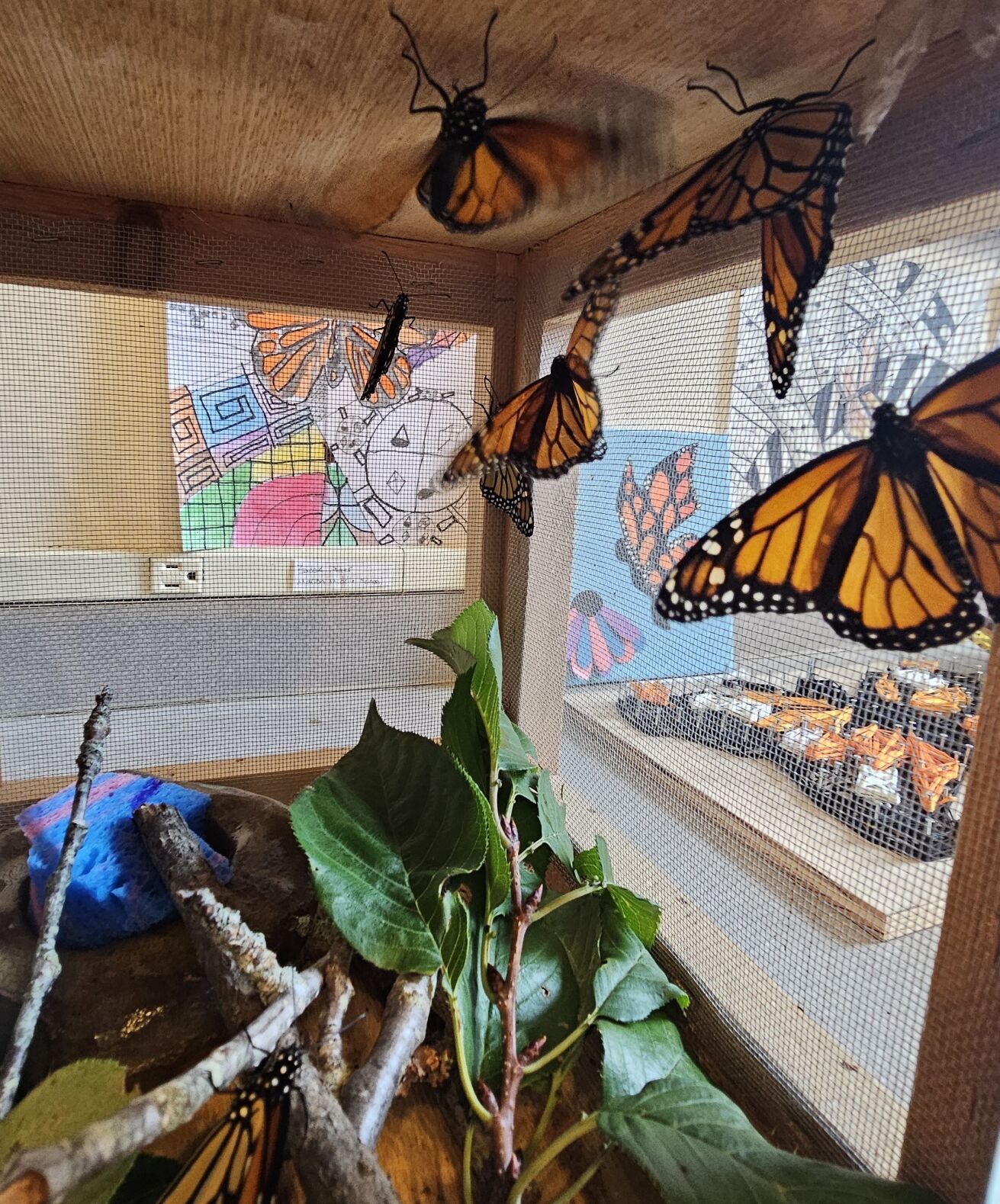
These monarchs were among those raised by Ellen Reynolds for the group at Hungry Mother to release. The morning was cool and the butterflies were slow to get moving.
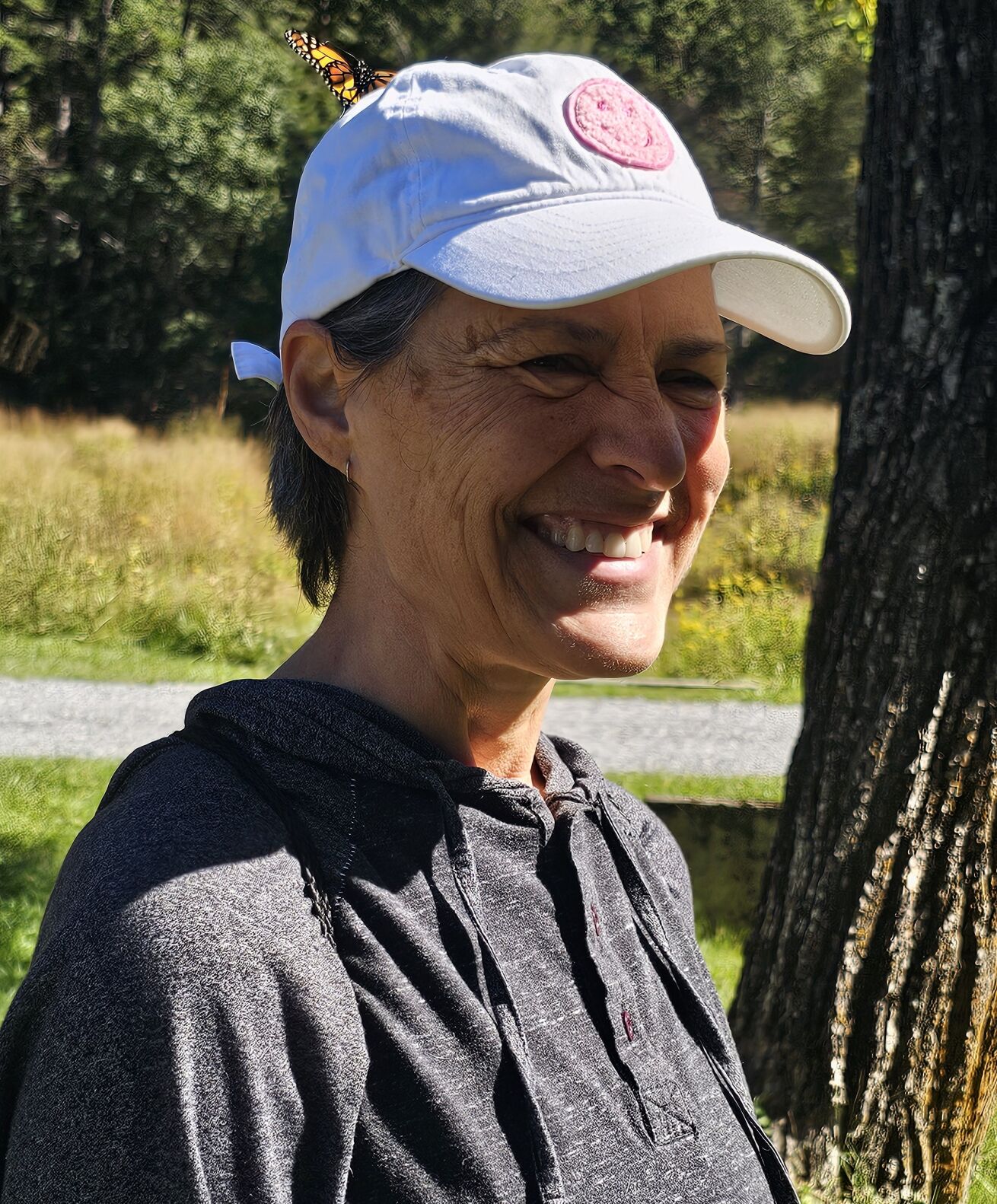
This woman enjoys her visit from a monarch.
Sixty to 65 people gathered at Hungry Mother State Park late last month to tag and release Monarch butterflies. Many of them had never touched a butterfly until that morning.
Ellen Reynolds, who co-owns Beagle Ridge in neighboring Wythe County, taught the participants to hold them between two fingers, but no thumbs, which will press too hard and will injure the fragile creature.
Reynolds, a longtime advocate for and educator about the natural world, guided the participants in their day’s work as citizen scientists.
She taught the audience about the life cycle of butterflies, also known as flying flowers.
Reynolds emphasized that monarchs truly undergo an amazing transformation, noting that if you cut into a chrysalis at a certain stage, the future butterfly is liquid – a green slime. That slime becomes the beloved winged orange and black monarch, a true metamorphosis.
Some of the younger participants had just studied the butterfly growth cycle at Marion Elementary School and shared it with the group.
Among those younger participants were Festus and Anthony Tuggle, who are in kindergarten at MES, and second-grader Annistyn Tuggle. Their grandmother Rachel Rogers brought them to the free program. It wasn’t just the youngsters getting new information. Rogers said, “I learned a ton of stuff.”
Tanya Hall, Hungry Mother’s Chief Ranger for Visitor Experience, said the park has hosted similar events with Reynolds in the past. Yet, she said, “I pick up something new every time.”
While everyone learns, Hall said, “It’s a fun experience” and one that connects participants to nature and to the park.
“Seeing a butterfly take off from your hand…,” Hall mused, knowing that “you did a little something to help.”
Reynolds raised the 52 monarchs that were released at Hungry Mother, joining millions of other monarchs – all that live east of the Rockies -- making their journey to Mexico for the winter.
Before they were released each monarch was tagged.
Reynolds and Beagle Ridge, which is home to a butterfly house, take part in the University of Kansas’ Monarch Watch program, which “is a large-scale community science project that was initiated in 1992 to help understand the dynamics of the monarch's spectacular fall migration through mark and recapture.”
Each tag featured an identifying number. If the tag is found, individuals can later look up their butterfly and see where it was located – often in Mexico or Texas.
Individuals who tag monarchs record the tag code, the release date, sex of the butterfly, geographic location and wing width and then release them.
Reynolds taught the participants to distinguish between male and female monarchs. Hall thought that was cool as was seeing the butterflies’ scales.
U.S. Fish & Wildlife reports that “according to the most recent monarch Species Status Assessment, by 2080 the probability of extinction for eastern monarchs ranges from 56% to 74% and the probability of extinction for western monarchs is greater than 95%. Threats to the species include the loss and degradation of breeding, migratory and overwintering habitat, exposure to insecticides and the effects of climate change.”
The agency has proposed that the monarch be listed as threatened under the Endangered Species Act, but that process takes time.
To help monarchs next year and beyond, Park Rangers took participants into the park to collect milkweed seeds to plant next year. Milkweed serves as the only host plant for monarch eggs and the only food source for monarch caterpillars.
At this time of year in this area, she said that the bright yellow Golden Rod is the most common source of nectar for monarchs.
If a gardener wants to see more monarchs, Ellen said that the right plants are necessary.
She pointed out that one monarch can lay 400 eggs. Each caterpillar needs its own milkweed plant. Currently, there’s not nearly enough milkweed to sustain that many caterpillars.
Monarchs, she noted, are a high-maintenance butterfly. They are the only butterfly species that can contract one of several diseases.
Less than 10% of monarchs make it in the wild, Reynold said. She noted that they face many predators along with potential harm from bad weather.
Rogers was delighted to see so many people from different places and of different ages – from children to an elderly man. “It was a great morning,” she said.
Rogers also praised the rangers, who she described as so engaged.
Individuals who want to learn more about Monarch Watch may visit https://www.monarchwatch.org/.
Learn more about Beagle Ridge, which is celebrating its 25th anniversary this year, at https://beagleridge.org/.