
Attorney General: Smyth's fentanyl awareness program could be model for Virginia

Virginia Attorney General Jason Miyares, Sheriff Chip Shuler and Marion Senior High Principal Mike Davidson listen as Ezrah Pennington, MSHS SCA president, tells how the community’s Fentanyl Awareness program helped her.

Attorney General Jason Miyares listens as Chilhowie High School SCA President Kenna Russell describes the impact of the Fentanyl Awareness program.

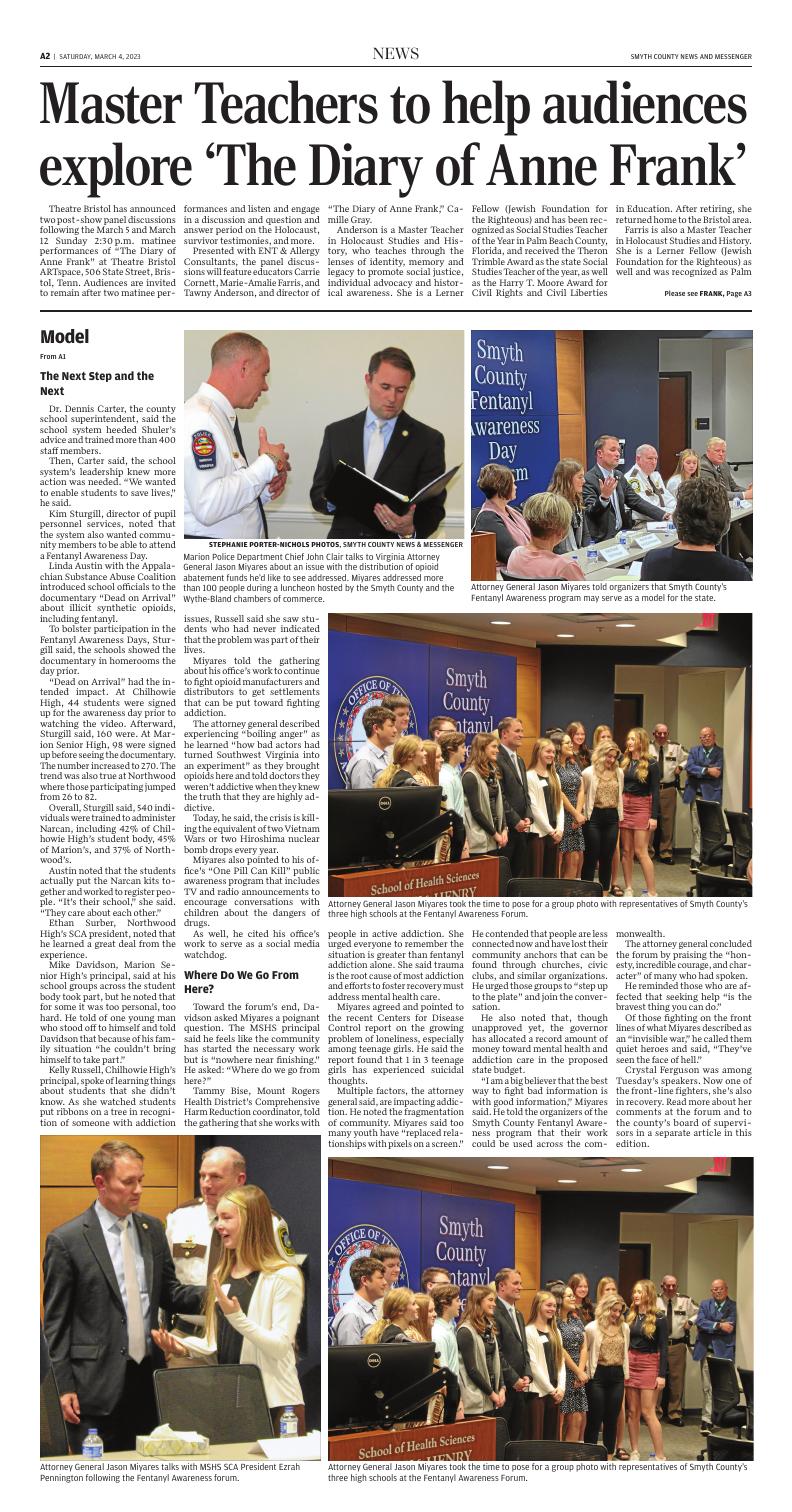
Attorney General Jason Miyares told organizers that Smyth County’s Fentanyl Awareness program may serve as a model for the state.

Marion Police Department Chief John Clair talks to Virginia Attorney General Jason Miyares about an issue with the distribution of opioid abatement funds he’d like to see addressed. Miyares addressed more than 100 people during a luncheon hosted by the Smyth County and the Wythe-Bland chambers of commerce.

Attorney General Jason Miyares talks with MSHS SCA President Ezrah Pennington following the Fentanyl Awareness forum.

Attorney General Jason Miyares took the time to pose for a group photo with representatives of Smyth County’s three high schools at the Fentanyl Awareness Forum.
Tears added a quaver to Ezrah Pennington’s voice and a poignancy to her words as the Marion Senior High School SCA president told Virginia’s attorney general and an auditorium full of listeners about the spread of addiction in her family and the toll it takes on those who love them.
Pennington also told Attorney General Jason Miyares that seeing her school come together in programs designed to raise awareness about addiction and the devastation of fentanyl encouraged her. “It helps,” she said.
Miyares, who spoke of his three daughters – ages 11, 14, and 16, assured Pennington, “You’re not alone.”
By the time, the forum concluded, Miyares told the Smyth County program organizers, “You’re a model for the rest of the state.”
Lighting the Fuse
Sheriff Chip Shuler told the gathering that included high school and college students, law enforcement from around the region, and behavioral health personnel that last August he was addressing the school system’s faculty and staff about active shooters when he felt moved to also talk to them about illicit fentanyl, which has a presence in Smyth County.
He cautioned the school personnel about secondary exposures and gave the example of a small amount being on a child’s backpack being enough to make them collapse. Shuler said he wanted educators to know how to respond. “Seconds matter in fentanyl exposure,” he said.
The sheriff urged everyone to be equipped with Narcan, an easy-to-administer drug that can revive an individual overdosing on opioids.
The Next Step and the Next
Dr. Dennis Carter, the county school superintendent, said the school system heeded Shuler’s advice and trained more than 400 staff members.
Then, Carter said, the school system’s leadership knew more action was needed. “We wanted to enable students to save lives,” he said.
Kim Sturgill, director of pupil personnel services, noted that the system also wanted community members to be able to attend a Fentanyl Awareness Day.
Linda Austin with the Appalachian Substance Abuse Coalition introduced school officials to the documentary “Dead on Arrival” about illicit synthetic opioids, including fentanyl.
To bolster participation in the Fentanyl Awareness Days, Sturgill said, the schools showed the documentary in homerooms the day prior.
“Dead on Arrival” had the intended impact. At Chilhowie High, 44 students were signed up for the awareness day prior to watching the video. Afterward, Sturgill said, 160 were. At Marion Senior High, 98 were signed up before seeing the documentary. The number increased to 270. The trend was also true at Northwood where those participating jumped from 26 to 82.
Overall, Sturgill said, 540 individuals were trained to administer Narcan, including 42% of Chilhowie High’s student body, 45% of Marion’s, and 37% of Northwood’s.
Austin noted that the students actually put the Narcan kits together and worked to register people. “It’s their school,” she said. “They care about each other.”
Ethan Surber, Northwood High’s SCA president, noted that he learned a great deal from the experience.
Mike Davidson, Marion Senior High’s principal, said at his school groups across the student body took part, but he noted that for some it was too personal, too hard. He told of one young man who stood off to himself and told Davidson that because of his family situation “he couldn’t bring himself to take part.”
Kelly Russell, Chilhowie High’s principal, spoke of learning things about students that she didn’t know. As she watched students put ribbons on a tree in recognition of someone with addiction issues, Russell said she saw students who had never indicated that the problem was part of their lives.
Miyares told the gathering about his office’s work to continue to fight opioid manufacturers and distributors to get settlements that can be put toward fighting addiction.
The attorney general described experiencing “boiling anger” as he learned “how bad actors had turned Southwest Virginia into an experiment” as they brought opioids here and told doctors they weren’t addictive when they knew the truth that they are highly addictive.
Today, he said, the crisis is killing the equivalent of two Vietnam Wars or two Hiroshima nuclear bomb drops every year.
Miyares also pointed to his office’s “One Pill Can Kill” public awareness program that includes TV and radio announcements to encourage conversations with children about the dangers of drugs.
As well, he cited his office’s work to serve as a social media watchdog.
Where Do We Go From Here?
Toward the forum’s end, Davidson asked Miyares a poignant question. The MSHS principal said he feels like the community has started the necessary work but is “nowhere near finishing.” He asked: “Where do we go from here?”
Tammy Bise, Mount Rogers Health District’s Comprehensive Harm Reduction coordinator, told the gathering that she works with people in active addiction. She urged everyone to remember the situation is greater than fentanyl addiction alone. She said trauma is the root cause of most addiction and efforts to foster recovery must address mental health care.
Miyares agreed and pointed to the recent Centers for Disease Control report on the growing problem of loneliness, especially among teenage girls. He said the report found that 1 in 3 teenage girls has experienced suicidal thoughts.
Multiple factors, the attorney general said, are impacting addiction. He noted the fragmentation of community. Miyares said too many youth have “replaced relationships with pixels on a screen.” He contended that people are less connected now and have lost their community anchors that can be found through churches, civic clubs, and similar organizations. He urged those groups to “step up to the plate” and join the conversation.
He also noted that, though unapproved yet, the governor has allocated a record amount of money toward mental health and addiction care in the proposed state budget.
“I am a big believer that the best way to fight bad information is with good information,” Miyares said. He told the organizers of the Smyth County Fentanyl Awareness program that their work could be used across the commonwealth.
The attorney general concluded the forum by praising the “honesty, incredible courage, and character” of many who had spoken.
He reminded those who are affected that seeking help “is the bravest thing you can do.”
Of those fighting on the front lines of what Miyares described as an “invisible war,” he called them quiet heroes and said, “They’ve seen the face of hell.”
Crystal Ferguson was among Tuesday’s speakers. Now one of the front-line fighters, she’s also in recovery. Read more about her comments at the forum and to the county’s board of supervisors in a separate article in this edition.