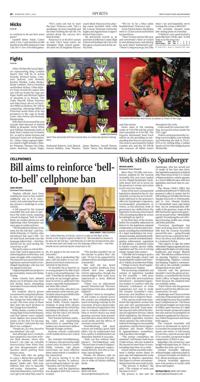


April Cline (pictured) will face Hannah Ross in a featured women's boxing bout.
April Cline (pictured) will face Hannah Ross in a featured women's boxing bout.
April Cline (pictured) will face Hannah Ross in a featured women's boxing bout.
April Cline (pictured) will face Hannah Ross in a featured women's boxing bout.
Virginia officials have been working for years to ban student cellphone use in K-12 classrooms, but enforcing those rules has proved a challenge in some schools.
A bill passed by the General Assembly this year aims to reinforce the state’s push, requiring schools to impose “bell-to-bell” limits on student phone use and tightening what lawmakers say were gaps in earlier policies.
“We intended for phones to be away for the full day,” said Sen. Stella Pekarsky, D-Fairfax, who introduced this year’s bill. “So we went back and made sure the language reflects that — that they should not be used during the school day at all.”
The push comes as school divisions take varied approaches to enforcing phone restrictions, and some struggle with consistency. The measure has passed the state legislature and now heads to Gov. Abigail Spanberger, who has not yet signed it into law.
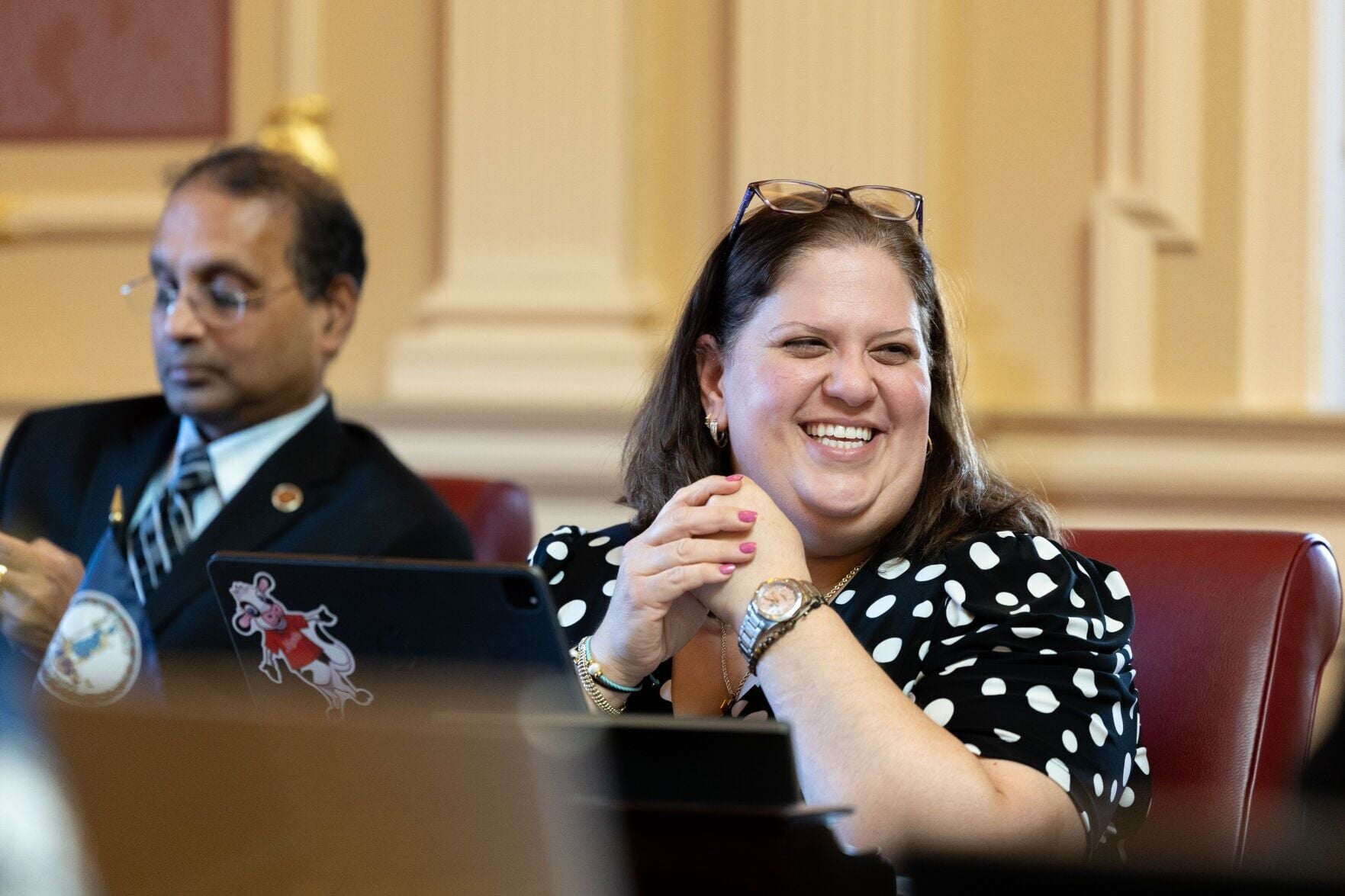
Sen. Stella Pekarsky, D-Fairfax, reacts to a joke on the floor of the Senate in the Virginia Capitol on March 10. “We intended for phones to be away for the full day,” said Pekarsky of a bill she introduced this year. “So we went back and made sure the language reflects that — that they should not be used during the school day at all.”
Virginia Republicans propose a gas tax holiday. Democrats blame Trump.
Some schools have allowed phone use in between class time and during lunch, prompting lawmakers to more clearly define expectations.
For students who’ve grown accustomed to using their phones in class over the past 10 years, the change has been difficult to accept. But even some of those who were the most hesitant to the change have benefited.
Kellice Banks, a senior at Armstrong High School in Richmond, said that almost every student in her algebra class passed their exams on the first try because their teacher “enforced the rule like it was a religion.”
“People are, in a way, forced to pay attention,” she said.
And although most students have adapted to class time without their phones, those who haven’t can take up valuable instructional time when they get into disagreements with teachers about putting their phones away.
“Those kids who are going to cause a distraction normally would be subdued with their phone,” Banks said. “But now, without that way to basically self-soothe themselves and entertain themselves, now if they can't get to do what they want to do, it's going to be (an issue for everyone)."
Banks, who is graduating this year, said she hopes to see cellphone restrictions enforced consistently in the future.
“It shouldn't be so hard for us as young people to be able to put it away, to do something else,” she said. “I feel like by doing this, we can help set up younger generations to not be as addicted to the screen, especially during important times like school.”
Across the state, educators say enforcement can be uneven, particularly when responsibility falls on individual teachers.
The official policy for Richmond Public Schools requires students to keep their phones stored throughout the school day, including in hallways and cafeterias, but the rule is not strictly enforced at all schools.
That tension between enforcing rules and maintaining instruction is something lawmakers say schools must address through stronger systems.
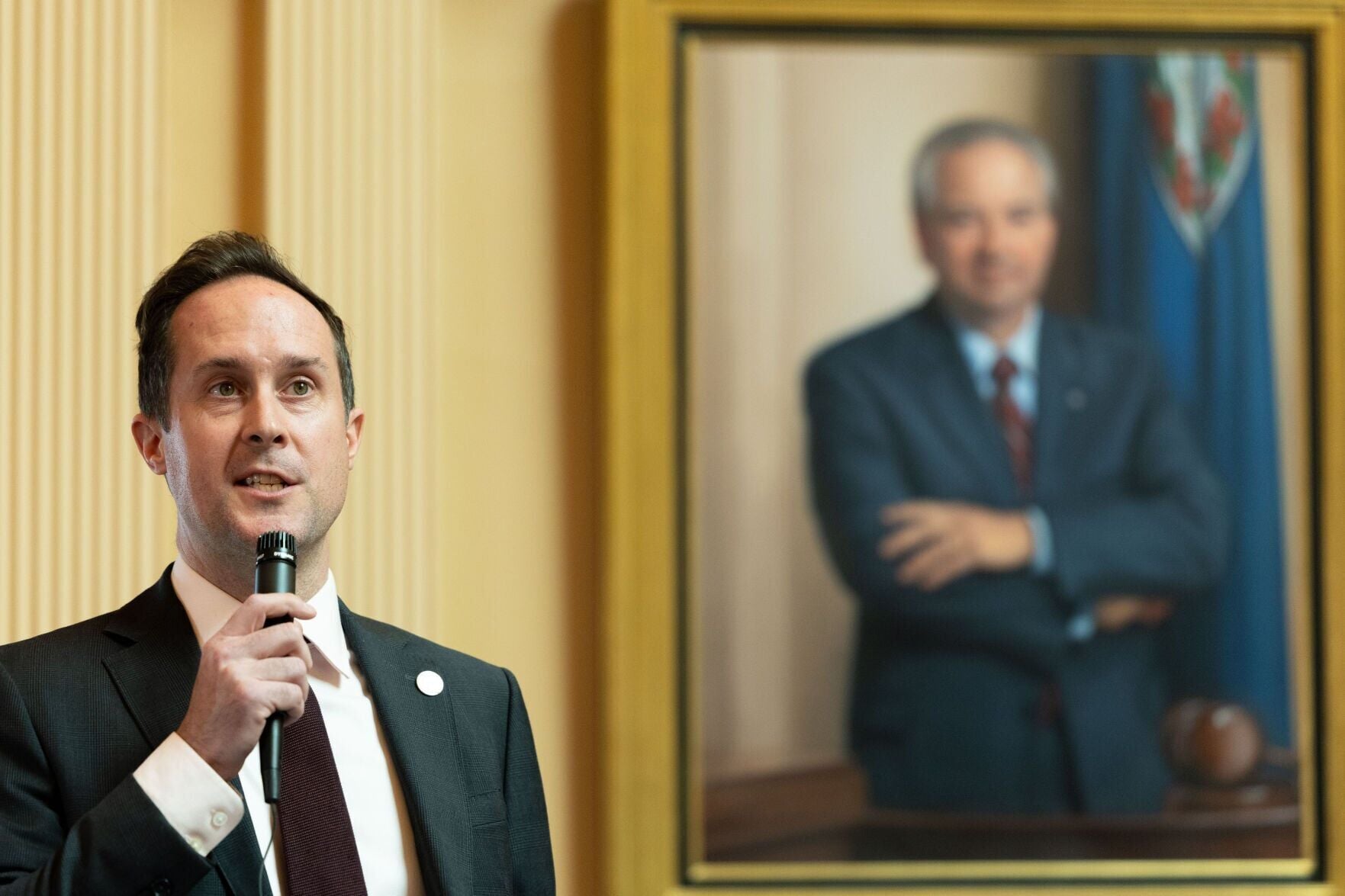
Sen. Schuyler VanValkenburg, D-Henrico, speaks on the floor of the Senate in the Virginia Capitol on March 10. “Kids can live without their phones,” VanValkenburg said. “We just have to make it happen.”
Hanover schools confiscated 1,600 mobile devices last school year
Sen. Schuyler VanValkenburg, D-Henrico, who also teaches high school civics in Henrico County Public Schools, said phone restrictions are most effective when enforcement is handled at the school level.
“If you’re leaving it to the individual teacher to enforce, you’re asking for failure,” he said. “Teachers can’t be the police.”
Pekarsky said the legislation was designed with that concern in mind.
“The burden shouldn’t be on the teacher to police this,” she said. “It has to be supported by administration and implemented schoolwide.”
She said she has heard largely positive feedback from schools that have adopted stricter approaches, though she acknowledged that some have experienced a more difficult transition.
“There was an adjustment period,” Pekarsky said. “But once expectations were clear, students adapted.”
Virginia’s move to strengthen its law comes as schools across the country are rethinking how much technology belongs in the classroom. At least a dozen states have introduced legislation this year to evaluate student screen time or restrict device use amid growing concerns from parents and educators about distraction, social media and the effects of constant connectivity.
VanValkenburg said most schools are making a good-faith effort, but he emphasized that how a policy is implemented can determine whether it succeeds.
“Kids can live without their phones,” VanValkenburg said. “We just have to make it happen.”
Virginia's proposed congressional districts and who is running | Special Report
Former AG Miyares calls on Spanberger to reverse ICE policies in wake of Fairfax stabbing death
Anna Bryson (804) 649-6922

A1 Minute! March 28, 2025: Week in Virginia | A1 Minute

The action will be fast and furious as always at Titans of the Cage.
The action will be fast and furious as always at Titans of the Cage.
More than 750 bills and resolutions adopted by the General Assembly this year have landed on Gov. Abigail Spanberger's desk, with about 400 yet to arrive for the governor's review and action in just over two weeks.
Some of the most consequential legislation adopted in the 60-day assembly session has yet to be formally delivered to the governor's office for Spanberger's signature, recommended amendments or vetoes, as the laborious work of governance has shifted from the legislative to the executive branch with a looming deadline for action by midnight on April 13.
In the final days of the session, before the assembly adjourned on March 14, the legislature adopted compromises on major policy proposals, including the establishment of a legal marketplace for recreational cannabis, paid family medical leave, controls on federal immigration enforcement, regulation of skill games, a potential casino in Fairfax County, electric utility regulation and the cost of serving energy-hungry data centers.
"I feel like we're trying to push a lot of water through a straw," said Senate Majority Leader Scott Surovell, D-Fairfax, in an interview Friday.
5 things to know about legalizing marijuana in Virginia
The increasing complexity and volume of legislation handled by the assembly — with more than 3,600 bills and resolutions introduced — prompted legislative leaders to contract with the National Conference of State Legislatures last year to study the General Assembly's rules, processes and deadlines to recommend ways to improve them.
A five-person study team monitored the legislative session this year and sent questionnaires to legislators and staff. Team members also met with staff at the Division of Legislative Services, which drafts legislation; the Division of Automated Legislative Systems, which operates the critical information technology to run assembly operations; and the House Appropriations and Senate Finance & Appropriations committees, which produce the budget.
"The money committees are slammed," said Senate Clerk Susan Clarke Schaar, who has worked in the Senate for more than 50 years, including more than 30 as clerk.
Schaar said the assembly underwent a similar review about 20 years ago and implemented some changes to improve operations. She hopes to receive recommendations from the new study by July.
"The process is broken," she said. "The volume of work and the time to do it."
The process is also new for Spanberger, who has served just 10 weeks of her four-year term. Her legislative experience is federal after three terms in the U.S. House of Representatives, which operates at a much different pace with less legislation and more time to consider it.
The House Clerk's Office has enrolled and delivered 757 bills to the governor's office to review, but it's still waiting on 396 bills that House Speaker Don Scott, D-Portsmouth, and Lt. Gov. Ghazala Hashmi, D-Chesterfield, must sign before they can be communicated officially to the governor. Some of the bills that haven't gone to the governor yet are part of her "affordability agenda" for reducing the cost of living in housing, health care, energy and other priorities.
"Governor Spanberger has been reviewing more than 1,100 bills that the General Assembly passed this year — going through them one by one, and line by line," Press Secretary Jack Bledsoe said in a statement Friday.
"She expects to sign the entire Affordable Virginia Agenda into law, addressing the high cost of housing, healthcare, and energy," Bledsoe said. "She will also continue to focus on growing Virginia’s economy, strengthening Virginia’s schools, and keeping Virginia’s communities safe as she carefully considers all legislation on her desk.”
Surovell said the governor shouldn't need the physical legislation, as enrolled by the House clerk's office, to begin reviewing them because the adopted texts are available online.
"I don't know why the governor needs to wait for the official communication," he said.
Spanberger won't have to review every line of the proposed two-year state budget because the assembly hasn't adopted one yet. The House and Senate budgets are more than $1 billion apart because of a fight over the Senate's proposal to repeal the sales and use tax exemption on computer equipment for data centers, which the governor and House both oppose.
The General Assembly will return to Richmond on April 22 to consider her proposed amendments and vetoes. It will remain in town for a special session April 23 to consider a proposed budget compromise, if there is one.
Regardless, the current two-year budget will expire June 30. That's a deadline the state can't miss.
General Assembly adjourns without budget, will return April 23
General Assembly sets limits on ICE, allows marijuana sales
General Assembly approves new state powers to tackle child abuse and neglect
Michael Martz (804) 649-6964

Gov. Spanberger addresses a joint session of the General Assembly on Monday, Jan. 19, 2026.