
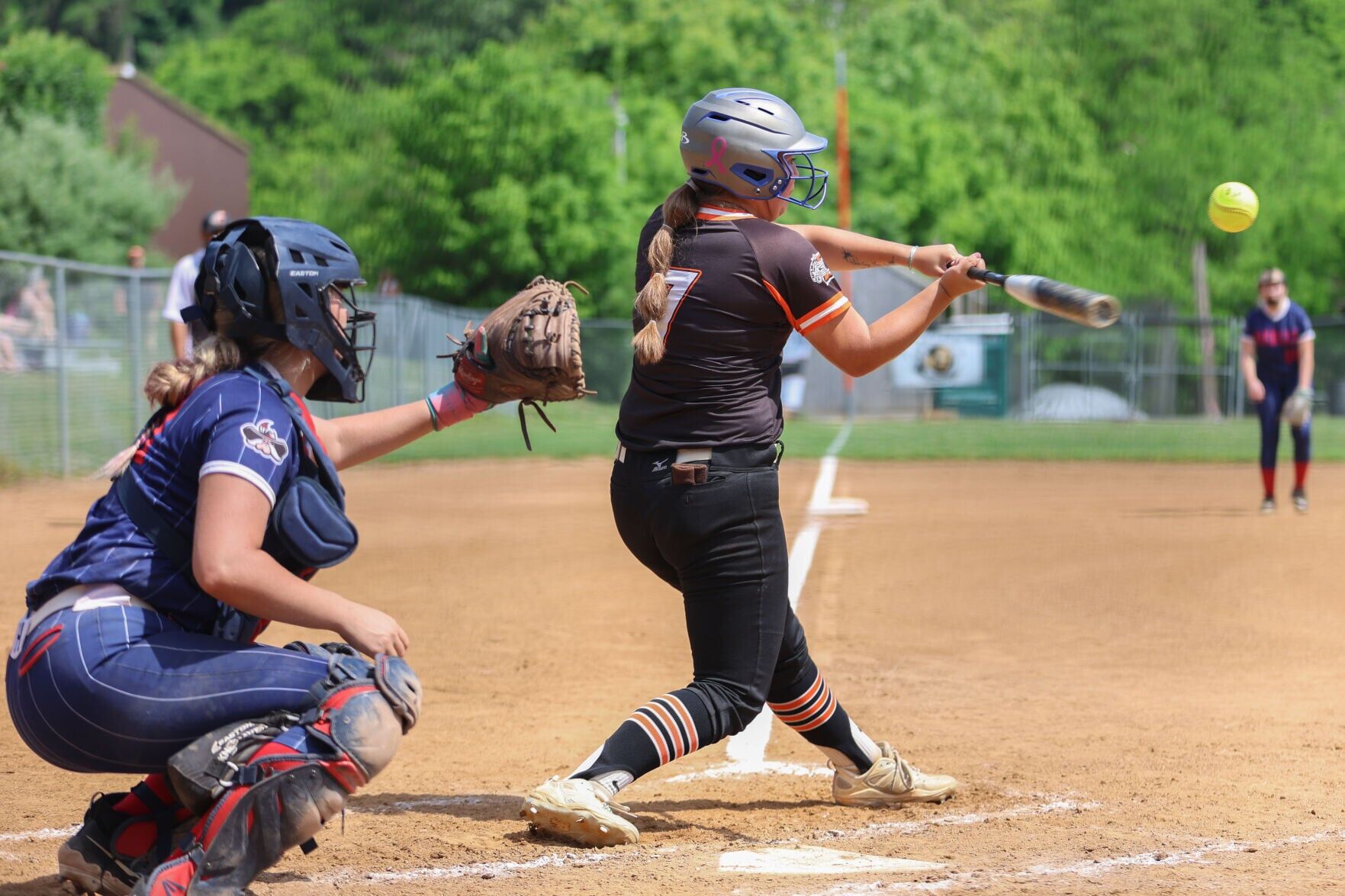
Chilhowie's Denessa Martin swings for a hit against Hurley on Friday afternoon.
Chilhowie's Denessa Martin swings for a hit against Hurley on Friday afternoon.
Chilhowie's Denessa Martin swings for a hit against Hurley on Friday afternoon.
Chilhowie's Denessa Martin swings for a hit against Hurley on Friday afternoon.
Roberta Ledgerwood Dennis returned an original portrait of Abijah Thomas to the Octagon House Foundation during a Saturday ceremony at the Smyth County Museum.
Roberta Dennis explained the significance of this conch shell to the Octagon House. It was among the items she donated to the foundation.
David Bridges told the gathering about his research about the Thomas family and his historical fiction.
Leaders of the foundation working to restore Smyth County’s Octagon House described Saturday’s event as the beginning of a new chapter.
At the Smyth County Museum, Roberta Ledgerwood Dennis donated a portrait of Abijah Thomas, a leading 19th-century industrialist who designed and lived in the house, to the foundation. According to Dennis, the portrait once hung in the Octagon House. She also donated another portrait of Thomas’ mentor Priscilla Scott and two artistic studies, including one of Thomas’ wife.
Dennis, a great-great-granddaughter of Thomas, hopes that one day the artwork will again hang in the Octagon House.
Among the donated items was a large conch shell.
Dennis, who now lives in Roane County, Tennessee, said it was once a tool used at the Octagon House, sometimes to signal the large number of enslaved and during the Civil War as a warning signal. How the shell made it to Smyth County is a mystery, Dennis said, though she noted that Thomas traveled to New York.
Dennis explained that the Abijah Thomas portrait was saved by a fire started in anger over a house being left to two people in a will.
She explained that images of people from this era didn’t portray them as smiling, which would have considered an affront to God. People were expected to be portrayed as serious, therefore they were seen as serious about God.
The artist is unknown.
Dennis acknowledged the large number of enslaved individuals who built the Octagon House and were kept there.
To grow this country, Dennis said that it’s important to know its historical strengths and weaknesses. She urged people to learn about the fingerprints of the enslaved still preserved in the Octagon House’s bricks, which were made on site.
In researching their family tree, Dennis said that her sister found that Civil Rights icon Roberta Parks is their 12th cousin. She recounted a story of her mother in the late 1940s-early 1950s seeing an older Black woman come onboard a bus she was riding. Her mother got up and let the woman sit down. The driver told the Black woman she had to get up and return the seat to her mother or get off. Her mother refused the seat and was kicked off the bus.
Dennis urged others to learn and preserve their family stories whether by genealogy or just listening to people’s stories at family meals.
As to why she donated the items to the Octagon House, Dennis said she’s 73 years old and is trying to think ahead. She noted the foundation successfully earning a $225,000 Paul Bruhn Preservation grant to help restore the Octagon House’s first floor and allow safe access. “It’s all happening now,” she said.
Of genealogy, Dennis said, “It’s the puzzle that never ends.”
Extending his gratitude to Dennis, Derek Orr, an Abijah Thomas descendant, former owner of the Octagon House, and founder of the foundation, said, “We have turned the corner.”
Orr said the work to preserve and grow the Octagon House is an effort to save the largest historic artifact in the community.
“It’s to tell the story. It’s the story of us,” he said.
Acknowledging the conch shell, Orr said, “Something so simple means so much” – to touch and feel the same items these historic figures did.
When someone touches the fingerprints in the Octagon House’s bricks, Orr said, “You touch their soul.”
Regarding interest in learning history, Orr said an uptick is being seen. “That’s taken all of us,” he said, noting the foundation, the museum, the historical society, the community.
Virginia Tech Support
The Saturday ceremony came on the heels of information from the Virginia Tech Center for Economic and Community Engagement about its work with the Octagon House along with the Community Design Assistance Center, the Institute for Policy and Governance, and the Virginia Tech Southwest Center.
The May 27 blog post said that the Virginia Tech entities are “helping the Octagon House apply for grants to complete the restoration of the building, finance program development, and add a wedding and event venue, visitor’s center, and lodging and dining services.”
Both students and professors have or are working on the endeavor.
“Keeping the historical integrity of the site and building were essential to the design work and its future,” said Professor Lisa Tucker, who serves as the director of the Center for Historic Preservation.
The post also noted that “Elli Travis, associate director of impact and evaluation at CECE, calculated the economic impact of the Octagon House on the local and regional economy and estimated there will be a projected economic impact of $1,585,603 annually after the final phase of the strategic vision is completed.”
The House
Construction on the nearly 6,000-square-foot, 17-room Octagon House, which is listed on the National Register of Historic Places and the Virginia Landmarks Registry, was completed in 1858.
The interior features faux marbleizing, stenciling, and graining. The marbleizing was quite rare in homes of the mid-19th century, Orr previously noted, usually reserved for courthouses and churches.
Orr bought the Octagon House in 2003 at auction. In 2014, he established the foundation and gave the house to it. For 12 years, its members have raised money through spaghetti dinners and other fundraisers in addition to seeking grants and assistance to move forward with the vision.
A Writer
The gathering at the museum also heard from David Bridges, also a descendant of Abijah Thomas and a former educator and Presbyterian minister, who now describes himself as the Cowboy Novelist.
For the last 10 years, Bridges said he’s been researching and writing about his family, the Thomas clan. He particularly follows John Lafaayette Thomas, who moved from Smyth County to Burke’s Garden in Tazewell County. Now, seven chapters into his third book in the series, Bridges said that Saltville will be a setting.
He’s also working on building a 32x19 Octagon House replica. Bridges said he’s striving to mimic Abijah Thomas by using the materials on his property. The timber is now drying.
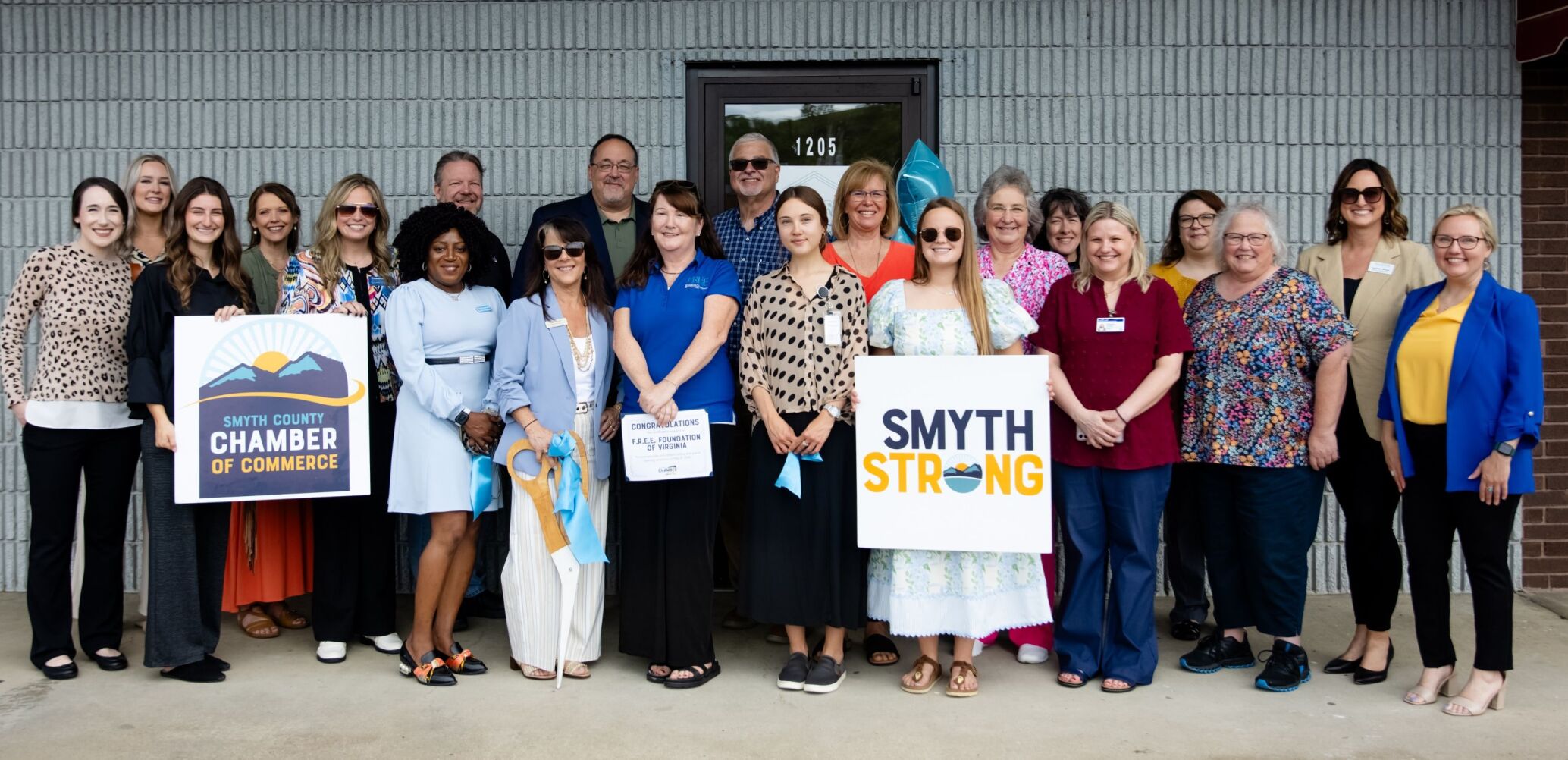
The Foundation for Rehabilitation Equipment & Endowment (F.R.E.E.) Foundation of Virginia celebrated its opening in Chilhowie.
The Foundation for Rehabilitation Equipment & Endowment (F.R.E.E.) Foundation of Virginia celebrated its opening in Chilhowie.
Smyth County’s real estate tax bills often add to individuals’ financial stress around the holidays since they come due in December. Now, the Board of Supervisors is looking at trying to ease that strain while also improving the county’s cash flow.
The supervisors took up the matter at their meeting last Thursday.
County Administrator Shawn Utt reported that staff have been reviewing options to even out cash flow throughout the year. High among those options is switching from billing real estate taxes only in December to twice a year.
“The goal is to get it away from Christmas,” Utt said.
He proposed that the supervisors set the due dates to June 5 and Dec. 5. For example, Utt said if a person’s total bill is $500, they’d be billed $250 in June and $250 in December.
Another locality that made such a switch, Utt said, has seen most people transition to paying the full bill in June.
Supervisor Roscoe Call noted that people can pay anytime now, even monthly if they choose.
Supervisor Rick Billings countered that many people may be like him, noting that he doesn’t pay until he gets a bill.
Under the current proposal, the change would take place in 2027.
However, the supervisors must set and hold a public hearing before the change can be enacted.
While no action has been taken, that hearing, which would seek citizen input, could be held in July.
The supervisors’ Budget Committee has already shown support for the twice annual billing.
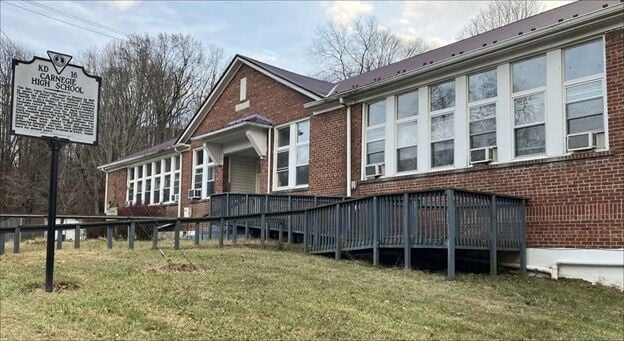
Smyth County officials will hold a public interest meeting about the future use of Carnegie High School on June 30 at 5 p.m. at First United Methodist Church in Marion.
The future of the historic Carnegie High School is up for community consideration.
Last year, Smyth County assumed ownership of the former Black school that opened in 1931. Since then, county officials have been exploring ideas for the Marion institution’s next purpose.
There’s been no shortage of ideas. A News & Messenger article posted to Facebook in December 2025 about the county’s exploration drew 85 comments.
Among the ideas already put forth are a community center, a GED/job resource center, affordable housing, a homeless shelter, a childcare center, a youth center, a housing assistance center, a food pantry, after-school center, historical teaching center, and nursing home.
Among those passionate about Carnegie School is Diane Hayes, a former student in the school, a historian of Smyth’s Black history, and leader of Mt. Pleasant Preservation Society and its museum.
On the News & Messenger article post, Hayes wrote, “The backbone of the black community built that school…. It’s not just a building; it is part of Smyth County history. It is part of my history…. Every black child that entered that building was taught to respect. To you it might look like bricks and mortar. To us it was our fountain. It was our safe place from a cruel world…. Ask any child from the headstart, any person that went to Mt. CAP for help or the many that travel to Carnegie High School Reunions what the building means to our history.”
The county has turned to Hayes to help their committee established especially to work on Carnegie’s future for both her ideas and willingness to engage the community.
County Administrator Shawn Utt has said that while the building is older and has issues, it is sound.
The building was most recently used by Mountain CAP (Community Action Program) before its merger with Open Door Community, a regional nonprofit service organization. Mountain CAP leased the property from the Smyth County School Board until their agreement ended on Aug. 31. While Mountain CAP used the building, Utt said that much of the structure sat empty. Once Mountain CAP left, the School Board said it no longer had an educational use for the building and turned it over the county.
As the Smyth County Board of Supervisors talked about Carnegie’s future use last Thursday evening, Utt said he doesn’t want the building to go unused for long.
The former Carnegie School is in Supervisor Courtney Widener’s district, and throughout the discussions, he’s championed the preservation of its history.
On Thursday, the supervisors agreed to hold a public interest meeting on June 30 at 5 p.m. at First United Methodist Church in Marion.
Supervisors’ Chair Charlie Atkins asked county staff to make sure that they use a variety of forums to notify interested individuals about the session.
Carnegie School was built to replace a Black school dubbed the Old Red Barn.
A 1928 letter to the editor from Wm. C. Pendleton to the Smyth County News told of the need. Pendleton wrote, “My attention has been drawn to the matter of the building of a new school house for the colored people of Marion. The building and premises now in use for the colored school are really a disgrace to our progressive and beautiful town…. An inspection of this school house will disclose to any observer a structure so dilapidated as to not only unfit it for its present use, but make it a menace to the health and life of its occupants….”
Carnegie High School was built by the Rev. Amos Carnegie, who “came to Marion by 1927 as pastor of Mount Pleasant Methodist Church. Finding the town’s school for African Americans ‘hardly fit for a stable,’ he organized a campaign for a new building. When the school board delayed, Carnegie raised money from the black community and secured a grant…. The four-teacher building, constructed by black craftsmen who donated their labor, opened in 1931 and closed in 1965, when local schools were desegregated….”
The grant for the school was awarded by the national Julius Rosenwald Fund, which supported more than 5,000 schools for black students across the South. The fund was launched by Sears, Roebuck and Company head Julius Rosenwald in 1917 "for the well-being of mankind."
In 2019, a marker was erected on the Iron Street’s building’s lawn, detailing that history.
The historical marker also noted that Carnegie’s most famous teacher, Katherine Johnson, who went on to work for NASA and is one of the women recognized in the book and movie “Hidden Figures”, started her professional career at Carnegie as an educator.