This content is unavailable. Please contact customer service for more information.
Already a subscriber? Login or Activate your account.
You've reached the end of the standard E-Edition.
This content is unavailable. Please contact customer service for more information.
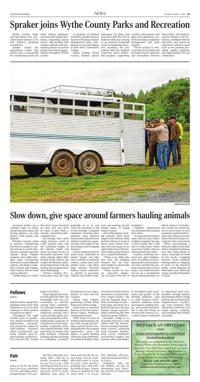
Spraker joins Wythe County Parks and Recreation
Wythe County Parks and Recreation has welcomed Reed Spraker as its new athletics programs coordinator.
Spraker joined the department earlier this month and is responsible for coordinating youth and adult athletic programs, assisting with league operations, organizing special events, and working with coaches, officials and community partners to provide quality recreational opportunities throughout Wythe County.
A graduate of Radford University, Spraker earned a Bachelor of Science in Sport Management after completing an associate degree at New River Community College.
Before joining Wythe County, Spraker gained experience in parks and recreation with the City of Radford while also serving as an assistant basketball coach at Dayspring Christian Academy. He also worked with the Radford University men's basketball program, supporting coaches with practice and game-day operations, statistical tracking, equipment management and team logistics.
"We're excited to welcome Reed to the Parks and Recreation team," said Parks and Recreation Director Alicia Sides. "His enthusiasm for athletics and recreation, combined with his education and hands-on experience, will be a great asset as we continue providing quality programs and opportunities for our community."
Slow down, give space around farmers hauling animals (copy)
Livestock trailers are a common sight on roads, and giving extra space and having patience can help protect both people and animals.
Whether moving cattle to pasture, transporting livestock to market or taking animals to county fairs, farmers regularly haul live animals along Virginia roadways. But unlike standard cargo, transporting livestock is a whole different animal, said Mark Campbell, a farmer and Virginia Farm Bureau district field services director.
“Unlike boxes in a trailer that don’t move, livestock do move and care must be taken to give them a smooth, uneventful ride,” Campbell said.
On average, beef cattle weigh between 1,200 to 1,400 pounds each, and the combined weight of the animals, trailer and truck can easily be tens of thousands of pounds. And when animals adjust their footing inside trailers, the weight distribution shifts, increasing rollover risk and making safe transportation more challenging.
“Drivers hauling livestock must start and stop gradually so as to not cause the livestock to fall or lose footing,” Campbell explained. “And they must maintain extra distance between the vehicle in front of them to allow for a gradual stop. The weight of the load requires extra stopping distance.”
Drivers hauling livestock travel more cautiously at slower speeds and take turns carefully to maintain vehicle control and avoid animal stress. Like other large vehicles, livestock trailers cannot maneuver as quickly as passenger vehicles, and sudden stops, turns and weaving can risk animal injury or losing vehicle control.
And while farmers hauling animals often leave ample room between them and the vehicles in front of them, many drivers mistake that extra space as an opportunity to pass the livestock trailer and get in front of it, Campbell lamented.
“When a car slides into that spot, the stopping distance (for the livestock trailer) is drastically reduced,” he said.
“These moves by cars are especially dangerous on roads with lots of stoplights.”
Campbell experienced this firsthand when hauling beef cattle.
“A car passed me and then came into my lane before suddenly stopping,” he said. “I drive slower, but I still had to brake hard, which caused my trailer’s tires to skid and jostle the cattle.”
Crashes involving livestock also add complications. In addition to assisting motorists, first responders must consider the animals and may need to close roads, call reinforcements and set up a containment area if animals get loose. In March, Route 37 in Frederick County was closed for six to seven hours as first responders performed livestock and vehicle recovery after a livestock hauler carrying 110 calves overturned.
When encountering a livestock trailer on the road, drivers should have patience and “give them plenty of space, especially in front of the truck,” Campbell advised. Avoid suddenly slowing down or stopping in front of the livestock trailer, avoid lingering in blind spots, pass safely and merge carefully with plenty of room.
Click and hold your mouse button on the page to select the area you wish to save or print.
You can click and drag the clipping box to move it or click and drag in the bottom right corner to resize it.
When you're happy with your selection, click the checkmark icon next to the clipping area to continue.