
The man who saved a billion lives (copy)
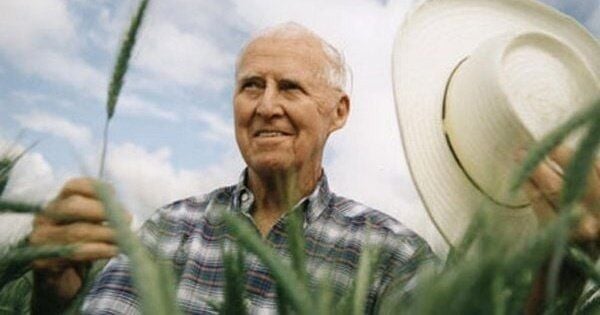
Norman Borlaug
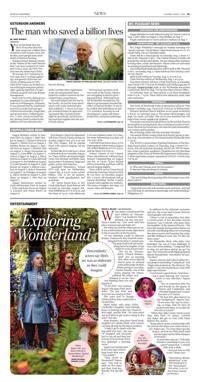
You would think that the story of an Iowa farm boy who saved over a billion lives would be a well-known story, but frankly, most people have never heard of Norman Borlaug.
Norman Ernest Borlaug, known as the “Father of the Green Revolution,” was born on March 25, 1914, near Cresco, Iowa. By 1970, Norman won the Nobel Peace Prize.
He earned a B.S. in forestry in 1937 and a Ph.D. in plant pathology and genetics from the University of Minnesota in 1942. Early in his career, he worked as a microbiologist and plant pathologist, gaining experience in agricultural research and crop disease management.
From 1942 to 1944, Borlaug was employed as a microbiologist at DuPont in Wilmington, Delaware. It was planned that he would lead research on industrial and agricultural bacteriocides, fungicides, and preservatives. Following the Dec. 7, 1941, attack on Pearl Harbor, Borlaug tried to enlist in the military, but was refused entry under wartime labor regulations, as his lab and personnel were tasked to conduct research for the United States armed forces.
His work helped win the war in the Pacific. He and his team developed a salt-water resistant glue that enabled U. S. forces to resupply stranded troops by approaching islands like Guadalcanal by night in speedboats and jettisoning food and supplies into the surf to wash ashore.
But Norman’s greatest work was south of the border. Mexico was struggling to feed its growing population. With help from the Rockefeller Foundation, the Mexican government founded the Office of Special Studies. It was to be staffed with both Mexican and U.S. scientists, focusing on soil development, maize and wheat production, and plant pathology.
Dr. Jacob George "Dutch" Harrar was selected as project leader. Harrar immediately set out to hire Borlaug as head of the newly established Cooperative Wheat Research and Production Program in Mexico; Borlaug declined, choosing to finish his war service at DuPont.
In July 1944, after rejecting DuPont's offer to double his salary, and temporarily leaving behind his pregnant wife and 14-month-old daughter, he flew to Mexico City to head the new program as a geneticist and plant pathologist.
Over the next decade, Borlaug selectively bred semi-dwarf wheat varieties that boosted yields to the point where Mexico evolved from an importer of wheat to being a net exporter of the grain.
Poor but populous nations like India and Pakistan followed suit and Norman’s work not only boosted those nation’s economies but ended the efforts of famine and starvation in many third world countries…. Earning him the title of “the man who saved a billion lives.”
Norman passed away in 2009, but his work lives on in many parts of the world. Texas A&M is home to the Norman Borlaug Institute for International Agriculture and Development. Borlaug joined the faculty at A&M in 1984. At an age when many would have been actively seeking retirement, Norman worked 22 more years at the Institute.
The Borlaug Institute strives to further Dr. Borlaug’s legacy of improving global food security, livelihoods, and resilience through applied agricultural research and Extension. Whether as the prime contractor or as a subcontractor, the Borlaug Institute has implemented agricultural development, food security, and educational projects in 54 countries. Over the last several years, project funding has exceeded $139 million, making the Borlaug Institute one of the largest such university-based organizations in the country.
And the work continues. As we push the envelope of crop yields, one area of concern is lodging. Lodging {unrelated to housing} is a condition where a crop becomes so heavy the stalk cannot bear the weight any longer.
Extreme lodging means that the crop is so close to the ground that mechanical harvest is impossible. Thus, as much work goes into breeding a stronger, more wind-resistant stalk as well as more grain.
For example, in 1994, Dad and I averaged 235 bushels per acre from our corn crop. Planted at 27,500 plants per acre, that meant that every stalk on average had to hold up just over a half pound of corn.
In 2024, David Hula in Charles City averaged 626 bushels per acre planted at 38,000 plants per acre. His corn planted almost a third more thickly had to hold up over a pound of corn per stalk.
By 1996, the variety we were planting had issues with stalk borer and would fall over if you didn’t get it to the chopper head just right. There was no way that variety’s stalk would have supported twice the weight in grain. Our world record crop would have been on the ground.
Long story short…. plant genetics was and is absolutely critical to feeding our world. We all owe Norman Borlaug a debt of gratitude for his help in setting us on the path to bounty.
Upcoming Events
Aug. 3--Deadline to register with VCE for the Commercial/Registered Tech Pesticide Course, 5 p.m., 276-706-8339.
Aug. 4 --Tri State Beef Conference.
Aug. 6--Tractor Trip to Benham, Ky.
Aug. 12--Registered Tech Training/Testing, 308 East Chilhowie Street, Marion, 8:30.
Aug. 18--VQA Sale.
Aug. 24--VQA Steer Take Up.
Aug 26--VQA Heifer Take Up.
Dr. Andy Overbay is the agriculture and natural resources extension agent for Smyth County.