

Fort Chiswell's Kenton Sutphin drives to the basket as George Wythe's Isaac Smith defends.
Fort Chiswell's Kenton Sutphin drives to the basket as George Wythe's Isaac Smith defends.
Fort Chiswell's Kenton Sutphin drives to the basket as George Wythe's Isaac Smith defends.
Fort Chiswell's Kenton Sutphin drives to the basket as George Wythe's Isaac Smith defends.
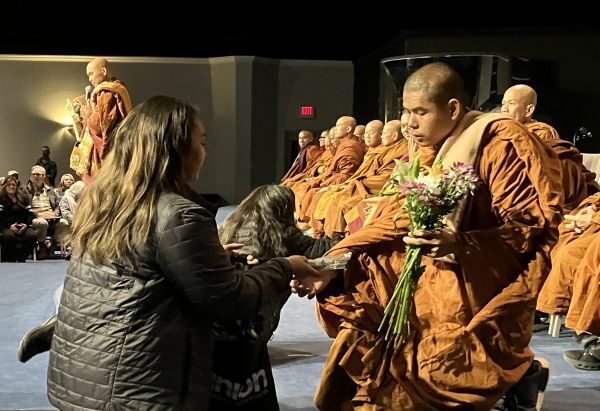
Friday morning, a woman presented a gift to one of the Buddhist monks who made the Walk for Peace from Texas to Washington, D.C.
Flowers were a popular gift.
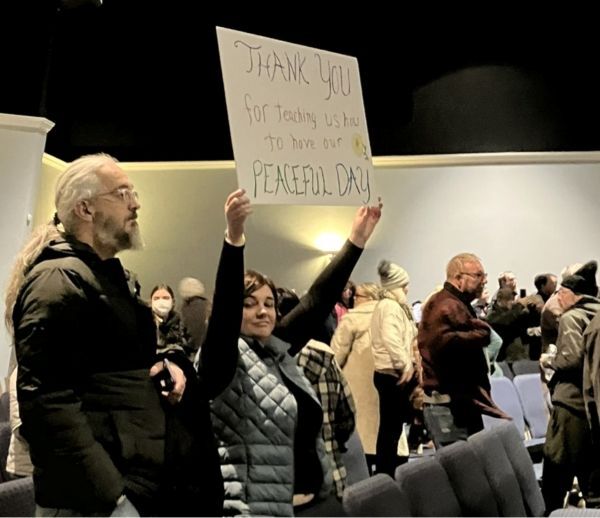
Messages of thanks were evident.
Homemade goodies and messages were also given to the monks.
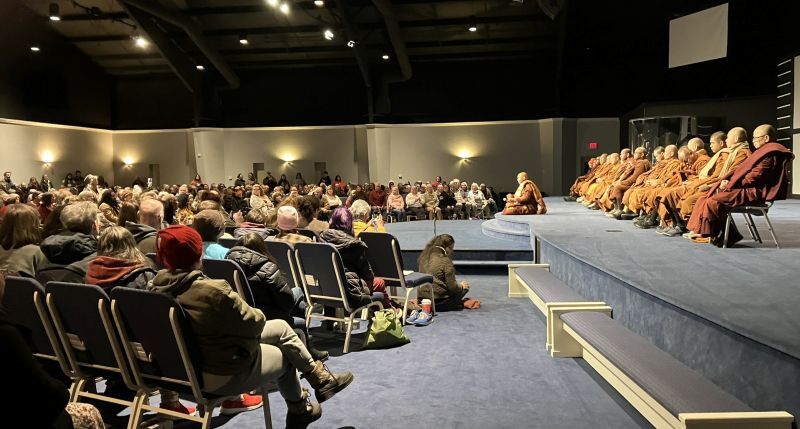
The Venerable Bhikkhu Pannakara led part of the ceremony sitting with his legs crossed.
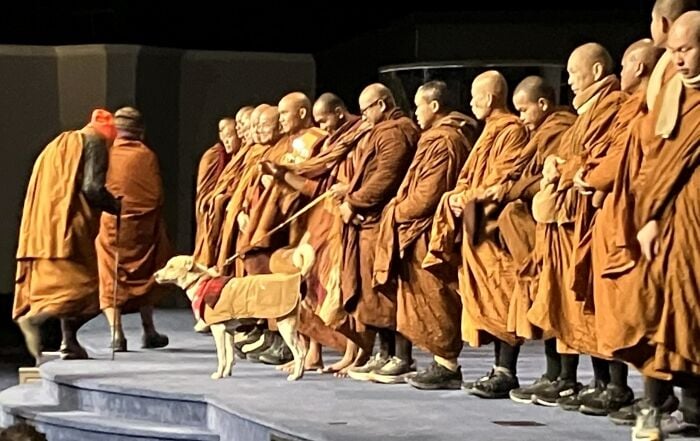
Aloka got his turn to deliver a message early in the ceremony.
“Peace is possible.”
The Venerable Bhikkhu Pannakara made that declaration before a standing-room only crowd gathered in Legacy Church’s sanctuary. He and the other Buddhist monks who made the 2,300-mile, 15-week Walk for Peace pilgrimage from Fort Worth, Texas to Washington, D.C., arrived in Wytheville by bus at 1 a.m. Friday. Though the official walk ended in D.C., and the monks are making their way home, Pannakara said, “Our journey will continue…. We will never stop walking on this path will you all.”
Many of those gathered had followed the monks’ journey on Facebook. Their pilgrimage wasn’t always easy – health problems, snow and ice and bitter cold played roles. As did, people who cursed at the monks and drivers who sped up as they went by, leaving exhaust fumes in their faces.
While toxic people try to impact others, Pannakara stressed that it is up to each individual to determine how and if they will respond. He urged not reacting, saying that it only brings on suffering.
The monk offered advice on how not to suffer and how to find peace in individual lives and spread it in the world.
To find peace individually, Pannakara urged the audience to learn to practice mindfulness, which focuses on being in the present moment, keeping an awareness of the breath.
The University of Texas at Arlington graduate and former IT engineer also focused on smartphones, contending that people should put them aside an hour before bed and not turning to them immediately after getting up. He cautioned against taking cell phones to the bathroom.
With a gently chiding and teasing voice, Pannakara told of going to a public restroom and finding people in the stalls on each side talking to people on their phones or listening to music. He was amazed. “It smells,” he cautioned, offering the advice, “Don’t get yourself constipated.”
The monk could also be solemn, speaking of going to funeral homes and seeing people crying. Pannakara wondered, “Why are we crying in front of this corpse, this casket?”
That love and caring should be shown while people are alive, he said, but added, “We just care about our own things, our own world.”
With technology and multitasking, the monk said people often eat a meal without really knowing what they’re consuming, just focusing on their phones.
His advice: “Do one thing at a time.” When eating, eat; when walking, walk; when reading, read.
Pannakara acknowledged that practicing mindfulness and loving kindness can be hard. He noted, however, that a month and half of 2026 is already gone. “We don’t have much time left. Why would we waste our time doing unmeaningful things?”
“Nobody has a guarantee” for how long they will live, he reminded the group.
He urged people to not stay in the past or focus on the future but live in the present.
“Now is the time to change,” the monk said.
Pannakara urged people to write down the phrase: “Today is going to be my peaceful day.” Say it out loud every day, he challenged.
“No one can mess up our day except us,” he contended. Pannakara again urged people not to react to difficult situations and to take a deep breath to forestall reactions when they’re building.
The idea for a peace walk came to Pannakara three years ago and he sat silently with his vow to do so for three years, wanting to help others and bring awareness to live-changing practices.
With the Texas to D.C. walk behind them, he said seeing so many people come out, share their stories and feelings “touched my heart” as did a person telling him: “You saved my life.”
Many people in the Wytheville church, who came from all around the region and nearby states, expressed their gratitude to the monks, saying their lives had been changed.
Trish Boardwine, of Wytheville, said she’d been following the Walk for Peace on social media. When her sister told her the monks were coming to Wytheville, she didn’t believe until she saw the stop on their map. Then she celebrated.
She reflected that this visual pilgrimage touched many hearts. Just walking up the hill to the church, Boardwine said, she saw a number of disabled people making the walk.
She also expressed an affection for Aloka, a stray who joined monks on a pilgrimage in India. Friday morning, Aloka, who had surgery during the walk, was quite vocal. According to Pannakara, his barks conveyed, “This is my show.”
Sally Archibald from Marion attended the gathering, joining friends from Blacksburg. She was excited to see the monks but was surprised by the tears that came to her eyes when they entered the sanctuary and walked by her.
Brett McCleary, Legacy Church’s senior pastor, said when asked by local officials to host the monks, he was happy to. Of the Friday gathering, he looked around the sanctuary and reflected, “This is great…. We all want peace.”
The monks left Wytheville, heading to Tennessee for a lunch stop and then back to Fort Worth.
From there, Pannakara said the monks will return to their temples in Vietnam, Thailand, Houston, New York, and other locations.
He reiterated, “We will never stop walking on this path with you all.”
Pannakara, who has published one book, said another is in the works and he may offer an online meditation practice. He is a leader at the Huong Dao Vipassana Bhavana Center in Fort Worth.
As people brought flowers, messages of love, and other gifts forward Friday, Pannakara accepted many and said, “So much love.”
County officials at the Feb. 10 Supervisors meeting said efforts continue to schedule a public meeting with Solis Arx chief executive officer Robert Noll, but no date has been set yet.
Meanwhile worries about the coming data center development in Progress Park continued. Late last year, county leaders announced that Solis Arx would build a data center on 99 acres in the park. The announcement immediately drew fire from residents who questioned electricity and water usage as well as the use of non-disclosure agreements.
Those questions lingered at the Feb. 10 board meeting even as residents prodded the county to consider how to spend the funds promised by the data center. At the Dec. 9, 2025, Board of Supervisors meeting County Administrator Stephen Bear said tax revenue is expected to top $10 million annually, starting in 2028. That number will make Solis Arx the largest taxpayer in the county. Current real estate revenue in Wythe County is $14 million annually, with an additional $7 million coming from personal property taxes. Bear noted that influx of cash would go a long way in the county’s current $118 million budget, giving examples of school construction and education costs, library costs, parks and recreation improvements and public safety costs, where rescue vehicles can run over $400,000 each and fire trucks can clock in at upwards of $1.5 million or more. Bear said, too, that he money could help the county keep taxes low.
Though he said he opposed the data center, Mike Forrest acknowledged it was coming. He proposed that the projected tax revenue be allocated by giving 10 to 20 percent toward teacher salaries, another 10 to 20 percent to reduce the county’s current tax rate from 51 cents per $100 of assessed value to 40 cents per $100 assessed value and the remaining be used for capital infrastructure.
Forrest urged the board to move on zoning ordinances. Wythe County is one of only three or four counties in the state that don’t have zoning laws on the books.
While Tony Floyd didn’t suggest ways to spend the tax windfall, he recommended the county create a written public policy outlining how the funds would be used. Floyd also requested more transparency on the data center, including updates on scheduling a meeting with Noll.
Andy Kegley urged more transparency, too. Kegley suggested that some of the expected tax funds be earmarked for housing and services, pushing the formation of a task force to address homelessness.
Kegley also announced a Feb. 21 public listening session to discuss concerns about data centers.
At the Dec. 9, 2025, meeting, Bear said Appalachian Power had confirmed the availability of electric and that the project would use a closed-loop water system, requiring about 2,000 gallons per day, roughly the same as a restaurant. Progress Park, he said, has 1.5 million gallons of water per day available.
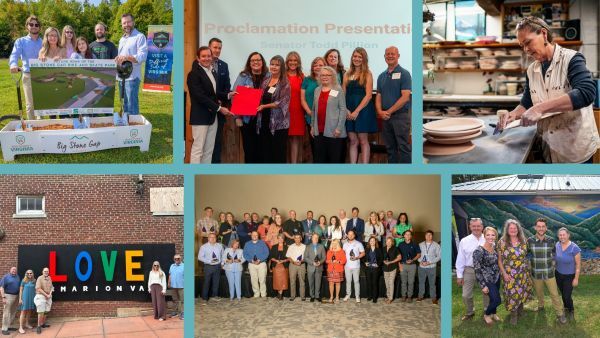
Wytheville and Marion were among the community selected to take part in a nine-month Downtown Inventory and Real Estate Redevelopment Strategy.
Friends of Southwest Virginia, in partnership with Place + Main Advisors, has completed a study supporting economic development and downtown revitalization in 10 Southwest Virginia and neighboring communities. Other communities included are Galax, Pulaski, Martinsville, Marion, Covington, Buena Vista, St. Paul, Bristol and Tazewell. All communities were selected through the Virginia Main Street Program.
Supported by the Appalachian Regional Commission, the initiative delivered market intelligence, practical implementation tools, and customized guidance that will help local leaders strengthen downtown districts and diversify economies historically shaped by extractive industries.
Each locality received an individualized report outlining priority opportunities, redevelopment pathways, and clear next steps tailored to its assets, market conditions, and leadership capacity.
“After spending the past nine months working alongside ten communities across Southwest Virginia, helping them identify their potential and chart a clear path forward, we are excited by the momentum and hopeful for the future of the region,” said Joe Borgstrom, Principal at Place + Main Advisors.
Regional partners and local leaders in each community participated in a collaborative planning process designed to strengthen downtown economies across the region.
The project paired detailed data analysis with hands-on fieldwork, including third-party market research, downtown and property tours, Business Opportunities on Main Street inventories, walking vision sessions, and facilitated meetings with local officials, property owners, and economic development partners. By aligning state, regional, and local perspectives, the process ensured that recommendations are realistic, financeable, and ready for action.
Friends of Southwest Virginia served as the regional convener and implementation partner, coordinating stakeholders, aligning the work with broader tourism and community development strategies, and ensuring that results can translate into future investment across multiple funding programs. The effort reflects Friends’ expanding leadership role in providing communities with the tools, partnerships, and technical expertise necessary to compete for redevelopment resources and position their downtowns for long-term success.
“This initiative puts real numbers, real opportunities, and real strategies in the hands of the people doing the work on Main Street every day,” said Kim Davis, Executive Director of Friends of Southwest Virginia. “By combining local vision with expert analysis and regional coordination, our communities are prepared to recruit businesses, bring vacant properties back into productive use, and build downtown economies that serve residents while attracting new visitors and private investment.”