
The dream of a Richmond casino appears to be dead.
People are also reading…

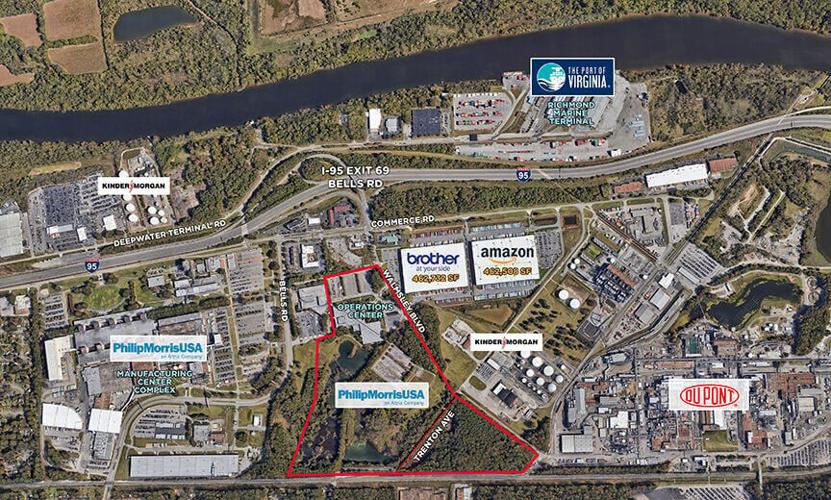
Altria is selling 98 acres of property adjacent to its manufacturing center in South Richmond. Developers previously pitched the land for a casino. It includes a three-story office and lab space.

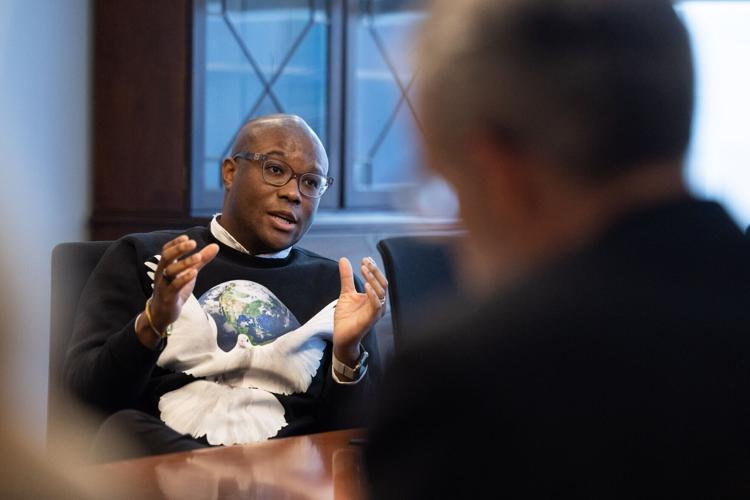
Allan-Charles Chipman, who opposed the proposed casino project, speaks to the editorial board of the Richmond Times-Dispatch on Oct. 24.

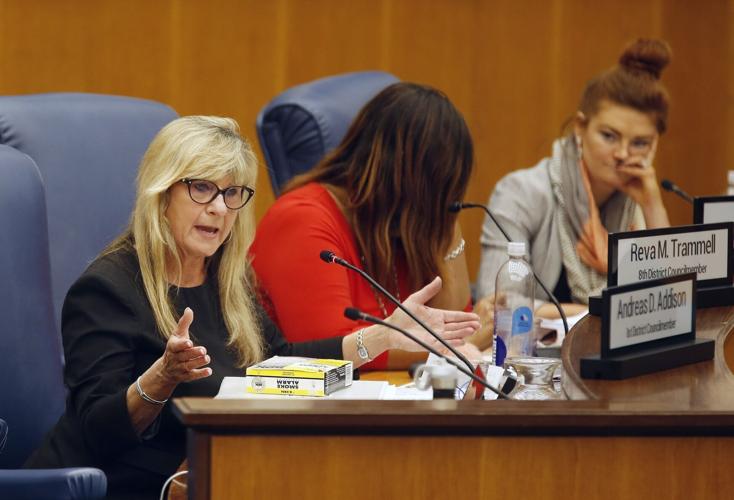
Richmond City Councilwoman Reva Trammell, seen here in 2020, said “my people still want this,” referring to a casino.
From the archives: Coverage of Richmond's eclipses since 1854

Richmond experienced a partial solar eclipse on May 26, 1854. The prediction was at the top of that day's edition of The Daily Dispatch.

Richmond's Daily Dispatch offered this advice on how to view the solar eclipse of Aug. 7, 1869.

A map that appeared in The Richmond Dispatch on May 27, 1900 described the next day's eclipse. Totality was seen in Hampton Roads, but Richmond saw it as a significant partial eclipse, just like 1970.

Thalheimers department store sold eclipse glasses for 10 cents leading up to the partial eclipse of Jan. 24, 1925.

Misses Mary Allen Taylor and Elizabeth Cheatham, 1724 Grove Avenue, get set for the eclipse and the heat in August 1932 at Byrd Park. They are shown, after a swim, trying out their smoked glasses.

A partial eclipse was visible from Richmond at sunrise on Oct. 2, 1959. Only 51 percent of the sun was obscured, and the sky was partially cloudy.

Indirect view of the July 20, 1963 solar eclipse in Richmond. The path of totality was farther north in Canada and Maine.

Sequence of photos from staff photographer Carl Lynn showing the eclipse of March 7, 1970 above Richmond's Byrd Park.
A total eclipse tracked along the East Coast on March 7, 1970, and Richmond barely missed out on seeing the totality. The maximum blockage of the sun here was 98 percent, and it happened at 1:35 p.m. with clear skies.

A total eclipse tracked along the East Coast on March 7, 1970, and Richmond barely missed out on seeing the totality. The maximum blockage of the sun here was 98 percent, and it happened at 1:35 p.m. with clear skies.

Instructions for creating a device to indirectly watch the Feb. 26, 1979 solar eclipse. That was the last total solar eclipse to be visible in the continental U.S., but it was only a partial eclipse for Virginia.

The brief ring effect of the annular eclipse of May 30, 1984 would have been visible along a 2.6-mile-wide track in southeast Virginia. This map appeared in The Times-Dispatch on May 13, 1984. The majority of that area ended up with a thick overcast, but near the North Carolina border there was enough clearing for a few glimpses.

Wolfgang Fielder lay on his back as he attempted to get a quick shot of the moon passing in front of the sun at the Science Museum of Virginia on May 10, 1994. Doris and Dieter Nanz (standing) and Kate Holzbach (seated) wore protective glasses as they waited for a view of the eclipse. But mostly, they saw only clouds.

Partial solar eclipse photographed on the front lawn of the Science Museum of Virginia on Feb. 26, 1998. The eclipse was photographed through a Mylar solar filter.

Dale Fortner of the the Richmond Astronomical Society holds a filter for Tate Shelby to view the partial eclipse on the front lawn of the Science Museum of Virginia. Photo taken Thursday, February 26, 1998.

Virginia saw a partial solar eclipse for about three hours on Christmas Day 2000, with the maximum eclipse taking place in Richmond at 12:41 p.m. The last time a solar eclipse was visible here on Christmas was in 1628.

Recreation of a solar eclipse with six different photo composition. Photos were taken at Science Museum of Virginia in Richmond on Monday, August 21, 2017.

Reid Christensen, 17, center, of Glen Allen views a solar eclipse with protective eyewear with others at Science Museum of Virginia in Richmond on Monday, August 21, 2017.

Sarah Conklin and Bill Gould viewed the eclipse from a comfortable spot on the lawn in front of the State Capitol in Richmond, VA Monday, August 21, 2017.