
News
Centerpiece Top Story
'The Coolest Hometown': Actors, stage crew sought to support new play about Marion

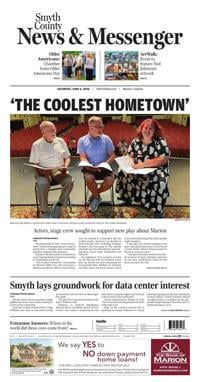
Mike Guy, Bob Watkins, and Hannah Combs enjoy a humorous moment as they review the script for The Coolest Hometown.

The playwright of “The Coolest Hometown” and the team gearing up to stage its production is hoping more community members will join their endeavor.
The play will take audience members on a tour through Marion’s history, including its founding as Royal Oak.
“The Coolest Hometown” was penned by Marion’s Mike Guy, who possesses a lifetime passion for history and writing. Guy has worked as a journalist and has written books. However, he decided to write this play after “watching Scrapper Broady’s one-man play at The Lincoln about his ancestor John Broady and reading Betsy Sayers book ‘Pathfinders and Patriots’.”
Guy explained, “It occurred to me that we are blessed with an excellent venue that we should use more frequently for local productions. Further, we all know too little about our local history, which is far more interesting than most people might imagine.”
A year ago, Guy started working on the play “and spent many hours at the Smyth County Public Library doing research in the local resources room.”
“I also got some information from family members of local celebrities and drew on my own recollections from the last seven decades,” he said.
Guy is a 1966 Marion High School graduate, who has served the community and world in many capacities.
After earning a degree from Virginia Tech, Guy served in the U.S. Peace Corps in the Philippines in 1970-71. He’s also taught and served as a supply pastor. In 1976, Guy returned to Marion, working first as the deputy director of the Mount Rogers Planning District Commission and then taking the post of District Three Governmental Cooperative’s executive director. He held the latter post for 37 years until he partially retired.
Guy has coached and served in multiple capacities with civic and service organizations.
As the play took shape, Guy said Betsy Sayers and Bob Rigley assisted by reviewing an early draft.
As the work took shape, Guy said he approached Bob Watkins, The Lincoln’s executive director, about staging the play there. Watkins stepped up, and he and his staff have helped in recruiting actors and providing rehearsal time.
Hannah Combs is serving as director.
Guy said they’ve got “the nucleus of a good cast.”
However, they are looking for a few more actors and behind-the-scenes folks to join the all-volunteer team and help tell this story. Several openings for teenagers exist, and no theatrical experience is required.
The play is set amid the United States’ celebration of its founding in 1776, 250 years ago.
This play will help tell audiences about Marion’s contributions to the Revolutionary War era and beyond.
The play recounts the community’s beginnings as Royal Oak a decade before the Declaration of Independence was signed in 1776 and highlights other significant historical events and people over the past two and a half centuries.
“The Coolest Hometown” is set for presentation at The Lincoln Theater in Marion on Sept. 19 and 20.
Anyone interested in a role or helping with the production in any other way may contact The Lincoln Theater or call Guy at 276-783-6389 or 276-759-6389.
Beyond telling the story of Marion, the play will also help raise money for historic preservation efforts. Proceeds will be distributed to the Smyth County Historical Society, the Smyth County Public Library, the Mount Pleasant Museum, and the Lincoln Theater.
In lieu of ticket sales for the Saturday and Sunday performances, the price of admission will be a voluntary contribution in any amount. Also to help generate funds, corporate sponsorships will be solicited.
In a previous interview, Guy talked about the foundation that undergirds his spirit of service. He first cited the Virginia Tech motto: “That I may serve.” Then, he added, “We’re here for a purpose… and need to support each other… and there are a lot of ways to do that.”
News
Centerpiece Top Story
Smyth County undertakes groundwork to prepare for potential data center interest

This graphic from the Virginia Economic Development Partnership shows some of the many data center companies doing business in Virginia.
Smyth County has not received a single application from a data center wanting to locate in the community.
Assistant County Administrator Clegg Williams was clear on that point during an interview with the News & Messenger this week.
“We don’t have anyone knocking on the door,” Williams said.
However, as artificial intelligence demand drives incredible growth in data centers, the county is preparing for the time when a company might want to locate a data center in the community.
County Administrator Shawn Utt said, “We’re trying to lay the groundwork to do it the right way.”
High on the county’s priority list is updating its Zoning Ordinance to clarify existing language and add new regulations for data centers. County residents will get an opportunity to comment on the proposed changes during a Thursday, June 25, public hearing at 7 p.m.
County staff have been watching the issues surrounding data centers in other localities and learning from them – what they’ve done right and wrong and how they’ve adapted. There’s been much to watch since Virginia is the largest center data center hub in the world with the greatest concentration in Loudoun, Fairfax and Prince William counties. Ashburn has been dubbed as Data Center Alley.
Neighboring Wythe County is now set to be the home of two data centers. Just this week, Cardinal News reported that Charlotte, North Carolina-based TAC Data Centers is planning to build a data center in eastern Wythe County that “would require more than a gigawatt — 1,000 megawatts — of power capacity and would consist of about nine to 11 buildings totaling 3.5 million to 4 million square feet on approximately 1,000 acres.”
Wythe County currently lacks zoning to regulate such development.
In Smyth County, new zoning requirements for data centers address many areas of key concern, including water usage, noise, buffers, emergency plans and a decommissioning plan.
Keeping Residents Informed
The proposed updates to the Zoning Ordinance include several steps to ensure that citizens know if a data center is being considered.
One of those steps requires the company wanting to develop a data center to hold a community meeting about the project before a formal county public hearing is held and provide at least seven days advance notice. To help make sure people know about the meeting, beyond traditional methods of notification such as newspaper ads and letters to adjoining property owners, the proposed requirements call for the company to post a 32-square-foot sign “visible from all adjoining state rights of ways, listing details of said community meeting.”
Also, if these zoning changes are approved, all data center applications will have to go through the process of getting a Special Use Permit, which requires a joint public hearing of the Planning Commission and Board of Supervisors. During such hearings, comments from citizens are accepted.
In that process, after the application is reviewed for compliance and citizens’ comments are accepted, the commission debates the request and makes a recommendation to the supervisors. The final decision rests with the supervisors.
Water Usage
A major issue surrounding data centers is the often large volume of water they use.
Williams said any company proposing a data center will have to provide proof that water capacity is available from whatever municipality or private water system they intend to use.
Electricity
If the needed electrical infrastructure exists to support the center would also be a key factor of consideration, Williams said, noting that backup power systems must meet the highest environmental standards (Tier IV).
Material released by the county this week said, “Another important consideration is the substantial cooling required to operate the computer equipment housed within these facilities. Cooling is typically accomplished either through significant water usage associated with cooling towers or through additional electrical demand used to mechanically cool equipment. Given the relatively limited water resources available in Smyth County, County staff anticipates that any future data center proposal would likely rely more heavily on electrical infrastructure than large-scale water consumption. As a result, electrical availability and infrastructure capacity would likely be among the primary considerations in evaluating any proposal.”
Noise
Under the proposed requirements, the company would have to hire a third-party independent contractor to perform pre-construction and post-construction noise tests. The noise generated by the data center could be no more than 55 weighted decibels, or dB(A), at the property line or 52 dB(A) where prominent tonal noise is present.
60 dB(A) is said to equate with an operating standard dishwasher.
Other Requirements
The proposed language also calls for setbacks from adjoining property lines to be a minimum of 60 feet.
Additionally, a minimum 15-foot-wide vegetive buffer would be required around the property perimeter and security fencing of at least six feet high must be put in place.
The building could be no more than 60 feet tall.
With this zoning update, the county also wants to limit how many large data centers can be in a certain area. The proposed ordinance says, “… no more than five percent (5%) of land within a five-mile radius of an existing large-scale data center may be approved for additional large-scale data center use.”
This measure is designed to prevent Smyth County from becoming a “Data Center Alley”.
The Board of Supervisors may also require a bond or letter of credit to secure its requirements.
Williams noted that the supervisors can place additional restrictions on a project if they believe it to be necessary.
Updating Language
Smyth County’s existing Zoning Ordinance does allow a “Call Center and/or Data Processing Facility” in commercial and industrial zones. Some people have expressed fear that that language might be used to allow a data center to come into the county.
While county staff don’t believe large-scale data centers fit that definition, to eliminate uncertainty, the proposed changes would include removing the words “and/or Data Processing Facility”.
As well, “data center” will be defined.
Revenue Benefits
As the county is struggling to make ends meet with the coming fiscal year’s budget, the tax revenue associated with data centers isn’t lost on officials.
“There’s no doubt that they’re a huge source of tax revenue,” said Williams, noting other localities that have been able to eliminate debt and pay for school projects without loans.
The material released by the county said, “In many localities, that additional revenue has helped reduce the tax burden on citizens and businesses. At the same time, many would also agree that poorly regulated or unregulated data centers can negatively impact a community.” The material cited the concerns of a poorly regulated center as the reason behind the proposed regulations.
Overall
Of these proposals, Williams said they are an honest attempt to try to pay attention to issues other localities have experienced.
He described the Special Use Permit process, which requires a public hearing, a vote by the Planning Commission and another by the Board of Supervisors, as one that provides checks and balances.
Zoning Administrator Becca Creasy acknowledged the process has “been a lot of learning.”
Utt and Williams noted that the county is trying to set up a tour for officials of Mecklenburg County, another rural community, that is home to data centers.
The proposed ordinance, a fact sheet and other material from the county are available on its Facebook page and its website – smythcounty.org.
Officials did urge individuals to stay up to date on the public hearing. If a large crowd is anticipated, the location may be changed to a school.
Individuals may also share their comments at publichearing@smythcounty.org or call 276-783-3298 Ext. 4.
Reflections
In reflecting on the concerns, Utt spoke of similarities with the controversy surrounding cell phone towers years ago when they were often opposed because of fears of radiation, impacts to property value, and viewshed disruptions.
Ahmed Saeed, an assistant professor in Georgia Tech’s School of Computer Science and a Brook Byers Institute for Sustainable Systems (BBISS) Faculty Fellow, compares data centers “to highways: essential to modern life, disruptive to nearby communities, and shaped by policy choices.”
Earlier this year in “Understanding the Data Center Building Boom”, he argued, “The question is not whether AI infrastructure should exist, but how transparently and fairly it is built.”