

Health Commission analysis finds Smyth hospital 'at risk of closure'
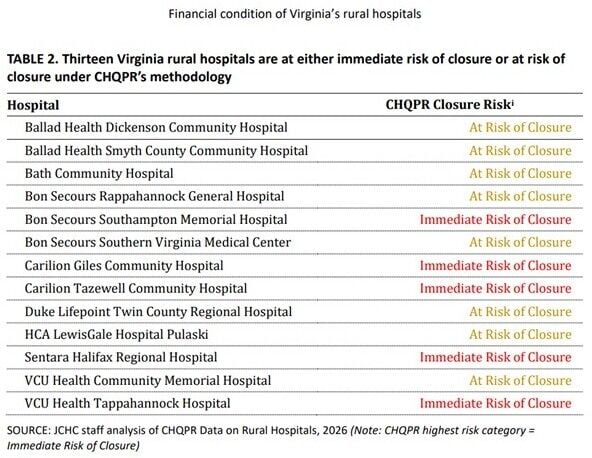

Last week, a report was released to the Governor and state legislators that said 13 Virginia rural hospitals are either at “immediate risk of closure” or “at risk of closure."
Smyth County Community Hospital in Marion was among the 13. It was cited as being “at risk of closure.”
The Joint Commission on Health Care issued the report that assessed the “Financial Condition of Virginia’s Rural Hospitals.”
Of the 13 hospitals, SCCH was joined by several other Southwest Virginia healthcare institutions, including Carilion’s hospitals in Giles and Tazewell, HCA LewisGale Hospital in Pulaski, Duke LifePoint Twin County Regional Hospital, and Dickenson Community Hospital. Both SCCH and Dickenson are Ballad Health hospitals.
The news of the report was disturbing for area residents.
Tom Graham, whose family has long supported and worked for healthcare in Smyth County, reflected, “For 60 years SCCH has been a dynamic and integral part of our community. Just by memory, my brothers and I counted over a hundred visits that we have had for stitches, X-rays or ER visits over the years.”
To ensure future care, Graham said, “We need to make noise or do whatever is necessary to preserve what has become the heartbeat of our little town.”
The News & Messenger asked Ballad Health for its response to the report as well as SCCH’s status and steps being taken to secure its longtime viability.
Ballad Health did not answer the questions directly but issued this statement: “Many organizations publish reports on the financial stability of rural hospitals, each using their own formula to speculate which hospitals may be at risk for closure. It is because of Ballad Health that, in this challenging environment for hospitals, no community in Southwest Virginia has lost access to a hospital. In fact, one hospital – Lee County Community Hospital, which closed before the creation of Ballad Health – was reopened by Ballad Health.”
The Commission report noted that Lee County Community Hospital closed in 2013 and reopened in 2021 under a limited-service model.
Ballad’s statement continued: “In the absence of Ballad Health, more hospitals would have closed in Southwest Virginia. However, rather than closing hospitals, Ballad Health has invested tens of millions of dollars in introducing new technology, hiring new physicians and expanding services to Southwest Virginia.”
The statement concluded: “The passage of H.R. 1 does pose new challenges to rural hospitals. In 2028, rural hospitals face material cuts. Proposed rules by the Centers for Medicare and Medicaid Services go even further than the legislation in making these cuts. Ballad Health is monitoring this situation and will advocate aggressively to preserve rural access to community hospitals.”
The Commission’s report also noted the potential impact of H.R. 1, also known as the "One Big Beautiful Bill Act."
Under the act, healthcare analysts project that about 17 million people will lose healthcare coverage because of cuts to Medicaid. The bill is also expected to lower reimbursement rates to hospitals and other providers, which is anticipated to impact rural hospitals most significantly. The act does include $50 billion in grants for rural health care projects, but estimates say that amount would only cover about a third of the expected losses.
The Commission’s report noted that since 2005 108 rural hospitals have closed across the country, while 139 rural hospitals have eliminated in-patient services.
It began: “Rural hospitals in the Commonwealth face growing risk of financial distress, service reduction, and potential closure as they face challenges with low patient volumes, unfavorable payer mix, inadequate reimbursement, rising costs, and persistent workforce shortages. Federal payment adjustments and special rural designations help support some hospitals, but they do not fully solve the structural gap between costs and reimbursement. These pressures are steadily weakening the financial stability of hospitals that serve as critical access points for emergency, inpatient, and outpatient care in geographically isolated and medically underserved communities.”
The Commission said it used “two established risk frameworks… to identify rural hospitals… that are most vulnerable to closure or experiencing financial distress.”
One focused on operating margins and financial reserves, while the second examined financial, operational, and market-level factors.”
The report noted, “These hospitals share a common pattern of system affiliation, thin operating margins, limited reserves, heavy public-payer dependence, structural difficulty sustaining broad inpatient services including obstetrical services, and a shift towards outpatient revenue dominance.”
It continued, “Financial and operating pressures are forcing many hospitals to concentrate on emergency and outpatient care, reduce or eliminate inpatient services, and restructure in ways that preserve access but narrow what the hospital can provide to its community.”
The report also noted the challenges such as “declining patient volumes, low reimbursement rates, increasing expenses, and workforce shortages….”
SCCH eliminated obstetric services on Nov. 1, 2010, moving that care to Johnston Memorial Hospital in Abingdon. It reopened its urgent care center in early 2023. Of staffing shortages, at that time, SCCH CEO Dale Clark said, “I don’t think we can fix it fast enough.”
The Commission report went on to note that “rural hospitals treat a higher proportion of Medicare and Medicaid patients than their non-rural counterparts,” while also saying that Medicaid and Medicare “may not fully cover the cost of services provided to patients at rural hospitals.”
“Analyses of hospital cost reports reveal that rural hospitals identified as at-risk of closure experience negative margins across nearly every payer category, including private insurance.”
In Virginia, two hospitals have closed since 2005 – Pioneer Health Services of Patrick County and Wellmont Mountain View Regional in the City of Norton. As noted earlier, the report also cited Lee County Community Hospital.
The Commission acknowledged the high community cost when rural hospitals close, saying, “Rural hospitals that close are disproportionately more likely to be located in communities that already face social and economic disadvantages. Hospitals that close are about twice as likely to be located in high-poverty, high-social vulnerability counties compared to those that remain open….”
The report noted changes at the hospitals from 2015 to 2024. In that time, Smyth County Community Hospital remained licensed for 44 beds. However, the number of staffed beds dropped from 44 in 2015 to 24 in 2024. Patient days declined from 6,555 to 5,848. In 2015, SCCH had 17,949 emergency department visits. In 2024 that number dropped to 16,717.
In 2015, SCCH provided 2,362 surgeries. In 2024, the number of surgeries was 1,277.
Eighteen legislators comprise the Joint Commission on Health Care, including eight senators and 10 delegates. The Secretary of Health and Human Resources serves as a non-voting, ex officio member.