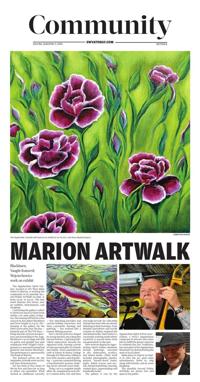


The September Artwalk will feature an exhibit of art by Eric and Siera Wojciechowicz.
The September Artwalk will feature an exhibit of art by Eric and Siera Wojciechowicz.
The September Artwalk will feature an exhibit of art by Eric and Siera Wojciechowicz.
The September Artwalk will feature an exhibit of art by Eric and Siera Wojciechowicz.
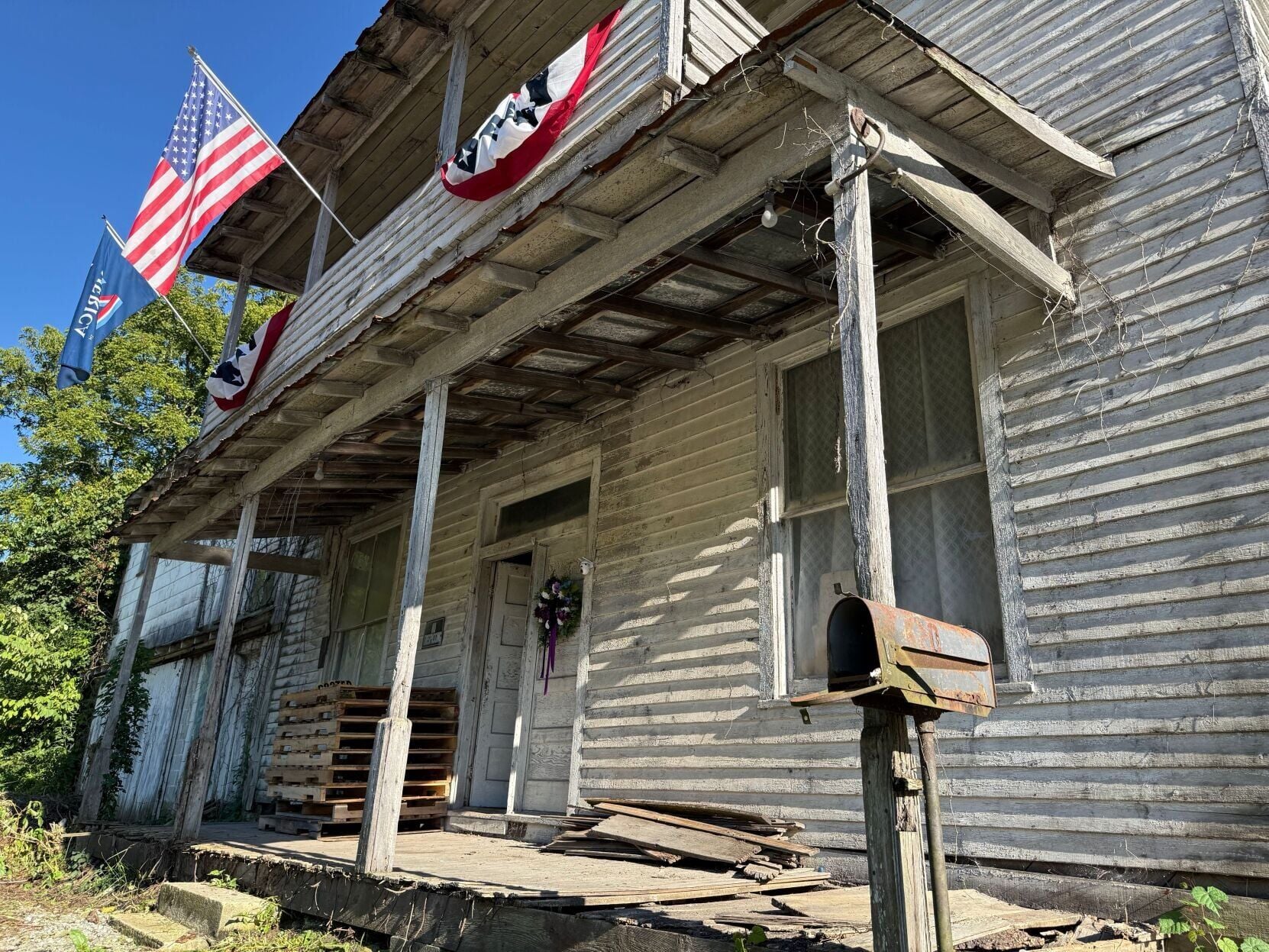
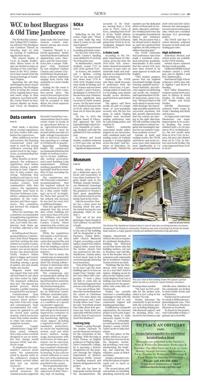
Austin Stanley, 28, is restoring the former R.B. Henderson General Store in the Plasterco community outside of Saltville. He is holding a monogrammed Bible that belonged to his third great uncle, the Rev. Ryburn Bolden "Rybe" Henderson, who operated the business from the post-war era to the 1970s.
The former R.B. Henderson General Store is one of only two surviving business structures remaining in the Plasterco community. Plasterco was once a bustling hub driven by United State Gypsum, a major gypsum mining and wallboard manufacturing operation.
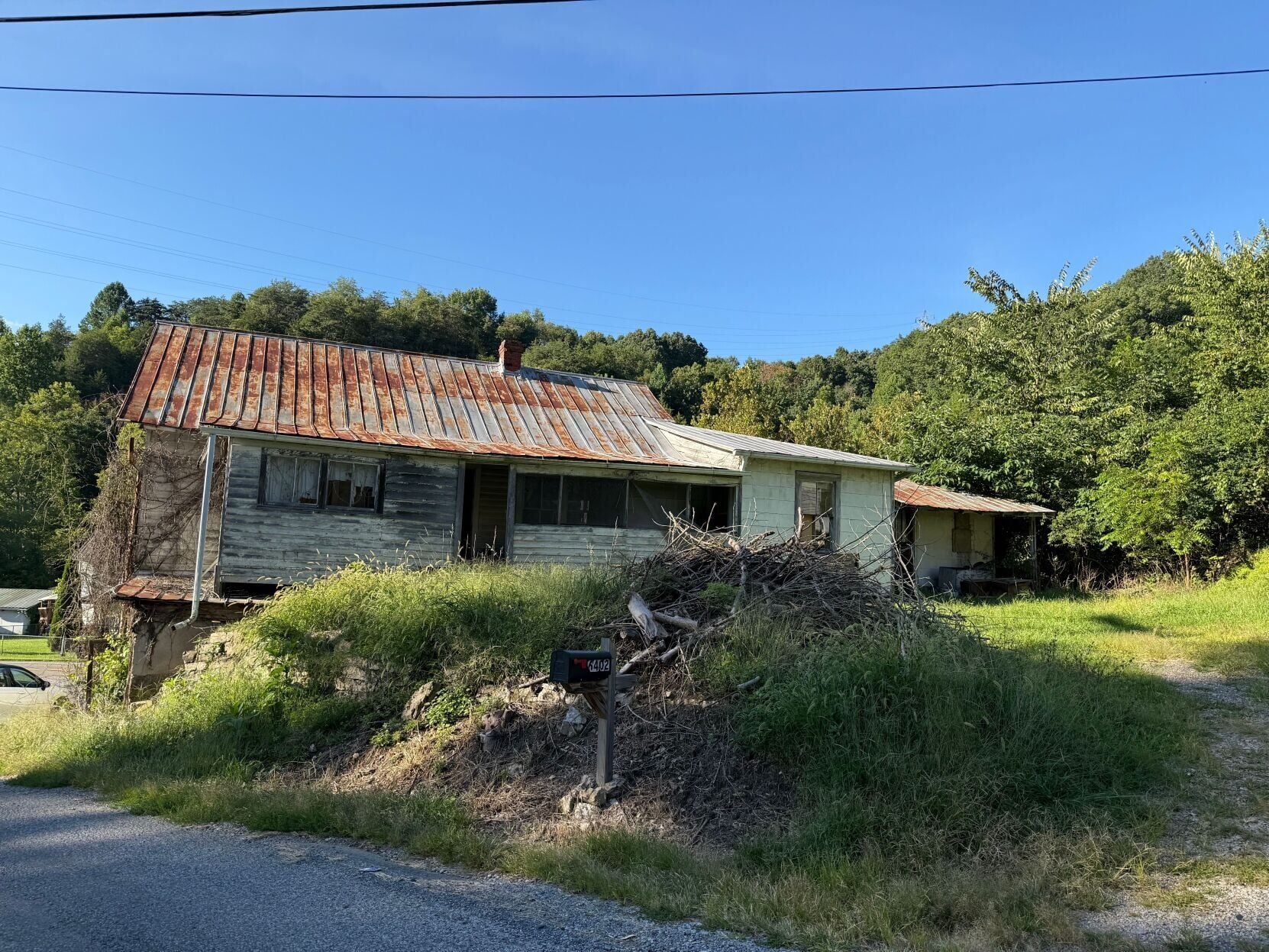
This rear view of the building shows the upstairs portion which served as a home for Austin Stanley’s ancestors.
Austin Stanley and his family stood in front of the weathered, abandoned building just outside of town last week and dreamed aloud of what could be.
“Once it gets fixed, I want to have our first Christmas in the store to celebrate with family,” said Stanley’s mother Betty, who is watching with pride as her son transforms a forgotten piece of the community’s past into a living history museum and tourism anchor for Southwest Virginia.
At just age 28, that may seem like a tall order. But, for Stanley, who grew up in the Tumbling Creek community of Washington County, where times were often tough, nothing is impossible.
A native of Saltville, Stanley has taken upon himself to restore the former R.B. Henderson General Store, a historic oak and pine building that sits quietly on the corner of Buchanan Road and South Main Street outside of Saltville.
The name of the new establishment will be R.B. Henderson Plasterco Museum in honor of Stanley’s ancestors who were foundational pillars of the community.
According to Stanley, the nearly 4,000 square-foot building is one of only two surviving business structures left in the Plasterco community.
Plasterco was once a bustling hub driven by United States Gypsum (USG), a major gypsum mining and wallboard manufacturing operation that fueled the regional economy in the 1920s.
The other surviving business structure in the Plasterco community today is the former Duncan’s Gas Station, another popular place for the locals to congregate decades ago. The Plasterco Church of God still stands and continues to serve as a place of worship in the historic mining community.
Through extensive research, Stanley has learned that for decades the store “served as the heartbeat of Plasterco.” He hopes to bring that same sense of community and devotion to the new museum.
“It was operated as a general store by my third great uncle, the Rev. Ryburn Bolden "Rybe" Henderson, who served simultaneously as the town merchant and the pastor of the Plasterco United Methodist Church. Rybe purchased the property and ran the general store from the post-war era until the 1970s. His son Brack continued to run the store until 1978,” related Stanley who is known around town for his ability to rattle off names, dates and details about the region’s history with remarkable ease.
“I’ve been characterized as an old soul. I’ve become accustomed to that,” he said with a grin.
The property’s early history is intertwined with the Porterfield family whose barter system during the Great Depression helped to inspire Robert Porterfield to establish the Barter Theatre.
According to Stanley, Robert Porterfield’s father, Thomas Porterfield, owned the store and property. Robert Porterfield and his brother Oscar worked there during the early years.
The upstairs portion of the building also served as a home for Stanley’s Uncle Rybe and Aunt Bessie Henderson, who lived in the large apartment directly on top of the store building where they raised their son, Brack. Uncle Rybe's sister, Mary Ellen Henderson Boardwine, and her husband George lived in the house behind the store.
“This property has a lot of history behind it. If you’re standing in front of the store and looking across the road on the ridge that’s where the confederates were stationed. An old cannon even has been found in the back of this property,” said Stanley.
A vision
Recognizing the building as an important fixture in local Appalachian history, Stanley’s vision is to preserve the ground level of the two-story building as a living community museum that honors the heritage of Plasterco and the surrounding region.
“I’ve thought a lot about the future of this place,” said the young property owner who was gifted the building earlier this year.
“Every time I go inside the building, I see something different from many points of view,” he said. “I know I want this to be a hands-on interactive place.”
Stanley has collected memorabilia to display in the store, and he continues to search for railroad artifacts, industrial equipment, photographs and documents that help to tell stories of the store’s past.
He also hopes to collect oral histories from people who remember the store and the surrounding community.
“The building needs work, but the foundation is good,” Stanley said.
The front entrance to the building will showcase antique equipment, much of which has remained in the store since its closing. The walk-through museum will feature its original counters from the 1910s, a Coca-Cola machine from the 1940s, chest-style Coca-Cola coolers, a vintage cash register, and local collectibles, including Cumbow China Lustreware.
“It’s just like a time capsule with everything left just like it was,” he said. Even bottles of spices and household items have remained untouched all these years and had a place on the perimeter shelving around the room.
Stanley would like the other half of the museum room to feature a display of antiques that would be available for purchase.
One room will contain the Saltville-Clinchburg HO Scale Model Railroad, a railroad model being built by Stanley, who is creating a layout of the entire Saltville branch from Olin Corporation to Clinchburg.
Stanley said his model is based off the National Railway Historical Society Excursion on Labor Day 1960 when it came to Saltville.
“It’s a mixture of Norfolk & Western diesel era and the last of the steam era,” he said.
Stanley plans to create a dedicated space for locals and researchers to trace their Southwest Virginia family roots in the William Donald Henderson Memorial Genealogy Center, a center named for the grandson of Stanley’s third great grandfather who started research on the family back in the 1920s.
Like his ancestors, Stanley has a keen sense for learning about the past. He started tracing his own genealogy when he was only 7.
“Just out of my own genealogy, I have enough to start a library,” he said with a laugh.
A former garage attached to the end of the building will be designated as the Plasterco United Methodist Church Memorial Chapel, recreating a small replica chapel that utilizes original items saved from the former church that was pastored by the Rev. Henderson. Stanley plans to host music jams in the converted garage featuring local musicians.
“One of the things I want to do once I get the store building open is to have an Angel Tree,” Stanley said, his voice filled with compassion. “I want a place for kids to come into an old-fashioned general store and see a tree with presents.
“I was one of those children who received help from the school at Christmas time. I’ve risen above my circumstances and I want to help others now,” Stanley said. “Everybody around here talks about how generous my Uncle Rybe was especially with the youth at church. Now, it’s my turn to show that kindness.”
Seeking help
Stanley is going through the proper channels to secure financial assistance for the restoration of the building. With the help of Patty Tymon, an English professor at Virginia Highlands Community College, he is pursuing a historic designation for the property through the Virginia Department of Historic Resources (DHR). Tymon is handling research and historic designation for the project.
“My role has been to help guide Austin through the documentation the Virginia Department of Historic Resources requires for landmark designation, building the historical record that shows why this building matters, not just to Plasterco and Saltville, but to the broader story of commerce and community life in Southwest Virginia,” Tymon wrote in an email.
“Buildings like the Henderson store hold memory in a way that's hard to replace. Helping secure its place on the Virginia Landmarks Register is my way of making sure that memory is protected for the generations who come after us,” Tymon said.
Stanley has recently launched a crowdfunding campaign to help with the renovations and to seek community support and funding partnerships.
Established as a nonprofit organization, the museum project is in its early stages, awaiting funds to make necessary repairs to the building. A GoFundMe account has been set up by Stanley’s cousin Christy Taylor Jacobs to help raise money.
The first phase of the project will focus on protecting the structure from the elements, including installing a new roof, weatherizing the building, and replacing the windows, many of which are broken.
Stanley estimated costs of the first phase of repairs could cost as much as $30,000.
The second phase will concentrate on installing plumbing, electricity and flooring where needed.
“We have $2,500 available for the project now, which is just a drop in the bucket,” he said.
Stanley welcomes the community to get involved with the restoration project, including helping provide financial support, and by donating items connected to the Plasterco and Saltville areas. Members of the community are invited to share family stories and oral histories.
Stanley may be contacted by email at RBHendersongeneral@gmail.com. Visit R.B. Henderson Plasterco Museum on Facebook.
To donate to the project, visit GoFundMe at https://gofund.me/c02a49ff1.
As a school division, Smyth County Public Schools performed above the state average across the board on recently released Standards of Learning (SOL) tests.
Dr. Brad Haga, superintendent, noted that Smyth County is now ranked 31st out of the state’s 131 divisions. The school system climbed to that ranking from 33rd.
In another win, he noted that Oak Point Elementary School improved its ranking more than any other school compared to other schools in the 81-county Comprehensive Instructional Program (CIP) consortium through which Virginia public school divisions work collaboratively to improve student achievement on SOLs.
Regarding the CIP, Haga said that Smyth County schools also climbed two spots in its rankings.
Such improvement, he said “is hard to do when we get closer to the top. All we can ask for is that we always strive and shoot for continuous academic improvement. We did that and we are proud of our academic accomplishments for our students and staff!”
Reflecting on the SOL scores, Haga said, “These are some really big wins when it comes to our staff and students!”
Smyth saw improvement in reading and math scores.
For the 2025-2026 SOLs, Smyth County’s Reading score climbed to 79.26 from 78.29 the prior year.
In Mathematics, Smyth students scored 77.37 in 2025-2026, up from 75.62.
In Science, the students saw a decline, scoring 75.09 on the most recent test, down from 77.79 in 2024-2025. Student scores were steady in Biology and SOC Science and was down in Grades 5 and 8 Science, declining to 72.56 from 76.35 the previous year. However, a more significant drop occurred in Earth Science scores. On the most recent test, students had a pass rate of 45.45, which was down from 64.29 from the prior year.
On Dec. 11, 2025, the Virginia Board of Education approved the 2025 Expanded High School Science Standards of Learning. Students will take the updated SOL this academic year.
In History and Social Studies, students achieved a 70.93 pass rate, up from 68.29 on the prior test.
Significant improvements occurred in VA Studies, moving from a 74.42 score to 79.07; Civics & Econ., jumping from 69.85 to 83.66; World History I, climbing from 23.81 to 30.43; and VA & US History, going from 36.84 to 45.16. Geography dropped from 68.69 to 60.39.
A State Look
According to the Virginia Department of Education, across the state, the 2025-2026 SOL assessments showed incremental increases in pass rates on statewide math and reading tests as compared to the prior school year.
Statewide, the VDOE said these small increases in proficiency from the prior school year, 0.4 percentage points in math and 0.4 in reading, were shared broadly across divisions, grade level tests and student groups.
The agency said these results are part of a longer trend of post-pandemic recovery over the last five years, in which Virginia students have increased reading proficiency rates by 5 percentage points, and math by 19.
“Today’s statewide assessment results reflect progress in our classrooms, with combined math and reading scores of students in grades 3–8 rising slightly across the state,” said Secretary of Education, Dr. Jeffery Smith. “Behind the numbers are the dedicated efforts of thousands of students, educators, and families working hard every day to strengthen foundational literacy and numeracy skills. We also know that a lot of hard work is ahead of us, and I am convinced that together, we will continue to address learning gaps.”
The VDOE contended that proficiency rates have made a sustained comeback toward pre-pandemic benchmarks. It also noted that the current SOL tests have been revised to be more rigorous in math and English.
“This modest progress proves that our targeted investments in high-dosage tutoring, updated instructional materials, and educator support are delivering real results for students,” said Superintendent of Public Instruction, Jenna Conway. “We know there is still work ahead to ensure every child develops the knowledge and skills needed to be successful anywhere, but this growth demonstrates that our schools are moving in the right direction. We will continue using this information to inform targeted and meaningful support for our students' long-term academic success."
Outside of math and reading results, the VDOE said history and social sciences pass rates improved most significantly, at 3.2 percentage points between 2024-2025 and 2025-2026; however, the same progress was not seen in science pass rates, which saw a nominal decrease (0.2 percentage points).
The VDOE said that 53 school divisions achieved increases in both math and reading pass rates.
High Achievers
Individual division and school scores are available on the VDOE website.
Several classes achieved the best result possible.
Chilhowie Middle School students earned a 100% pass rate in Algebra I and EOC Mathematics.
Northwood High School achieved a 100% pass rate in Algebra I and 98.04 in Reading.
Rich Valley Elementary students earned 100% pass rates in History & Social Studies, VA Studies, and CST Studies and Social Studies.
Saltville Elementary achieved 100% scores in Grade 5 Reading and Math and Science.
As Haga noted, Oak Point Elementary saw major improvement in its scores. In Reading, the scores climbed from a 63.58 pass rate to 78.32. In Mathematics, the test results went from 61.18 to 77.62. In Science, the pass rate climbed from 60 to 77.36. In History and Social Studies, the score improved from 52.83 to 68.89.
Having heard good and bad about data centers, a citizen asked members of the Board of Supervisors if they would put their name and seat behind the centers if one comes to Smyth County and bad things happen.
Their responses were straight to the point.
Board Chair Charlie Atkins said, “We accept responsibility for everything we do.”
Supervisor Roscoe Call said that when he put his name on the ballot, he was accepting responsibility for his actions.
Supervisor Jason Parris said that he doesn’t know how he’ll vote, adding that he’s in the learning phase. “I’m still trying to figure it out…. Get as educated as I can.”
Next week, a decision about zoning regulations for data centers will come before the supervisors.
After additional review and revision, the Planning Commission voted last week to send the zoning ordinance covering data centers back to the supervisors, recommending that they adopt it.
After months of development, the ordinance’s regulations went before citizens during a public hearing in June. Opposition to data centers was strong. Following that feedback and trips to visit Mecklenburg County and Loudon County, both communities with data centers, the regulations ultimately went back to the Joint Ordinance Committee, composed of three members of the Commission and three supervisors. This committee put forward the original regulations.
After two meetings, the committee recommended strengthening regulations to the Planning Commission. Last week, the commission took them up. It further adjusted a few points.
In talking about the proposed ordinance, Commission Chair Hazel Wagoner said that visiting the data centers in Loudon County, home to hundreds of such centers, was an eye opener for her. She observed that Utility Trailer’s Atkins plant is bigger and noisier than many data centers. Standing among a group of centers, she said, nearby traffic was louder.
Wagoner noted that one expert they met with advised them to not allow any data center by right. The proposed ordinance does not. The special use permit process, which includes a public hearing, is required for any project.
Commissioner Tony Dean voiced the public’s concern about protecting water from over usage and contaminants. Dean recommended the ordinance be updated to call for closed loop cooling systems, which use far less water than earlier models, or other low-water consumption systems.
Assistant County Administrator Clegg Williams noted, however, that a data center could be designed to use no water, but that change would increase HVAC and electricity usage.
To emphasize the community’s concern about water, the commission voted to specify water in the ordinance’s purpose and intent section rather than just say natural resources.
To protect farms and natural resources, the commission also supported the Joint Committee’s recommendation that if a data center wants to locate in an agricultural district or an agricultural/residential district, it must be located within one mile of a high-voltage transmission line or electrical substation operating at a voltage of 138 kilovolts or greater.
Regarding building height, the commission recommended limiting the height of rooftop accessories to 30 feet. Additionally, rooftop accessories must meet Building Code requirements without needing a guardrail. Building height shall be no more than 95 feet excluding the accessories.
The commission also OK’d the joint committee’s recommendations that the required setback be increased from 60’ to 200’ for a data center building’s up to 65’ in height. For those that exceed 65’, the setback will increase by one foot for every foot of additional height.
They also agreed to recommend that the actual data center building not cover more than 25% of its lot. Williams said Smyth doesn’t want to look like Loudon County, where numerous data centers are easily visible from multiple roads.
While the regulations did require a total decommissioning of any data center that reached the end of its life, Williams noted that the building could be of use, even the home of an industry.
With that in mind, the commission recommended changing that regulation to allow the Zoning Administrator to determine what assets may remain after decommissioning.
The commission also recommended adding the responsibility for removing all hazardous materials from the site in a center’s decommissioning plan.
Throughout the process for an individual center, Williams reminded planners that many specific requirements can be added as a condition of a special use permit’s approval.
The proposed ordinance that will go to the Board of Supervisors continues to regulate noise with ongoing monitoring, lighting, visual impact including a vegetative buffer, environmental protections, an onsite fire monitoring system, road and other access matters, energy usage, backup power with restrictions on when generators can be exercised, and transparency, including a required community meeting and separate public hearing. It also calls for a bond sufficient to cover the costs of decommission and site restoration to be provided to the county.
The recommended ordinance will go before the supervisors at their Thursday, Sept. 10, meeting.